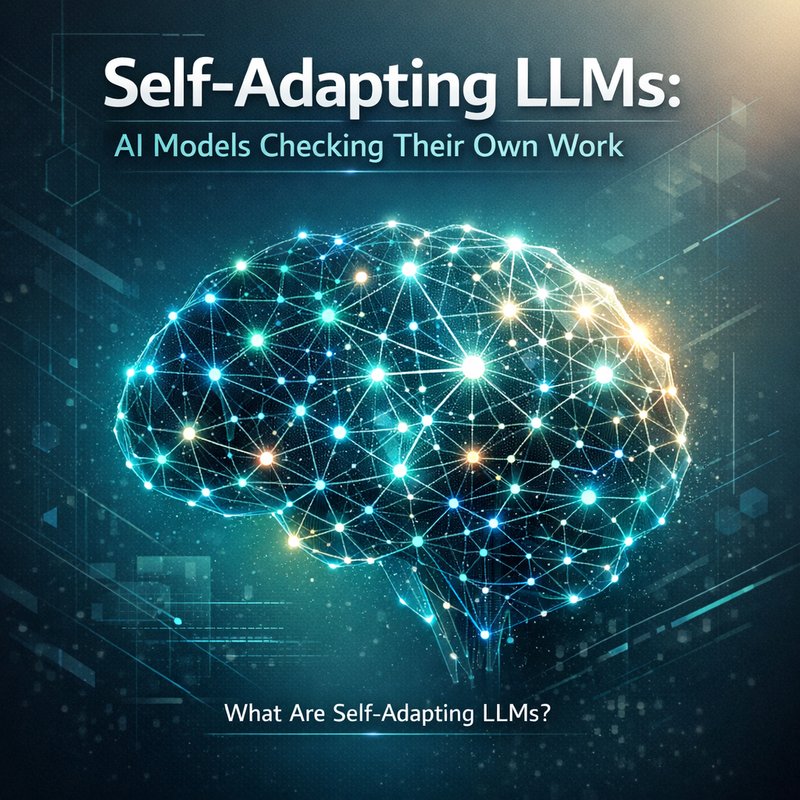
Artificial intelligence has grown fast, but the newest wave of models is doing something a lot of people didn’t expect: they are learning to double‑check themselves. These self‑adapting LLMs can spot mistakes, ask for more data, and even correct their own answers before sending them out. In this article we’ll break down how this works, why it matters, and what it means for developers and everyday users.
What Are Self‑Adapting LLMs?
Large language models (LLMs) like GPT‑5.5 or Claude Mythos are built to generate text from prompts. Traditionally, they just spit out an answer and hope it’s right. A self‑adapting LLM adds a new layer: an internal loop that checks the answer, looks for inconsistencies, and can ask the model to revise it. Think of it as a built‑in proof‑reader that can ask for more evidence before giving a final response.
How the Internal Deliberation Loop Works
- Generate a Draft – The model first creates a draft answer.
- Analyze the Draft – A separate reasoning module reviews the draft for logical gaps or factual errors.
- Decide to Keep or Revise – If the analysis flags problems, the model is prompted to revise; otherwise it finalizes the answer.
- Repeat if Needed – The loop can run multiple times until the answer meets a confidence threshold.
This process is similar to how a human writer edits a draft, but it happens automatically inside the model.
Why Is This Important?
1. Higher Accuracy
Because the model checks itself, the chance of giving a wrong or misleading answer drops. For tasks that need precision—like medical advice, legal research, or coding help—this extra safety net is a game changer.
2. Faster Development
Developers can rely on these models to produce cleaner outputs without writing extra validation code. That means less time debugging and more time building features.
3. Trust and Transparency
When a model can explain why it changed an answer, users can see the reasoning behind the final result. This builds trust, especially in regulated industries.
Real‑World Examples
| Use Case | How Self‑Adapting Helps | Example Model |
|---|---|---|
| Customer Support | The model can double‑check policy references before replying. | GPT‑5.5 with internal loop |
| Code Generation | It can spot syntax errors and correct them before sending code. | Claude Mythos |
| Financial Analysis | The model verifies calculations and cross‑checks data sources. | DeepSeek‑V4 Pro‑Max |
These examples show that self‑adapting LLMs are not just a theoretical idea—they’re already improving real applications.
Building with Self‑Adapting LLMs
If you’re a developer, here’s how you can start using these models:
- Choose a Provider – Many vendors now offer models with built‑in self‑checking. Look for terms like “internal deliberation” or “self‑validation” in the documentation.
- Set Confidence Thresholds – Decide how strict the model should be. A higher threshold means more revisions but higher accuracy.
- Log the Revision History – Store each draft and revision so you can audit the process later.
- Integrate with Existing Workflows – Plug the model into your chatbot, code editor, or data pipeline as you would any other LLM.
Example: Using the OpenAI Agents SDK

The new OpenAI Agents SDK supports Model Context Protocol (MCP), which lets you control how many times the model can revise itself. Here’s a quick snippet:
from openai import OpenAI
client = OpenAI()

response = client.chat.completions.create(
    model="gpt-5.5",
    messages=[{"role": "user", "content": "Explain quantum computing in simple terms."}],
    max_revisions=3,  # Allow up to 3 internal checks
    confidence_threshold=0.9
)
print(response.choices[0].message.content)
This code tells the model to keep revising until it reaches 90 % confidence or it has tried three times.
Challenges and Limitations
While self‑adapting LLMs are powerful, they’re not perfect.
- Latency – Each revision adds time. For real‑time applications, you may need to balance speed and accuracy.
- Resource Use – More internal checks mean higher compute costs.
- Over‑Correction – Sometimes the model may over‑edit, removing useful nuance.
Understanding these trade‑offs helps you decide when to use self‑adapting LLMs.
The Future of Self‑Adapting LLMs
The trend is clear: models are becoming more autonomous and reliable. In the next few months we expect:
- Standardized APIs for self‑checking across vendors.
- Better Explainability so users can see the reasoning steps.
- Hybrid Models that combine self‑adapting LLMs with specialized tools (e.g., code linters, fact‑checking APIs).
If you’re building AI products, staying ahead of these developments will keep you competitive.
How Neura AI Supports Self‑Adapting Workflows
Neura AI’s platform already embraces the idea of models that can reason and act. Our Neura ACE tool lets you build content pipelines that automatically validate and revise text. And with Neura Router, you can route requests to the best model for the job—whether that’s a self‑adapting LLM or a specialized tool.
Check out our product page for more details: https://meetneura.ai/products
Conclusion
Self‑adapting LLMs are a new chapter in AI. By letting models double‑check themselves, we get higher accuracy, faster development, and more trust. Whether you’re a developer, a business owner, or just an AI enthusiast, understanding how these internal loops work will help you make smarter choices.
If you want to dive deeper, explore our case studies on how companies are using self‑adapting models: https://blog.meetneura.ai/#case-studies