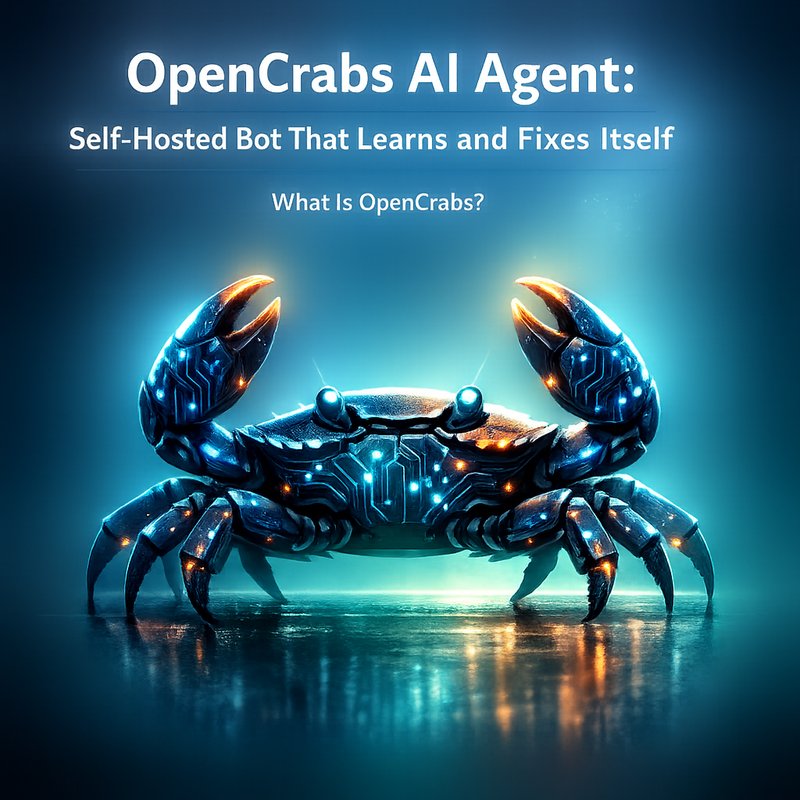
OpenCrabs AI agent is a self‑hosted bot that learns from its own actions and can fix mistakes without human help.
OpenCrabs AI agent runs on your own computer or server, so no data leaves your network.
OpenCrabs AI agent uses a simple interface that lets you see how it thinks and what it does.
OpenCrabs AI agent can read documents, answer questions, and even edit code.
OpenCrabs AI agent is built with Rust and Ratatui, making it fast and easy to run on many platforms.
OpenCrabs AI agent is the newest example of a self‑learning AI that can be trusted to stay private.
What Is OpenCrabs?
OpenCrabs is a single binary that you download and run.
It connects to large language models (LLMs) like Gemini or Claude, but all the data stays on your machine.
OpenCrabs AI agent can be used in chat, in a terminal, or even in Slack and Discord.
OpenCrabs AI agent is open source, so you can look at the code and change it if you want.
OpenCrabs AI agent is part of a growing trend of self‑hosted AI tools that give users full control.
Key Features
- Self‑learning – The agent can update its own knowledge base after each conversation.
- Self‑healing – If a tool fails, the agent automatically tries another one.
- Zero‑data‑leak – All requests stay on your local network.
- Cross‑platform – Works on Linux, macOS, and Windows.
- Extensible – You can add new skills with a simple YAML file.
How Does OpenCrabs Learn?
OpenCrabs AI agent uses a technique called reinforcement learning from human feedback (RLHF).
When you ask a question, the agent sends the prompt to an LLM.
The LLM returns an answer and a confidence score.
OpenCrabs AI agent checks the score and decides if it should keep the answer or try again.
If the answer is wrong, the agent learns from the mistake and updates its internal memory.
This loop happens automatically, so the agent gets better over time.
The Learning Loop
- Prompt – You type a question or command.
- LLM Response – The model replies with text and a confidence level.
- Evaluation – OpenCrabs AI agent checks the confidence.
- Update – If the confidence is low, the agent rewrites the prompt or uses a different model.
- Persist – The new knowledge is saved to a local file for future use.
Self‑Healing and Fault Tolerance
OpenCrabs AI agent can detect when a tool or model fails.
It keeps a list of backup providers and switches to them automatically.
If a network drop happens, the agent retries the request up to three times.
The agent also logs errors so you can see what went wrong.
Because everything is local, you can debug the problem without sending data to the cloud.
Health‑Aware Fallbacks
- Provider Health Check – The agent reads a JSON file that tracks which providers are healthy.
- Sticky Fallbacks – If a provider fails, the agent remembers to skip it for the next request.
- Retry Events – The terminal shows “⏳ Retry 2/3” so you know it is trying again.
Security and Privacy

OpenCrabs AI agent is designed to keep your data safe.
All communication stays inside your network.
The agent does not store any personal data in the cloud.
You can run it behind a firewall or in a Docker container for extra isolation.
OpenCrabs AI agent also supports TLS for local HTTPS connections if you want to expose it to other devices on your LAN.
Use Cases
- Personal Knowledge Base – Store notes, recipes, or project docs and ask the agent to retrieve them.
- Code Review – The agent can read your code, suggest fixes, and even run tests.
- Chatbot for Teams – Deploy it in Slack or Discord to answer FAQs automatically.
- Learning Tool – Ask it to explain concepts or solve math problems.
- Automation – Combine it with n8n or other workflow tools to trigger actions based on its output.
Comparison to Other Agents
| Feature | OpenCrabs AI agent | Hermes Agent | OpenClaw |
|---|---|---|---|
| Hosting | Self‑hosted | Cloud | Cloud |
| Data Privacy | Local only | Cloud | Cloud |
| Learning | Self‑learning | No | No |
| Fault Tolerance | Built‑in fallbacks | Basic | Basic |
| Extensibility | YAML skills | Plugin system | Limited |
OpenCrabs AI agent stands out because it is fully local and can improve itself over time.
Other agents rely on cloud services and do not update their knowledge base automatically.
Future Roadmap
- Video Vision – The latest release adds a video analysis tool that can read short clips.
- JSON Repair – Automatic fixing of malformed JSON responses.
- TCP Keepalive – Faster detection of network drops.
- OpenRouter Caching – Zero‑cost caching for identical requests.
- Skill System – A new skill format that lets you add tools with a single YAML file.
- Security Audit Skill – Detects CVE patterns in code automatically.
These updates make OpenCrabs AI agent more powerful and easier to use.
How to Get Started
- Download the latest binary from the GitHub releases page.
- Run it with
./opencrabs. - Add a skill by creating a
skills/my_skill/SKILL.mdfile. - Ask questions in the terminal or connect it to Slack.
- Watch it learn – the agent will improve as you use it.
For more details, check the official documentation on GitHub or visit the Neura AI product page at https://meetneura.ai/products.
Conclusion
OpenCrabs AI agent is a powerful, self‑hosted tool that learns and fixes itself.
It gives you full control over your data while still enjoying the benefits of large language models.
With its simple interface, robust fault tolerance, and continuous learning loop, OpenCrabs AI agent is a great choice for developers, researchers, and anyone who wants a private AI assistant.
Try it today and see how it can grow with you.