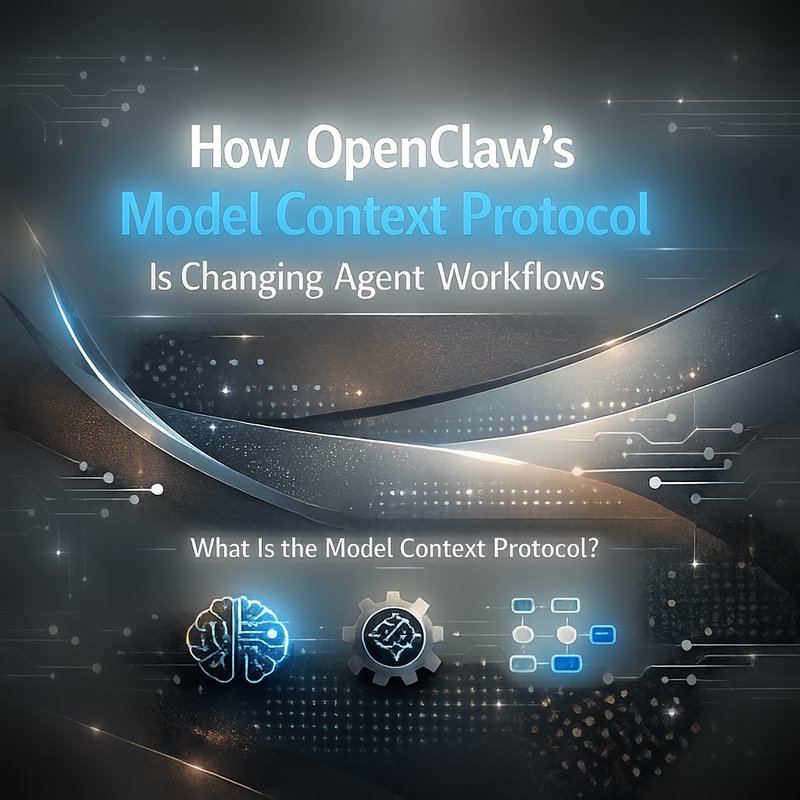
OpenClaw is a popular open‑source tool that lets developers build AI agents that can talk to other software, run code, and make decisions. The newest feature that is turning heads is the Model Context Protocol (MCP). MCP is a simple set of rules that tells an agent how to share information with other tools and services. In this article we’ll explain what MCP is, why it matters, and how you can start using it to build smarter, faster agents.
What Is the Model Context Protocol?
The Model Context Protocol is a lightweight language that describes the data an AI model needs to do a task. Think of it as a recipe that lists the ingredients (inputs) and the expected dishes (outputs). MCP lets an agent:
- Ask for the right data from a database, API, or file.
- Send the data back to the model in a format it understands.
- Receive the model’s answer and hand it off to the next tool.
Because MCP is a standard, any tool that follows it can talk to any other tool that follows the same standard. That means you can mix and match services from different vendors without writing custom code for each one.
Key Parts of MCP
- Context Schema – A JSON schema that defines the shape of the data.
- Context Provider – The component that fetches data (e.g., a database query).
- Context Consumer – The component that receives data and passes it to the model.
- Context Router – The glue that routes data between providers and consumers.
MCP is not a new AI model; it is a protocol that makes existing models work together more smoothly.
How MCP Works Inside OpenClaw
OpenClaw uses MCP as a “glue layer” that sits between the AI model and the tools it calls. Here’s a step‑by‑step look at the flow:
- Agent Receives a Prompt – The user asks the agent to find the latest sales data.
- MCP Router Builds Context – The router looks up the MCP schema for “sales data” and asks the context provider to fetch it.
- Provider Returns Data – The provider pulls the data from a database and sends it back in the format defined by the schema.
- Consumer Sends Data to Model – The consumer packages the data and feeds it to the LLM.
- Model Generates Response – The LLM uses the data to answer the user’s question.
- Agent Returns Result – The agent formats the answer and sends it back to the user.
Because the protocol is standardized, you can swap the database provider for an API provider, or change the model from GPT‑4 to Claude, without touching the rest of the pipeline.
Why MCP Is a Game Changer for Developers
1. Less Boilerplate Code
Before MCP, developers had to write custom code for every tool integration. With MCP, you only need to define a schema once, and the router handles the rest. That saves hours of repetitive work.
2. Better Error Handling
MCP includes built‑in validation. If the data does not match the schema, the router throws a clear error. This makes debugging easier and reduces runtime failures.
3. Faster Iteration
Because the protocol is language‑agnostic, you can prototype new tools in any language and plug them in quickly. You can test a new database provider in Python, a new API in Go, and a new model in Rust—all without rewriting the agent logic.
4. Seamless Multi‑Agent Collaboration
MCP can be used by multiple agents in the same workflow. One agent can fetch data, another can analyze it, and a third can generate a report. Each agent only needs to know the MCP schema, not the details of the other agents.
Real‑World Use Cases
LangGraph Enterprise Adoption
LangGraph is a framework that builds stateful agents for business workflows. By integrating MCP, LangGraph can now pull data from OpenClaw’s context providers and feed it into its own reasoning engine. This has helped companies like Klarna automate tasks that used to require 850+ employees.
Parallel Web Systems
Parallel Web is a new infrastructure that lets agents browse the web at machine speeds. MCP allows Parallel to request data from OpenClaw’s web scraper, then pass that data back to the agent for analysis. The result is a faster, more reliable web‑search workflow.
ByteDance Deer‑Flow
ByteDance’s Deer‑Flow is a long‑horizon agent that can manage tasks that last for hours. By using MCP, Deer‑Flow can request context from OpenClaw’s database provider, keep the data in a persistent memory store, and hand it back to the model when needed. This reduces the need for manual checkpoints.
OpenAI Operator vs. Convergence Proxy
Both OpenAI’s Operator and Convergence’s Proxy are browser‑use agents. MCP can serve as a common interface for both, allowing developers to switch between them without changing the agent code. This flexibility is especially useful for teams that use multiple cloud providers.
Getting Started with MCP in OpenClaw

Below is a quick guide to set up MCP in your own OpenClaw project.
1. Install OpenClaw
cargo install openclaw
2. Define a Context Schema
Create a file called sales_schema.json:
{
  "type": "object",
  "properties": {
    "region": { "type": "string" },
    "date_range": { "type": "string" },
    "sales": { "type": "number" }
  },
  "required": ["region", "date_range", "sales"]
}
3. Create a Context Provider
Write a simple Rust function that reads from a CSV file:
fn fetch_sales(region: &str, date_range: &str) -> Result<SalesData, Error> {
    // read CSV, filter by region and date_range
}
4. Register the Provider with OpenClaw
openclaw register-provider sales_provider --schema sales_schema.json
5. Build an Agent Prompt
"Please provide the total sales for the North America region in Q1 2026."
OpenClaw will automatically use MCP to fetch the data, feed it to the model, and return the answer.
6. Test the Agent
openclaw run-agent sales_agent
You should see the agent return a concise answer like:
"The total sales for North America in Q1 2026 were $12.3 million."
Future Directions for MCP
OpenClaw’s MCP is still evolving. Here are some upcoming features:
- Self‑Adapting LLMs – Models that can edit their own prompts based on MCP feedback.
- Multi‑Agent Orchestration – A built‑in scheduler that can run several MCP agents in parallel.
- Persistent Memory Stores – MCP can now keep context in a database across sessions, enabling long‑term memory for agents.
- Cross‑Platform SDKs – SDKs for Python, JavaScript, and Go will make it easier to write providers in any language.
These updates will make MCP even more powerful for building complex, autonomous systems.
Conclusion
The Model Context Protocol is a simple but powerful standard that lets AI agents share data cleanly and reliably. By using MCP, developers can reduce boilerplate, improve error handling, and build multi‑agent workflows that were previously difficult to manage. OpenClaw’s implementation of MCP is already being used by companies like Klarna and by cutting‑edge projects such as Parallel Web and ByteDance Deer‑Flow. If you’re building AI agents, MCP is a tool you should add to your toolbox.