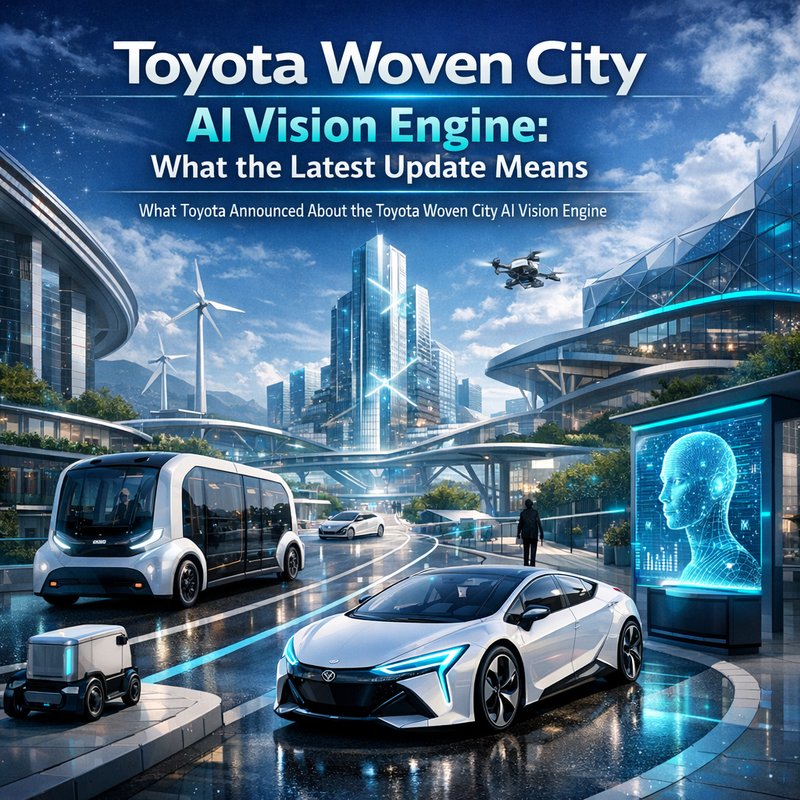
AI in real cities is moving fast, and the Toyota Woven City AI Vision Engine is a clear example.
On September 25, 2026, Toyota announced new capabilities for its Toyota Woven City AI Vision Engine at Woven City.
If you care about safer roads, better traffic flow, or how computer vision is actually tested outside a lab, this update is worth your attention.
In this article, I’ll break down what the Toyota Woven City AI Vision Engine announcement likely signals, why it matters, what teams should learn from it, and how you can evaluate similar AI vision releases without trusting hype.
For the original source, start here: Toyota Woven City Press Release
https://woven.toyota/news/2026-09-25
What Toyota Announced About the Toyota Woven City AI Vision Engine
Toyota’s press release says the Toyota Woven City AI Vision Engine gained new capabilities during the Woven City operations period.
The big takeaway is simple.
Toyota is not treating vision as a one-time demo.
It’s treating it like a system that must keep improving as the city changes, sensors change, and real driving edge-cases show up.
That matters because computer vision in the real world is different from vision in a clean dataset.
Real streets come with messy lighting, odd camera angles, occlusions, motion blur, reflective surfaces, and unpredictable objects.
So when you see new Toyota Woven City AI Vision Engine capabilities announced, it usually means one or more of these areas improved:
- Better object detection under difficult lighting
- More reliable tracking when objects partially block each other
- Stronger lane or road-boundary interpretation
- Faster inference or improved performance at the edge
- Cleaner integration between sensors and the rest of the perception stack
Now, you might wonder: how can we know what changed if the press release is short?
Good question.
Press releases often describe outcomes more than the exact model changes.
But you can still extract real meaning by looking at what type of problems cities try to solve, and how Toyota tends to operate these systems.
Why “AI Vision Engine in a City” Is Harder Than It Sounds
Let’s be honest.
Vision research papers are one thing.
Running vision in a living environment is another.
With the Toyota Woven City AI Vision Engine, the “hard part” is that the system has to work across many repeating situations, plus a bunch of rare ones.
Common failure points for a city-scale AI vision system
Here are the failure points teams hit over and over:
- Lighting changes between morning, midday, and evening
- Weather and haze affecting contrast
- Shadows that look like objects
- Reflections in glass, wet pavement, and metal surfaces
- Occlusions from pedestrians, bikes, and vehicles
- Motion blur on fast movement or camera shake
- Camera misalignment due to mounting drift
So the Toyota Woven City AI Vision Engine is valuable because it’s designed to survive those conditions.
Not just pass a benchmark once.
Reading Between the Lines of the Toyota Woven City AI Vision Engine Update
Press releases usually won’t list every model metric.
But there are still smart ways to interpret change.
Look for these “signals” in an AI vision engine release
When the Toyota Woven City AI Vision Engine gets “new capabilities,” watch for signals like:
- Mentions of real deployments or testing at Woven City
- References to performance improvements under varied conditions
- Clues that integration is improving, not only the model
- Anything that suggests faster processing or more stable behavior
Even without full technical details, the direction is clear.
Toyota wants the engine to get more dependable over time.
And that is exactly what city environments demand.
What teams can learn from the approach
Even if you never build a full city system, the lesson transfers.
A vision system needs:
- Real data loops
- Clear evaluation criteria
- Monitoring for failure modes
- Safety-focused fallback behavior
That’s where many products stop working after launch.
The market loves demos.
But reliability comes from operations.
How to Evaluate an AI Vision System Like the Toyota Woven City AI Vision Engine
If you’re an engineer, product lead, or researcher, you shouldn’t judge only by what the press says.
You should judge by repeatable evaluation.
Step 1: Ask “What is the ground truth?”
For any Toyota Woven City AI Vision Engine-type system, ground truth matters more than accuracy numbers.
Ask:
- How is labeling done for street scenes?
- Is it manual verification or automatic with review?
- How do they handle ambiguous cases like far-away pedestrians?
- Do they track “unknown” or “uncertain” outputs?
The best vision teams treat uncertainty as a first-class output, not a bug.
Step 2: Test robustness, not just average accuracy
Average accuracy can hide dangerous weakness.
A strong evaluation checks:
- Performance across lighting bands
- Performance with partial occlusions
- Behavior with unusual objects
- Consistency over time
If the Toyota Woven City AI Vision Engine improves reliability, it should show up most in robustness tests.
Step 3: Look for operational signals
This part is underrated.
In the real world, the system also needs:
- Stable frame-by-frame behavior
- Minimal flicker in detections
- Clear handling of sensor dropouts
- Predictable latency
Even if you get high accuracy, unstable behavior can reduce safety.
Related Trends: City-Scale Vision Is Becoming a Product, Not a Research Project
This update also fits a bigger trend.
More companies are pushing perception systems out of the lab and into real environments.
You’ll often see the same shift:
- from “model-only” improvements
- to “system” improvements, including data, sensors, and monitoring
The Toyota Woven City AI Vision Engine is a strong example of that system thinking.
And it pushes expectations upward for everyone else using computer vision.
What Woven City Means for Real-World AI Vision
Woven City is not just about autonomous vehicles.
It’s about treating the environment like a long-running testbed.
That changes the kind of AI work that happens.
Instead of building one-off experiments, teams can:
- run longer test cycles
- gather more edge cases
- improve gradually based on observed failures
If you work on AI vision, this is one of the most practical ideas you can steal.
Don’t only measure the model output.
Measure the whole pipeline in time.
How This Connects to Modern AI Systems (And Why It Matters)
Even though the Toyota Woven City AI Vision Engine is about vision, it reflects a broader operational theme in AI systems.
Good AI systems are built to handle:
- changing input patterns
- messy data
- edge cases
- continuous evaluation
You might be working on a totally different problem, like:
- document understanding
- customer support routing
- image analysis
- transcription
- research workflows
But the core lesson stays the same.
Operational reliability wins.

It’s not enough for an AI to “sort of work.”
It needs to behave well in the situations that show up when people actually use it.
What Should You Do With This Information?
The Toyota Woven City AI Vision Engine update can help you in a few practical ways.
If you’re building vision products
Use this like a checklist:
- Build a real test set that matches the real street environment
- Plan for monitoring after release
- Track failures by category, not only by overall error
- Add a process for updating data and evaluation
If you’re deciding what vendors to trust
Ask to see:
- robustness testing results
- latency and stability metrics
- how the system handles uncertainty
- how ground truth is produced and audited
If you’re just trying to stay informed
Pay attention to announcements that suggest continuous improvement.
The most interesting releases are rarely the flashy ones.
They’re the ones that hint at long-term reliability gains.
Conclusion: The Toyota Woven City AI Vision Engine Is a Reliability Story
The headline about the Toyota Woven City AI Vision Engine is a new step in Toyota’s city testing work.
But the deeper meaning is what matters: this is an ongoing push toward vision systems that can handle the messy real world.
If you want to judge updates like this, don’t stop at “capability added.”
Ask how robustness improved, how evaluation is done, and how stability behaves over time.
That’s the path from impressive demos to dependable systems.
For the original announcement, use this link again:
https://woven.toyota/news/2026-09-25