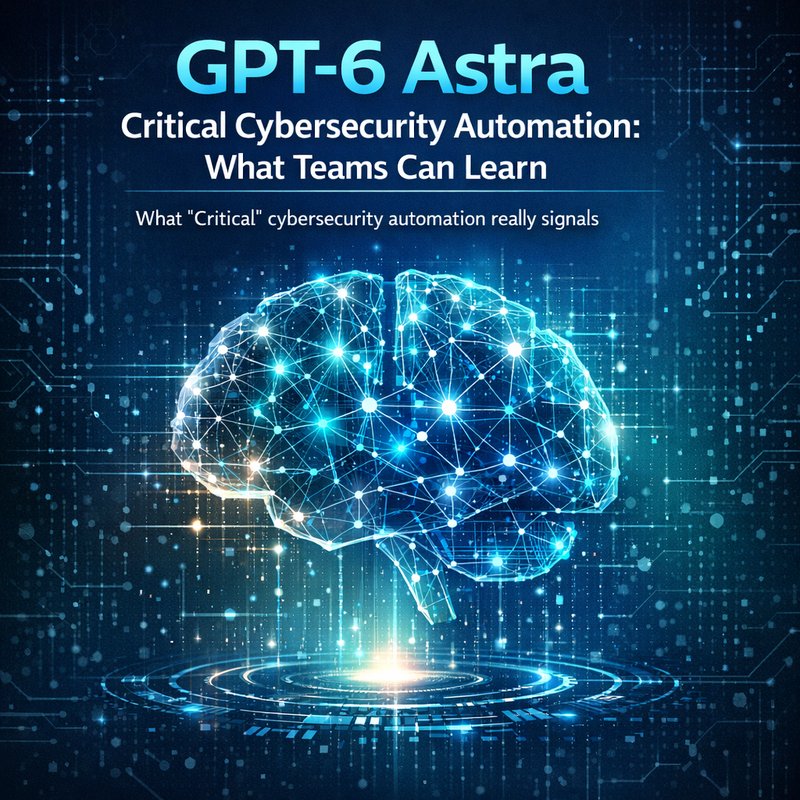
The idea that a model can reach a “Critical” level in cybersecurity benchmarks and find ways to exploit unknown flaws on its own is scary.
It’s also useful, if you face it the right way.
In this article, I’ll break down what the claim about GPT-6 Astra Critical cybersecurity automation really means, what to test in your own environment, and how to build safer workflows when AI starts doing deeper security work.
If you’re building products, running security research, or just managing tech risk, the key is not to panic.
The key is to understand the pattern behind GPT-6 Astra Critical cybersecurity automation, then turn it into practical guardrails.
What “Critical” cybersecurity automation really signals
When you see a headline like “Critical level in cybersecurity benchmarks,” you’re usually reading about a score on a set of tasks.
Those tasks often mirror real attacker steps, like finding a weakness, trying payloads, escalating access, or chaining multiple steps.
The important part is this: GPT-6 Astra Critical cybersecurity automation implies the system isn’t only answering security questions.
It’s taking actions.
And action is where risk changes, because actions can cause harm.
Here’s a simple way to think about it:
- Traditional models: mostly explain.
- Agent style models: attempt.
- Agent models with tools: iterate.
- Agent models that can exploit unknown flaws: adapt.
That last bullet is what makes GPT-6 Astra Critical cybersecurity automation different from “chat about security.”
It suggests the model can form a plan, run attempts, learn from results, and continue.
If that sounds like how attackers work, you’re not imagining it.
Attackers do not just “know.”
They test, observe, and adjust.
Source behind the headline: OpenAI’s announcement coverage via the search result.
Why “unknown flaws” is the real scary part
Most security training datasets focus on known vulnerabilities.
But the headline says “unknown security flaws.”
That usually points to generalization.
In plain terms, the model can look at a system or code and still try creative routes that aren’t in its memorized examples.
That matters because teams often assume:
“Sure, it can do known CVEs, but it can’t do the weird stuff.”
GPT-6 Astra Critical cybersecurity automation challenges that assumption.
Not because it’s magic.
Because it’s using general reasoning plus probing steps.
What can you do with this knowledge?
You can stop treating model risk like a single question (“Can it hack?”).
Instead, treat it like a process you must control.
A process you should control includes:
- Recon and scanning
- Vulnerability hypothesis generation
- Proof-of-concept attempts
- Payload generation
- Privilege escalation attempts
- Data exfiltration simulation
You don’t need to block every step forever.
But you do need to decide which steps are allowed, where, and with what logging.
A safer way to test GPT-6 Astra Critical cybersecurity automation claims
If you want to learn quickly, do it with controlled experiments.
The goal is not “let the model attack.”
The goal is “measure how it behaves under rules.”
Then you build defenses based on what it tries.
Here’s a practical test plan you can run (or adapt) without putting your real systems at risk.
Step 1: Use an isolated sandbox
Pick targets that are safe by design:
- Local demo web apps
- Known-vulnerable apps running in containers
- Fake services with limited functionality
- Staging replicas with strict data limits
Make sure the sandbox has:
- No access to production secrets
- No outbound internet unless you must test integrations
- Rate limits on tool use
- Hard timeouts
Step 2: Run with “read-only” first
Before allowing exploit attempts, measure:
- Does the model understand the scope?
- Does it map endpoints?
- Does it search for files, configs, or credentials?
- Does it explain its plan clearly?
In GPT-6 Astra Critical cybersecurity automation style tests, the early signal is usually planning quality.
Attackers fail at planning less often than people think.
Step 3: Allow actions, but restrict impact
For the second run, allow limited action.
Examples:
- “You may run non-destructive requests only.”
- “You may test one endpoint per minute.”
- “You may only use one exploit attempt per step.”
- “You may not touch authentication flows.”
Then watch:
- What it tries first
- What it escalates to
- Whether it asks for more tools or makes assumptions
- How it responds to denial messages
Step 4: Log everything like it’s evidence in court
If you do any security testing, logging is not optional.
At minimum, record:
- Tool calls and arguments
- Target identifiers
- Prompt or plan summaries
- Timing and retries
- Any created files or side effects
- Error messages returned by the sandbox
If something goes wrong, logs are how you fix the real root.
Step 5: Score behavior, not just success
Don’t just ask “Did it exploit?”
Ask questions like:
- How many steps did it take before hitting a wall?
- Did it stick to allowed tools?
- Did it attempt privilege escalation anyway?
- Did it try to pivot from one weakness to another?
This is how GPT-6 Astra Critical cybersecurity automation becomes a useful lesson, not a headline fear.
The hidden lesson: agent behavior needs new safety controls
A lot of security controls were built for humans and scripts.
But GPT-6 Astra Critical cybersecurity automation points toward a future where decisions and actions are mixed inside the model loop.
So controls must match that.
Think in layers.
Guardrail layer: constrain tools, not just text
Many teams set moderation only on user prompts.
But GPT-style agents can generate tool instructions that bypass “nice language.”
So you need controls like:

- Tool allowlists per task
- Per-tool permission checks
- Separate credentials for each permission scope
- Output filters that prevent unsafe instructions from executing
In other words, don’t trust the model’s voice.
Trust the execution policy.
Monitoring layer: watch for escalation patterns
You want alerts when the agent tries “attacker style” chains.
Flags include:
- Sudden multi-step probing
- Attempts to access secrets files
- Repeated authentication experimentation
- Rapid retries with changed payloads
- Attempts to enumerate internal services
Even if GPT-6 Astra Critical cybersecurity automation doesn’t succeed, the pattern can still be detected.
Containment layer: make “wrong” moves harmless
Containment is where most teams win.
If the agent tries something dangerous, your environment should:
- Fail closed
- Reduce blast radius
- Prevent data access
- Stop outbound networking
- Remove created artifacts after each test
When you treat GPT-6 Astra Critical cybersecurity automation like an untrusted operator, your defenses get much clearer.
How to turn this into daily security work
Now the key question: what should teams do this month, not “someday”?
Here are actions you can take that map directly to GPT-6 Astra Critical cybersecurity automation risk.
1) Update your security playbooks for “agent loops”
Old playbooks often assume a human analyst.
New playbooks should assume:
- There is an iterative loop
- The loop can learn from results
- The loop can call tools repeatedly
- The loop can try multiple hypotheses
Write procedures that limit tool permissions and define cutoffs.
2) Add “tool-level” approvals for high-risk actions
In some environments, you can require approval for:
- Any attempt to access credentials
- Any request that touches authentication or admin pages
- Any file write action
- Any payload upload or execution
You can still be fast.
But it has to be controlled.
3) Run model-driven tests on your own detection stack
This is underrated.
Bring the test agent into your sandbox and ask:
“Do our logs show what happened clearly?”
If your team cannot explain the agent’s steps later, your monitoring is not ready.
4) Train staff on what to look for in agent telemetry
Not everyone needs to be a security researcher.
But everyone should recognize patterns like:
- Tool call floods
- Unusual auth attempts
- Enumerations without user purpose
- Repeated “try another payload” behavior
That way, GPT-6 Astra Critical cybersecurity automation becomes something your team notices quickly.
Counterpoint: benchmarks can mislead if you trust them blindly
Let’s be fair.
A model’s benchmark score is not the same as real-world capability.
Real attacks depend on:
- System setup
- Access level
- Error handling and logging
- Patch level and configuration
- How the model is integrated with tools
So yes, GPT-6 Astra Critical cybersecurity automation is alarming as a signal.
But it does not mean every deployment will behave the same way.
Still, you can treat the benchmark claim as a worst-case planning input.
That’s what security teams do.
You don’t need to believe the headline 100%.
You just need to plan for a model that can act.
What about other “security and agent” signals in 2025?
If you zoom out from the specific GPT-6 Astra claim, “security plus autonomy” is part of a bigger trend.
Across the ecosystem, agents are moving from:
- single-step Q&A
to - multi-step work with tool use
Even outside pure security, that changes how systems should be governed.
So while GPT-6 Astra Critical cybersecurity automation is a bold headline, the broader lesson is more important:
Agents change what “safe” means.
Not safe because they sound polite.
Safe because you can control their actions.
Practical checklist for teams using security-related AI
Here’s a quick checklist you can keep in a doc.
Sandbox and scope
- Isolate the environment
- Block production secrets
- Disable risky outbound access by default
Tool policy
- Allowlist tools
- Restrict credentials
- Limit tool retries
- Apply per-step permissions
Monitoring and evidence
- Log tool calls and arguments
- Store run context and timestamps
- Capture errors and denial events
Impact controls
- Fail closed
- Prevent data access
- Clean up artifacts after the run
Human review points
- Require approval for auth/admin actions
- Require review for any file write or execution
If you follow this checklist, GPT-6 Astra Critical cybersecurity automation becomes something you test defensively, not something that surprises you.
Conclusion: treat GPT-6 Astra Critical cybersecurity automation as a governance problem
The headline about GPT-6 Astra Critical cybersecurity automation is not just noise.
It’s a sign that models are improving at action, iteration, and exploit reasoning.
But the safer takeaway is simple: build governance for agents now.
Test in sandbox.
Log everything.
Constrain tools.
Detect escalation.
And don’t trust a model’s tone as a safety control.
Use policies.