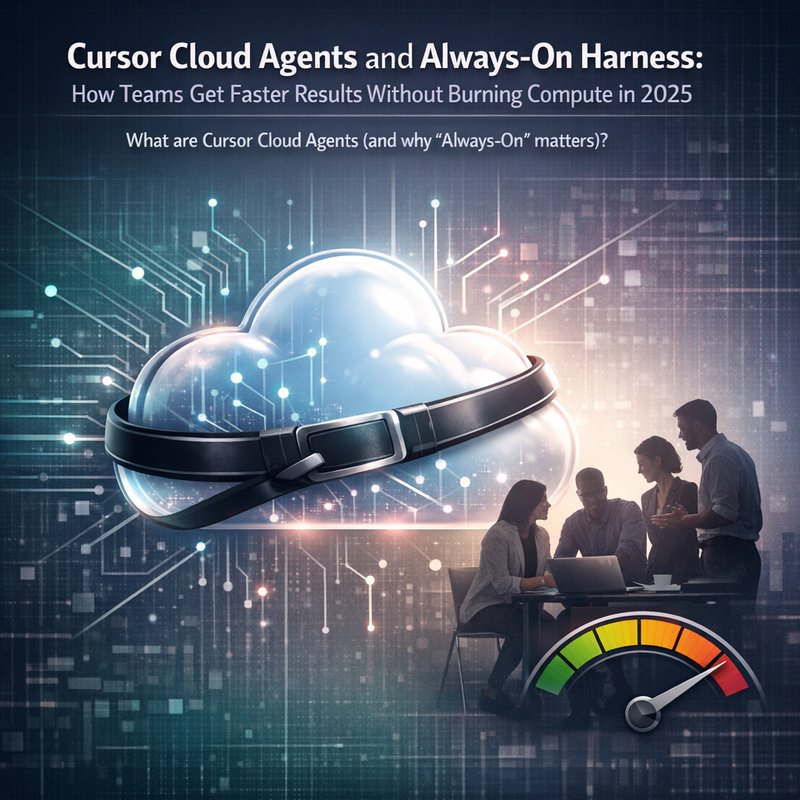
If you’re building with AI agents, Cursor Cloud Agents and the new Always-On style of agent work changes what “done” looks like. Instead of starting a job, babysitting it, and hoping it finishes before time runs out, you can keep an agent task alive in the background and recover when things break. In this guide, I’ll explain what’s new in Cursor’s Always-On Cloud Agents update, how “harness” systems like this work, and how you can apply the same design ideas to your own agent setups. I’ll also share practical safety tips so your automation stays predictable, not chaotic.
In October 2025, teams are trying to move from “click and wait” AI to “set it up and keep it going.” Cursor Cloud Agents are part of that push, and the best part is the focus on reliability and longer running work. The same ideas show up elsewhere too, like the Gateway Restart Recovery pattern in agent runtimes and the push toward agent-ready software workflows in code review systems.
Let’s break it down.
What are Cursor Cloud Agents (and why “Always-On” matters)?
Cursor Cloud Agents are Cursor’s way to run agent work in the cloud. That sounds simple, but the key difference is the operating style: Always-On means the agent isn’t just a one time run. It’s closer to a long-lived worker process.
Here’s why that matters:
- You spend less time restarting tasks.
- The agent can keep context longer (or at least keep the “job” alive).
- Interruptions like network glitches or service hiccups become less destructive.
The big rumor in agent land is “agents are smart enough to do the work.” But honestly, the daily problem is boring: jobs fail midway, retries waste money, and humans fill the gap with manual checking.
That’s where Cursor Cloud Agents feel different. The update to Cursor’s Harness specifically targets the idea of always having something ready to receive work and continue running.
Source to start from: Cursor’s update about the Cursor Harness and Always-On Cloud Agents is covered via the Cursor article noted in your search results.
https://cursor.com (Cursor Harness Always-On Cloud Agents update was referenced in the search results you provided)
The hidden hero: harness design for agent reliability
A lot of people treat an agent like a “model plus prompts.” That’s not the whole story.
A good agent system has at least three layers:
-
Plan and tool use layer
The agent decides what to do, which tools to call, and when. -
Runtime layer
This is where code runs, terminal commands execute, files are edited, and outputs return. -
Harness or orchestration layer
This is the glue that keeps everything alive, retries safely, and survives interruptions.
The reason harness matters is simple: long-running work is fragile.
Why long-running work breaks in real life
Agent jobs fail because of:
- Server restarts
- Temporary disconnects
- Tool timeouts
- Partial file writes
- Rate limits
- “The agent did something, then got stuck”
In search results, GitHub materials also highlight Gateway Restart Recovery, which is the kind of runtime feature that aims to survive restarts.
This is the same class of problem, just solved in different ecosystems. The design lesson is identical: your agent system needs a recovery story, not just a best effort run.
If you want a deeper baseline understanding of agent harness recovery patterns, look at the “Gateway Restart Recovery” idea referenced in the GitHub search result your prompt included.
Always-On vs normal run-and-go agents: the practical difference
So what does “Always-On” change for day-to-day work?
Here are a few common workflows where it helps:
1) Code tasks that require multiple steps
Example:
- Read codebase
- Propose changes
- Run tests
- Fix failing parts
- Re-run checks
- Summarize changes
If your agent stops partway, you lose momentum. Cursor Cloud Agents aim to reduce that “stop and restart” pain by keeping the execution environment more stable.
2) Research tasks that need waiting and multiple tool calls
Example:
- Find docs
- Compare APIs
- Draft an answer
- Then verify with sources
Waiting for web results or fetching more data can create long idle periods. An always-on worker can keep the job going while the UI stays responsive.
3) Continuous improvements for PR scale review loops
Your search results mention “Agent-Ready Code Review” and agent-ready repositories. Even if you’re not using the same vendor, the pattern is similar: in real teams, you review lots of PRs, and you can’t have your automation die mid-stream.
The better harness systems are trying to make those workflows smoother.
How to think about the “agent job” as a state machine
This is the mental model that makes harness features make sense.
Instead of thinking “the agent works,” think “the agent job moves through states.”
A state machine job might look like:
- queued
- running
- waiting for tool output
- editing files
- running tests
- producing summary
- completed
Now add recovery:
- If the system restarts while in “running,” you restore to the last safe state.
- If the network drops while waiting for tool output, you resume the wait or retry safely.
- If an edit fails, you roll back or reapply deterministically.
This is also where safety rules matter. If your agent can’t clearly track which state it’s in, you can get duplicates or conflicting edits.
That’s a big reason harness design is becoming a “first class feature” in AI developer tools.
A simple checklist for using Cursor Cloud Agents safely
Even with a reliable harness, you still need guardrails. Otherwise you get the dreaded “agent did something unexpected while you were away.”
Here’s a checklist I recommend for teams using Cursor Cloud Agents or any always-on agent workflow.
1) Lock down tool permissions
Ask:
- What can the agent run?
- What files can it edit?
- Can it install packages?
- Can it call external APIs?
If your agent can do everything, the risk becomes a matter of time.
2) Require “plan before edit” for high-impact actions
For anything that changes lots of files:
- Have the agent outline a short plan first.
- Confirm the intent before applying.
You don’t need manual approvals for small edits. But big refactors should have a “pause and verify” step.
3) Add stopping rules and budgets
Budget types:
- time budget (max minutes)
- tool budget (max tool calls)
- cost budget (if you track usage)
- risk budget (max changes to certain directories)
Always-on agents are great, but infinite is never safe.
4) Make outputs readable and reviewable
The agent should return:
- what it changed
- why it changed it
- where it got evidence
- what it didn’t do
This makes it easier for a reviewer to step in and finish work if needed.
5) Use a recovery-friendly workflow
The harness idea is recovery. So design your change processes to be recoverable too:

- make small commits
- run tests often
- keep file diffs scoped
- avoid one giant “edit everything” action
Where “agent-ready code review” fits in (and why it’s a big deal)
Your search results highlight “Agent-Ready Repository” and an “AI Code Review” system launched by Harness.
Even if you never touch Harness, the concept matters.
Agent-ready means your repo is set up so an agent can:
- find the right entry points
- understand build steps quickly
- run tests consistently
- follow contribution rules
- produce changes that fit team style
In other words, it reduces friction.
Friction is how you waste compute and time. So when Cursor Cloud Agents or other always-on agents succeed, it’s often because the workflow around them is more predictable too.
If you’re building internal tools, you can apply this without copying any specific product:
- document the build and test commands
- ensure consistent tooling versions
- keep scripts in standard locations
- define a review checklist
These are not sexy tasks. But they make agents behave better.
Applying the same ideas in your own AI agent architecture
Let’s say you’re not only using Cursor. Maybe you’re building your own agent service.
Here’s how to apply “Always-On harness” ideas without copying any single vendor.
Step 1: Separate “brain” from “worker”
Your “brain” does reasoning and planning.
Your “worker” does tool execution, file edits, and command runs.
That separation makes it easier to recover. If the worker restarts, the brain can rehydrate the last plan state.
Step 2: Store job state after each tool action
After every tool call:
- save input
- save output
- save next state
Then on restart, you can continue without redoing expensive steps.
Step 3: Design idempotent file edits
Idempotent means “running it twice doesn’t break things.”
For example:
- patch the same file with the same diff
- ensure edits are applied only if they match a precondition
- avoid “append random text at the end” patterns
Step 4: Build a “resume strategy”
A resume strategy could be:
- resume tool wait if result is expected
- rerun tool if the output isn’t available
- skip tool if it already completed
Which you choose depends on the tool and risk.
Step 5: Add audit logs for every decision
When agents run without you watching, audit logs become your safety net.
Log:
- tool calls
- rationale summary
- changed file list
- detected errors
That helps with debugging and trust.
Cost control: the real reason teams move to always-on agents
Let’s be honest. Compute cost is a major driver.
Even if an agent is “smart,” repeating steps because of failures is expensive.
Always-on approaches can reduce waste by:
- keeping job execution alive
- reducing restarts
- continuing from state
- cutting down manual retries
However, cost control is still not magical.
If you allow the agent to run forever, cost goes up fast. So the best approach is always:
- always-on for reliability
- strict budgets for spend
Practical scenario: from stalled agent to recoverable job
Here’s a realistic scenario.
A developer asks an agent to:
- update a dependency
- fix broken tests
- run lint
- update docs
It starts running.
Then:
- CI flakes
- a tool times out
- the server restarts once
In a weak setup:
- the agent loses context
- it restarts from the beginning
- you end up with messy changes and duplicate diffs
In a strong harness + recovery setup:
- the job state is restored
- the agent resumes from the “tests failed” stage
- it rechecks only what’s needed
- you end with one clean patch set
That’s the “real world” win behind Cursor Cloud Agents and harness improvements. It’s not about fancy prompts. It’s about job continuity.
How this connects to Neura AI workflows (only when it helps)
If you run AI workflows across multiple apps, you need routing and tool connections that make sense.
Neura is set up as an integrated business platform with AI-powered RDA Agents that automate tasks, enhance creativity, and streamline operations. The practical part for teams is that routing matters when you have different tasks and different tool needs.
If you want a quick way to explore Neura’s app ecosystem:
- Start at https://meetneura.ai/products when you’re comparing how different agent types fit your workflow.
- If you care about leadership and team background, check https://meetneura.ai/#leadership.
- If you want examples of real agent work, browse https://blog.meetneura.ai/#case-studies.
This article is about Cursor and harness reliability, but the shared lesson is broader:
Good agent tooling is not just “the model.”
It’s the system around it that keeps work stable.
Quick “do this next” guide
If you’re adopting Cursor Cloud Agents right now, do this:
- Use always-on for multi-step tasks.
- Set tool and time budgets.
- Require a plan before large edits.
- Keep diffs scoped.
- Review agent summaries like you would a junior PR.
If your team does that, Cursor Cloud Agents can feel like a real teammate instead of a risky demo.
Conclusion: Always-On agents are about reliability, not magic
The main takeaway is simple. Cursor Cloud Agents and their updated Harness design push agents toward long-running, recoverable work. That means fewer half-finished jobs, less wasted compute, and smoother code change flows.
The deeper lesson is harness design: treat agent tasks like state machines, store progress after tool actions, and build recovery paths. Once you do that, always-on becomes useful instead of dangerous.
And if you want more agent workflow inspiration across tools, explore how Neura builds router-based agent experiences at https://meetneura.ai/products and real examples at https://blog.meetneura.ai/#case-studies.