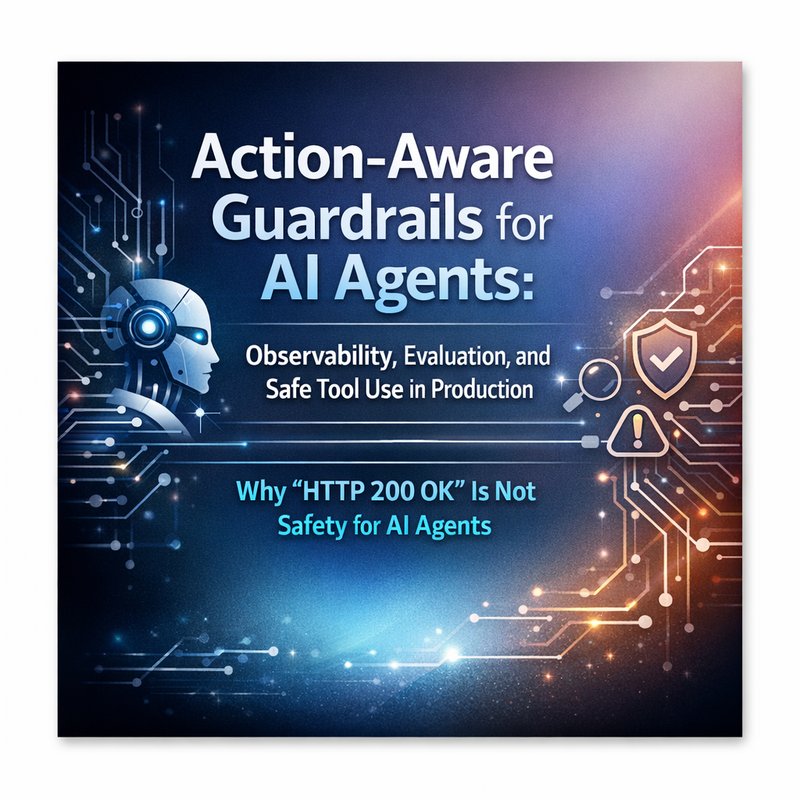
AI agents are not just chatbots anymore. They plan, call tools, and try again when something fails. That is exactly why action-aware guardrails matter for safe tool use in production. An agent can get an HTTP 200 response and still be stuck in a loop, wasting tokens and time. Or it can call the wrong API with wrong parameters because it guessed what it needed. With action-aware guardrails in place, you can stop bad tool calls before they happen, record what happened after, and keep improving with continuous evaluation.
This article breaks down a practical way to build action-aware guardrails for AI agents using three pillars that show up again and again in modern enterprise setups: observability, continuous evaluation, and action-aware guardrails. You’ll also see concrete design patterns you can copy, like parent-child tracing for multi-agent flows and pre-execution tool firewalls.
Why “HTTP 200 OK” Is Not Safety for AI Agents
Let’s be honest. When an AI agent calls an API, your standard logs might show something simple like:
- Tool call happened
- HTTP status is 200
- Response looks normal
Cool, right?
But agents are non-deterministic. They can:
- Plan for too long instead of finishing
- Retry with increasingly wrong arguments
- Call a tool that matches the request, but not the goal
- Get “poisoned” by tool outputs and keep going anyway
That is why action-aware guardrails are not optional for safe tool use in production. You need more than text filtering or a basic API gateway error rate. You need guardrails that understand the meaning of the tool call, not just the shape of it.
Two categories usually show up in real production problems:
- Planning failures (the agent keeps thinking, looping, or revising)
- Tool execution failures (the agent calls a tool with unsafe or wrong parameters)
Your observability should help you spot both. Your guardrails should prevent the tool execution part from turning into a real incident.
Observability for Agent Workflows: Trace the Plan, Not Just the Request
Traditional APM gives you latency, CPU, and error codes. That helps, but agents need deeper visibility. Modern agent monitoring focuses on reasoning chains, tool use, and multi-agent delegation.
What “agent tracing” must include
If you only store flat logs, you’ll miss the real story. You need traces that show:
- The parent agent that started the job
- The child agents it spawned
- Each tool call made by each agent
- The inputs and outputs that influenced future steps
- Token usage and context-window usage across steps
- When the plan changed, revised, or restarted
This is especially important when you use multi-agent systems. Hierarchical tracing helps you answer questions like: “Did it get stuck in circular reasoning?” or “Which sub-agent made the unsafe decision?”
Use OpenTelemetry so you can compare apples to apples
A big theme in current enterprise agent stacks is standardization with OpenTelemetry (OTel) and LLM agent tracing standards (often discussed alongside OpenInference). Using OpenTelemetry makes it easier to move between tools and keep the same mental model across vendors.
If you want the canonical reference, start with the OpenTelemetry project here: https://opentelemetry.io/
Practical observability targets for safe tool use
Set up dashboards and alerts around things that actually predict failures:
- Tool-call rate spikes (one tool getting hammered)
- Token explosion (token use grows while progress stalls)
- Repeated plan revisions for the same task
- High frequency of denied attempts (often means policy mismatch)
- Parent-child span patterns that look like loops
These signals help your team connect “what the system did” to “what the agent decided.”
Continuous Evaluation: Score the Whole Trajectory, Not Just the Final Answer
Now, the next piece: evaluation. Many teams evaluate the final response quality, maybe in offline tests. That’s not enough for agents.
Why? Because danger often happens mid-trajectory. A model can produce a “good enough” final message while it did unsafe or wasteful actions on the way.
So modern enterprise teams shift toward continuous evaluation loops:
- Run evaluation in CI/CD on every prompt or tool schema change
- Grade full trajectories, not only final text
- Use smaller or specialized models as judges when possible to control cost
The cost part matters. Scoring every production run with frontier models can be expensive. The common direction is to use specialized SLM judges, heuristics, and sampling, then ramp up full scoring only where risk is high.
What to evaluate when you care about action-aware safety
For action-aware guardrails and safe tool use in production, evaluate these things:
- Did the agent call the correct tool for the goal?
- Were tool parameters valid and within allowed boundaries?
- Did it try to do prohibited actions (refund too large, delete without permission)?
- Did it keep retrying after tool failures?
- Did it get tricked by tool output and change direction?
Then you use those scores to trigger:
- Prompt or policy changes
- Tool parameter schema tightening
- Guardrail upgrades
- New regression tests
If you want a starting point for continuous evaluation concepts, you can also check resources around automated LLM evaluation from teams and tooling vendors like DeepEval and general evaluation research (for example, DeepEval has public docs and examples). A good general reference is: https://github.com/confident-ai/deepeval
Action-Aware Guardrails: Pre-Execution Tool Firewalls That Understand Intent
This is the core of the article.
Action-aware guardrails are checks that happen before an agent executes an external action. Instead of only filtering text output, they intercept “intent to act” and validate it.
A useful mental model:
- The model proposes an action
- The guardrail checks whether action is allowed and safe
- If safe, the tool call runs
- If not safe, the guardrail blocks or rewrites
- Everything is logged with enough detail for debugging
What static filters miss
Earlier guardrails focused on text input/output filtering, like:
- PII masking
- Toxic language detection
- Prompt injection string patterns
These still matter, but they don’t solve the biggest enterprise pain for agents: tool execution with wrong parameters, wrong permissions, or unsafe thresholds.
That is why action-aware guardrails should be “tool aware.”
Guardrail checks that matter in real workflows
Here are common checks you can implement:
-
Permission checks
Does this agent role have permission for this tool and this resource? -
Parameter boundary checks
Are numeric values within safe ranges? Are IDs formatted correctly? -
Semantic checks
Is the action goal consistent with the user request? For example, “refund” vs “delete record.” -
Business threshold checks
Refund under $X is allowed, anything above needs approval. -
Least-privilege scoping
The agent should only see tool credentials it truly needs.
Context-aware policy enforcement reduces false positives
Generic safety filters can block real business requests and cause frustration (false positives). A better approach is context-aware enforcement.
For example:
- A customer says “I lost my card”
- A naive filter might block wording it thinks is suspicious
- A semantic guardrail can allow the request because intent is clear
For a good overview of “agentic security” themes and risk patterns, see OWASP’s agent-oriented security materials here: https://owasp.org/
A Concrete Design Pattern for Safe Tool Use in Production
Let’s make this practical.
Step 1: Make tool calls structured and machine-checkable
If your agent sends tool calls as free-form prose, guardrails struggle. Structured tool calls (JSON schemas, typed parameters) make validation much easier.
You want:
- Tool name
- Parameter object
- Agent role
- User/request metadata
- Optional “reasoning summary” for audit
This also helps multi-agent tracing because each tool call becomes a clean span.
Step 2: Put a pre-execution guardrail service in the tool path
Build a small service that sits between the agent runtime and the tool executor.
Flow:
- Agent proposes tool action
- Guardrail evaluates policy and schemas
- Guardrail returns allow, deny, or rewrite instructions
- Tool executor runs if allowed
This is what “runtime proxies intercepting intent before API execution” looks like in practice.
Step 3: Validate both syntax and meaning
Do it in two layers:
-
Syntax validation
Schema check, required fields, correct types -
Meaning validation
Cross-check values against rules you encode from business policy
Example rules:
- Refund limit per request
- Delete operation requires explicit confirmation flag
- Tool access bound to the customer account ID
Step 4: Log everything with parent-child spans
After each decision, log:
- Proposed tool call
- Guardrail decision (allow, deny, rewrite)
- Policy version used
- Key reason codes (short, consistent)
- Parent span and child span IDs
This is where observability and action-aware guardrails meet. Without tracing, you can’t debug why an agent was blocked.
Step 5: Evaluate guardrail outcomes over time
Finally, continuous evaluation should measure:
- How often guardrails block correct requests
- How often guardrails fail to block unsafe actions
- Whether blocking increases retries or causes stuck loops
- Which policy rules need tuning
This cycle turns your guardrails from a one-time setup into a living safety system.
Multi-Agent Safety: How to Prevent “Wrong Agent, Wrong Tool”
One sneaky issue in multi-agent systems is that the orchestrator might delegate tasks, but the sub-agent might interpret the task differently. Then you get tool calls that look valid but are unsafe in context.
To reduce this:

- Track which agent created each tool call (not just that a tool was called)
- Use hierarchical tracing for parent-child relationships
- Include agent handoff metadata in traces
- Add guardrail checks that consider agent role and job type
When sub-agents share tool access, the risk increases. Least-privilege scoping becomes even more important.
If you’re standardizing runtimes, OpenTelemetry tracing helps keep the structure consistent across frameworks.
Cost Control Without Losing Safety
There’s a tension people feel immediately:
- Safety needs more checks, more logs, and more evaluation
- But you still want the system to run fast and cheap
So teams often do this:
- Use small judges for most evaluations
- Use heavier models only for high-risk actions
- Apply sampling for low-risk traffic
- Do full-trajectory scoring when policy or tools change
- Add cutoffs for loops (stop after N retries or plan revisions)
This is how you keep safe tool use in production without exploding compute bills.
Common Failure Modes and What Guardrails Should Do About Them
Here are a few failures I’ve seen teams run into with agentic systems.
Failure mode: Planning loop that burns tokens
Symptom: tool calls may stop, but tokens keep rising. The agent keeps revising plans.
Guardrail fix ideas:
- Stop rules when no progress is detected
- Alert when plan revisions exceed a threshold
- Evaluation checks for “wasted steps”
Failure mode: Wrong tool with “valid” data
Symptom: guardrails allow because parameter formats pass, but the action is semantically wrong.
Guardrail fix ideas:
- Semantic policy rules tied to the user goal
- Tool permission rules that are action-specific
- Debug logs linking intent to the actual tool called
Failure mode: Too many false positives
Symptom: the agent gets blocked often and can’t complete real requests.
Guardrail fix ideas:
- Context-aware checks instead of only text matching
- Rewrite suggestions rather than hard denial when safe
- Track denied reasons and tune policies using evaluation data
Where Neura Fits When You Need Agent Tool Safety
If you’re building real workflows, you quickly hit these same problems: tool execution paths, multi-step tasks, and the need for safe routing and automation.
Neura focuses on integrated business automation with AI-powered Router Agents (RAG + reasoning + decision and action). In practical terms, that means routing the request to the right internal app or capability, and then keeping the workflow moving.
If you want to explore Neura’s ecosystem, start here:
And if you want example real-world workflows from our blog, check:
(That won’t replace your own safety policies, but it helps you think about how agent routing fits into real operations.)
Conclusion: Build Safety as a System, Not a Single Filter
Here’s the bottom line.
Action-aware guardrails for safe tool use in production work best when you treat safety as a full system:
- Observability so you can trace decisions and tool calls across multi-agent runs
- Continuous evaluation so you grade full trajectories and catch dangerous mid-run behavior
- Action-aware guardrails so the system blocks or rewrites unsafe tool actions before execution
Once you do that, the “HTTP 200 OK” problem stops being a mystery. You’ll know what happened, why it happened, and how to fix it.
And yes, there will still be edge cases. But with tracing and evaluation in place, those edge cases become data, not surprises.