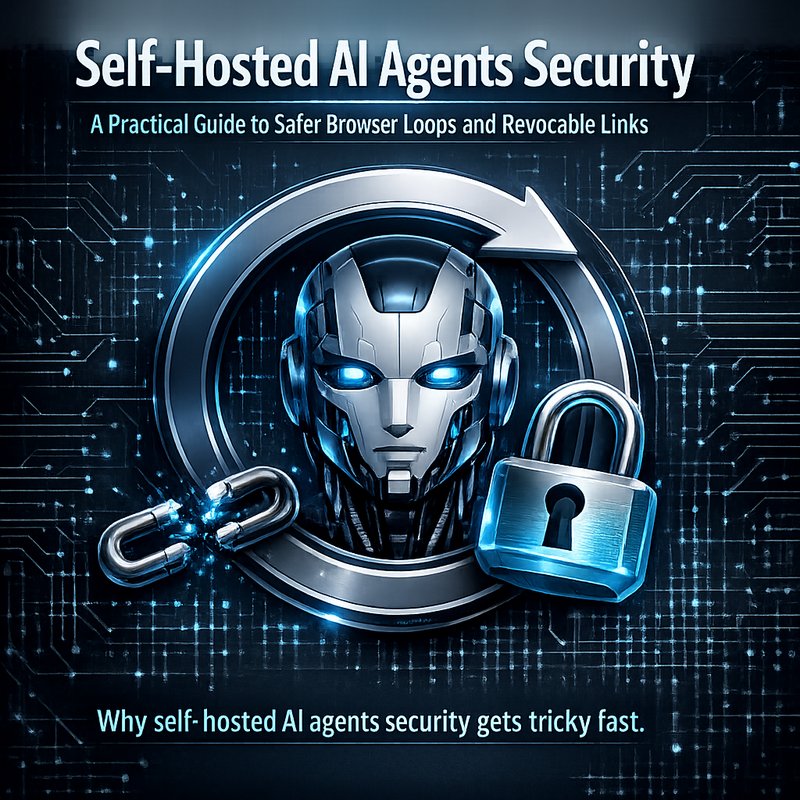

AI agents feel useful, until you remember one scary truth.
If an agent can browse, click, and write code, it can also do damage.
That’s exactly why self-hosted AI agents are trending right now. They let you keep code execution inside your network, reduce data exposure, and move trust decisions from a vendor to your own controls.
In this guide, I’ll explain what’s driving the shift toward self-hosted AI agents, how “agent loop” patterns can help you fix mistakes faster, and what “revocable links” and safer update flows mean in real life.
By the end, you’ll have a practical checklist you can use to evaluate any self-hosted AI agents setup you plan to run.
Why self-hosted AI agents are getting attention now
A few things are converging at once.
1) Tool use is normal now, but risk is still real
Modern coding and research agents do more than chat. They plan tasks, call tools, visit pages, and run commands.
That’s the point.
But it also means the agent needs guardrails.
Without guardrails, you get the classic problems:
- The agent writes bad code (or buggy code).
- The agent follows a wrong step and “doubles down.”
- The agent leaks secrets through logs or tool calls.
- The agent gets stuck in a loop and wastes time or money.
2) Safer agent browser patterns are becoming a standard
Search results point to a “new wave” of agent design ideas: live browser control, revocable chat links, and safer update handling.
The core theme is simple.
Instead of letting the agent run free, you gate what it can access and how updates propagate.
3) Multi-agent workflows reduce single-agent mistakes
One of the most notable ideas from recent research is multi-agent task splitting. A planner does architecture and task breakdown, an implementer writes the work, and an independent QA checks results.
One paper described a three-agent approach (Planner, Implementer, Independent QA) that built a working first-person shooter game autonomously over 70 iterations.
That doesn’t mean every app needs three agents. But it shows a pattern: separate responsibilities so one agent is less likely to quietly fail.
Primary source: Harness-of-Harness framework paper https://arxiv.org/abs/2609.01481v1
When you run self-hosted AI agents, this matters even more, because you want the safety checks to live close to your environment.
4) Self-hosted machines keep execution private
Another search result highlights support for “Self-Hosted Machines”, where code execution stays inside a private network.
That’s a big deal because it reduces the chance your sensitive operations run on a third-party system.
If you’re serious about self-hosted AI agents, assume you’ll want this capability.
Cursor notes on self-hosted machines (via the search redirect)
https://vertexaisearch.cloud.google.com/grounding-api-redirect/AUZIYQEGBTTfQ-XEydNa4rfrbAlEmVb7EVMHfIyuswoB1ix-dTVS_NYSoxv_KXDj6NgPdvUSgKVOaQwH1H8WfVpsLxwN5M_VFylIqCCUYw4uPceXykGdwHvK
The core idea behind safer self-hosted browser loops
Let’s talk plainly about “agent browser loops,” because this is where most real-world risk shows up.
A browser loop usually looks like this:
- The agent reads a page.
- It decides what to click or copy.
- It takes an action.
- It checks results.
- It repeats until it finishes.
The danger is when any step goes wrong. The agent can click the wrong thing, pull the wrong data, or follow a malicious link.
So safer self-hosted AI agents setups add controls at three points:
- Before action: limit what URLs and actions are allowed.
- During action: verify the action outcome and stop if it seems off.
- After action: validate what changed and roll back if needed.
Revocable chat links: why that change matters
Revocable chat links are one of those ideas that sound small, but they fix a real problem.
In many agent systems, the agent interacts with a chat or tool session that can stay “valid” longer than it should.
Revocation means you can invalidate a link or session when:
- the task finishes,
- the user requests a stop,
- you detect suspicious behavior,
- or secrets might have been exposed.
For self-hosted AI agents, that’s useful because it gives you an emergency lever.
You can shut off access without bringing down your whole stack.
Practical meaning:
- If an agent session starts acting weird, you revoke access.
- If an operator copies a link somewhere it shouldn’t go, you revoke it.
- If a task tries to escalate beyond what it should do, you revoke.
Search results reference “revocable chat links” as part of safer agent updates.
Multi-agent planning plus QA is safer than “one brain”
You might wonder: why not just run a single strong agent.
The honest answer is that single-agent systems fail in boring ways.
They hallucinate steps, they misread instructions, or they forget to re-check assumptions.
Search results mention coordinator-style agents that plan architecture and delegate subtasks to specialized agents in parallel.
That pattern helps because:
- planning becomes more structured,
- implementation becomes more focused,
- QA can actually test for issues.
One paper also supports the idea with separate roles across many iterations: https://arxiv.org/abs/2609.01481v1
When you run self-hosted AI agents, multi-agent separation also helps with permissions:
- the QA agent may have read-only access,
- the implementer may have write access,
- the planner may have no direct system execution rights.
Think of it like splitting duties inside a dev team.
“Max effort” reasoning caps: limit how much the agent can ramble
Another area trending in your referenced topics list is safe reasoning capping, like using something called maxEffortLevel to constrain how much reasoning an agent performs.
I’ll keep this simple:
- Agents that can think longer often generate more tool calls.
- More tool calls means more chances to do something unintended.
- So a cap reduces risk and cost.
If you’re designing self-hosted AI agents, you should treat effort caps like a safety valve.
Add it alongside other checks, not as your only safety measure.
A practical checklist for running self-hosted AI agents safely
Here’s a real checklist you can use.
Step 1: Choose what runs inside your network
Decide what must be private:
- code execution
- browser sessions
- access to internal docs
- access to production credentials
Then configure your self-hosted AI agents so the “heavy actions” happen inside your network.
Search result reference on self-hosted machine execution:
https://vertexaisearch.cloud.google.com/grounding-api-redirect/AUZIYQEGBTTfQ-XEydNa4rfrbAlEmVb7EVMHfIyuswoB1ix-dTVS_NYSoxv_KXDj6NgPdvUSgKVOaQwH1H8WfVpsLxwN5M_VFylIqCCUYw4uPceXykGdwHvK
Step 2: Set URL and action allowlists
If your agent can browse, you must restrict:
- allowed domains (or even allowed paths)
- blocked query patterns (to prevent secret exfil)
- maximum redirects
- click limits per step
For example, allow:
- documentation pages
- your own knowledge base
- known code hosts
But block:
- unknown search results
- random “download now” links
- suspicious login flows unless necessary
Step 3: Add “stop conditions” for agent browser loops
A stop condition can be:
- the agent tries to access a blocked URL
- it exceeds N clicks
- it sees an unexpected page type
- it fails validation checks
This is how you keep self-hosted AI agents from spiraling.
Step 4: Put QA between you and deploy
Even basic QA helps:
- run unit tests after changes
- scan for secrets in logs
- validate output format
- compare diffs against expected changes
If you can, use a multi-agent setup:
- planner (architecture)
- implementer (changes)
- QA (verification)
Primary research supporting role separation: https://arxiv.org/abs/2609.01481v1
Step 5: Use revocable sessions for agent actions
Maintain the ability to revoke access fast:
- revoke chat session links
- revoke tool tokens
- revoke browser session credentials
This aligns with the “revocable chat links” trend in safer agent design.
An automation pattern you can steal: Planner, implementer, QA (but with fewer moving parts)
You don’t need three agents for every task.
But you can steal the idea.
Here’s a lightweight version for self-hosted AI agents:
- Planner mode (text only): agent proposes steps and file changes.
- Implement mode (tool access): apply changes in a sandbox.
- QA mode (verification): agent compares actual results to the plan.
If QA fails, revert and ask for a corrected plan.
Why this works:
- you prevent the “write first, think later” failure mode
- you create a checkpoint you can trust
How to test your setup before you let it touch real systems
Testing is where teams often get lazy. But safe self-hosted AI agents need proof.
Create a “red team” task set
Examples:
- prompt injection attempts (agent is tricked into ignoring rules)
- fake admin links (agent tries to access restricted paths)
- secret bait (agent is shown a string that looks like a key)
- loop traps (agent runs longer than expected)
Your goal is to confirm:
- the agent refuses blocked actions
- the agent revokes or stops correctly
- your logs capture what happened
Run everything in a sandbox first

Even if you have self-hosting, keep this rule:
- execute code in a disposable container or VM
- only promote changes after QA verification
Common misconceptions about self-hosted AI agents
Let’s clean up a few myths.
Myth 1: “Self-hosted means fully safe”
No. It means you control where execution happens.
But safety still needs:
- permissions
- allowlists
- verification steps
- session revocation
- operator review where needed
Myth 2: “One strong agent is enough”
It can be, but it’s often not stable for long tasks.
Multi-agent planning plus QA reduces silent failures, as shown by role-separated research patterns: https://arxiv.org/abs/2609.01481v1
Myth 3: “Revocation is optional”
Revocation is how you respond fast when something goes wrong.
It’s not optional if the agent has tool access.
Mapping these ideas to Neura’s approach to agent workflows
If you’re evaluating self-hosted AI agents for real operations, you’ll care about workflow design.
Neura’s platform focuses on RDA Router Agents that route requests based on intent, plus specialized apps for tasks like document analysis, transcription, and content operations.
If you want to understand how routing and agent workflows are designed in practice, you can start here:
And if you’re curious about how case studies look in the real world, check:
This won’t replace your security work.
But it helps you think about routing and how you avoid giving every request the same level of access.
Industry security pressure is rising, and agent safety is part of it
One search result points to a requirement for AI product manufacturers to report exploited vulnerabilities within a 24-hour early warning window.
That signals mounting pressure on the entire AI ecosystem to address risk faster, not later.
Primary context link in your search results:
https://vertexaisearch.cloud.google.com/grounding-api-redirect/AUZIYQHHF9IHSo01uXgDekpwYv_BrSGfDn-rN8mo7kqggRFgR4cWbwSi3EzwE5HXwuGJN6jkNC69BqsMLSRTR5FHzla8xx8ml_PblMTvw29jffxN4wViOLh2eqjSfJrDQyNsUT9dFJMQfBcZIr7uy6l-T7aWlZSPvTNm8W2n5G_gNjMbI1b676n5zB_vFBephquD0NwRfXcABsKh3qGSVQbeQAEmtWha39S2nlHEZZzxrA==
So when you build or buy self-hosted AI agents, your security model matters.
It’s not just about performance. It’s about operational responsibility.
Conclusion: safe self-hosted AI agents start with control, not trust
Here’s the bottom line.
Self-hosted AI agents can reduce exposure by keeping execution in your network.
But the real safety comes from how you build the loop:
- restrict what the browser can do
- validate every action outcome
- use revocable sessions so you can cut access immediately
- split responsibilities with planning and QA patterns
- cap effort if you need to control tool call volume
- test with red team scenarios before real use
If you do those basics, you’ll move from “cool demo” to “useful system.”
And that’s the goal.
Related self-hosted AI security checklist you can reuse
If you want a compact checklist you can paste into your internal docs, use this:
- Execution stays private: use self-hosted machines for code runs.
- URL allowlists: block unknown domains and suspicious redirects.
- Loop stop rules: max clicks, max steps, unexpected page fails fast.
- Revocable sessions: revoke links and tokens when tasks finish or misbehave.
- QA checkpoint: verify diffs and run tests before anything promotes.
- Audit logs: keep tool call records for incident review.
That’s how self-hosted AI agents become predictable.