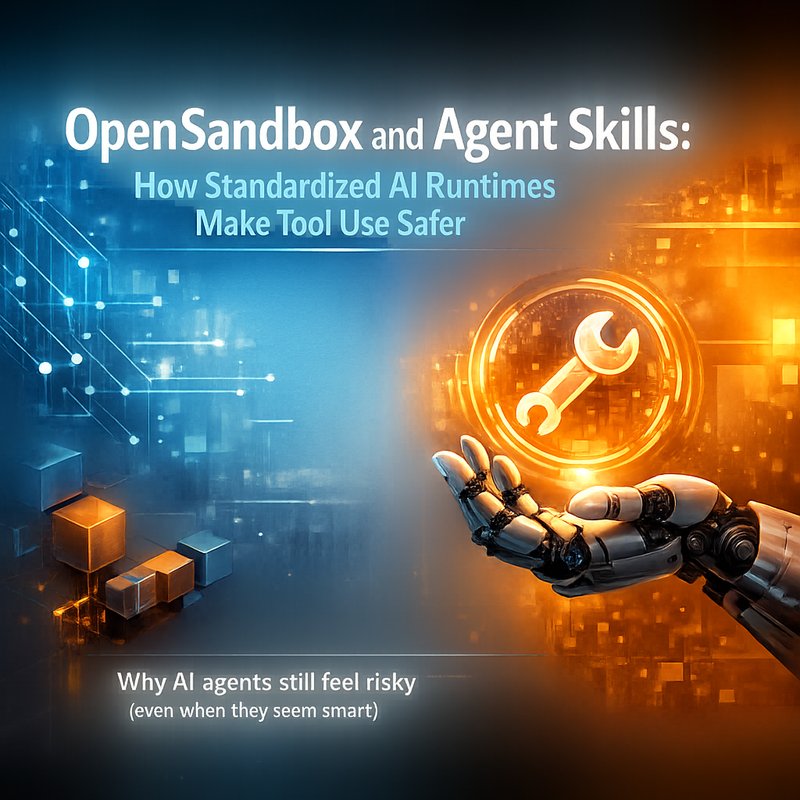
If you’re building or using AI agents, you’ve probably seen the scary part already: the agent can run tools, access files, call models, and sometimes do it in ways you did not fully expect. OpenSandbox and Agent Skills aim to fix that by pushing common standards for sandboxing, tool execution, and agent-to-agent tool handoffs, so different systems behave more like a “known safe workflow” instead of a one-off experiment.
In this guide, I’ll break down what OpenSandbox and Agent Skills mean in plain language, why they matter right now, and how teams can use these standards to build safer agent tools and more reliable agent behaviors.
You can jump ahead based on what you care about most, but if you want the short version, here it is: these standards are trying to make the messy middle of agent tool use safer, testable, and easier to swap between models and runtimes.
Why AI agents still feel risky (even when they seem smart)
AI agents are not just chatbots. They can:
- call tools
- run code
- browse or fetch data
- write files
- interact with external systems
- keep working over multiple steps
That’s powerful. It’s also where mistakes happen.
Here’s what usually goes wrong in real projects:
Tool calls lack consistent safety boundaries
One agent runtime might sandbox file access well. Another might not.
“Works on my machine” behavior shows up in production
If your agent depends on a specific runtime setup, moving it can break tool execution or weaken your guardrails.
Model output formats differ
Even if two agents both “use tools,” they might format tool requests differently, or interpret results differently.
Interoperability is fragile
If your agent can only work with one specific toolbox or vendor stack, it’s hard to test and hard to replace.
The industry is now trying to calm those worries with standards. That’s where OpenSandbox and Agent Skills enter the picture.
(Quick note: The topic here is standards for runtimes and tool execution. It’s not about a single app. It’s about the rules agents follow, under the hood.)
What “OpenSandbox and Agent Skills” are trying to standardize
From the research you provided, the Linux Foundation AAIF expansion added open-source agent standards: Agent Skills, Open Responses, OpenEnv, and OpenSandbox.
The point is not to force one company’s architecture on everyone. The point is to create shared building blocks so safety and interoperability improve across systems.
Source: Linux Foundation AAIF project roster expansion (Agent Skills, Open Responses, OpenEnv, OpenSandbox)
https://linuxfoundation.org
Let’s translate each relevant idea into something you can picture.
OpenSandbox: common runtime sandboxing for tool use
OpenSandbox and Agent Skills focus heavily on how tools are executed.
A “sandbox” is a restricted environment. The job is to reduce the blast radius if something goes wrong. For agents, that usually means:
- limiting what the agent can access
- controlling what processes it can spawn
- restricting network calls or making them explicit
- validating tool calls before execution
- isolating file system writes
In plain terms, OpenSandbox tries to help you run tools in a consistent, inspectable way.
Agent Skills: modular agent capabilities, not one giant bot
Agent Skills sounds boring, but it can matter a lot.
Instead of one monolithic agent that mixes planning, tool calling, and actions, Agent Skills pushes toward modular “skills” that plug in. Think of skills like:
- “This skill knows how to parse a document.”
- “This skill knows how to run a test command safely.”
- “This skill knows how to call a specific tool with a known I/O format.”
When skills are standardized, different runtimes and frontends can share them more easily, with fewer surprises.
OpenEnv and Open Responses: model and environment interoperability
Even if sandboxing is better, tool execution can still be messy if:
- prompts produce different tool call formats
- tool results are represented differently
- the environment assumptions are different
OpenSandbox and Agent Skills connect to broader standards like OpenEnv and Open Responses. Those help align environment details and how inputs and outputs are exchanged.
That makes everything easier to test and safer to maintain.
A short “tool use” story that shows what changes with standards
Imagine three teams all build “an agent that can run terminal checks”:
- Team A has a sandboxed runner.
- Team B runs commands directly.
- Team C uses a specialized connector that only works with their platform.
They all say: “Our agent can run tests.” But in practice, the risk profile is very different.
Now imagine you want to swap Team B with Team A because you care about safety.
But Team B’s tools, environment assumptions, and output formats don’t match.
So you end up rewriting integration glue.
And while rewriting, safety gaps can creep back in.
With OpenSandbox and Agent Skills, the goal is to reduce how much glue work you need, so tool execution happens in a more consistent, standard way.
That means:
- fewer hidden differences between systems
- clearer verification of what runs where
- easier testing of the safety boundary
- easier reuse of skills across agent runtimes
This is not magic. But it is real progress toward fewer “unknown unknowns.”
How these standards make AI agents easier to verify
A lot of people think verification means “do more monitoring.” That helps, but it is not the full story.
Standards like OpenSandbox and Agent Skills can improve verification before you even deploy.
Here are key verification upgrades you can expect when sandboxing and tool contracts become standardized.
1) You can test tool calls in a repeatable environment
When the environment contract is stable, you can write tests like:
- “This tool call must be rejected if the agent tries to read outside the allowed directory.”
- “This tool call must time out if it runs too long.”
- “This tool call must be logged with the same schema.”
Without standards, these tests can be brittle.
2) Tool results can be normalized
When skills have defined inputs and outputs, you can validate:
- schema of tool results
- expected fields present
- error formats
- exit codes
That reduces the chance of “agent thinks it succeeded, but it didn’t.”
3) Reviews get easier
When safety and tool routing are explicit, it’s easier for a reviewer to ask:
- What can this agent do?
- Under what boundary does it run?
- How do skills route tool calls?
- What happens if the tool fails?
That’s an important difference. Most teams can’t review random agent behavior deeply.
Standards help make review possible.
Real-world momentum: runtimes, terminals, and agent execution loops
Your search results also show a lot of practical work happening around agent execution, terminals, and cloud loops.
For example:
-
Anthropic updated Claude Code, adding a terminal keyword
ultrathinkfor higher reasoning effort, plus VS Code extension improvements.
Source: Claude Code update (via provided search result)
https://claude.com -
Spool launched an integration running Claude Code loops on Anthropic’s scalable cloud infrastructure, reducing local machine limits.
Source: emergent.sh result (via provided search result)
https://emergent.sh
These examples show the industry moving fast on “agent workflows” and how they run.
But speed creates risk when the tool execution boundary is different from one setup to another.
That is exactly what OpenSandbox and Agent Skills try to make more consistent.
Build safer agent tool execution with practical steps
Now, let’s turn this into an action plan. You don’t need to adopt an entire standards stack overnight.
Step 1: Start by listing your agent tool surfaces
Write down the tools your agent can access, like:
- file read, file write
- shell commands
- network calls
- database queries
- external APIs
Then label each with one shared concern:
- data exposure risk
- command execution risk
- data integrity risk
- denial-of-service risk
This helps you decide where OpenSandbox and Agent Skills style boundaries matter most.
Step 2: Define what is allowed and what is rejected
Even without full standard integration, you can create tool rules such as:
- “Only allow reading from /workspace.”
- “Only allow executing whitelisted commands.”
- “Block access to environment variables unless needed.”
- “Allow network calls only to these domains.”
Standardized contracts make these rules easier to enforce consistently.
Step 3: Treat skills as small reusable modules
If your agent currently has one big action function, refactor into smaller capability chunks.
Your goal is modularity like:
SkillDocumentSummarySkillRunTestsSkillFetchSpecSkillGeneratePatch
This is basically the “skills” mindset behind OpenSandbox and Agent Skills.
Step 4: Normalize tool I/O
Make sure tool calls and tool results follow a single contract across your system.
That might include:
- required fields
- error format
- result schema
- deterministic timeouts
- consistent logging fields
Step 5: Add tests that attack the sandbox boundary
Don’t only test happy paths.
Test misuse attempts, like:
- tool tries to read disallowed paths
- tool tries to write outside the workspace
- tool call is malformed
- tool call output is missing required fields
This makes OpenSandbox and Agent Skills ideas concrete, not just theoretical.
Where OpenSandbox and Agent Skills fit in your stack
You might be wondering: “Does this replace my agent framework?”
No. Usually, standards complement your framework.
A typical setup looks like:
- a model layer (where responses are generated)
- a skills layer (where capabilities are described)
- a runtime execution layer (where tools run)
- a sandbox layer (where execution is restricted and audited)
- an environment contract (where tool assumptions are documented)
OpenSandbox and Agent Skills target the middle layers so your tool execution is safer and more predictable.
That also means you can move pieces around more easily in the future.

What about portability and vendor lock-in?
A fair concern: standards can help portability, but teams still worry about lock-in.
Here’s the key point. Standards like OpenSandbox and Agent Skills are designed to reduce “hard coupling” between:
- skills
- tool contracts
- runtime sandboxing behaviors
- environment assumptions
- response formats
Even if you use one vendor today, standardized skills make it easier to adapt later.
And since Agent Skills are modular, you can reuse capability definitions across systems more easily.
Limitations to keep in mind (because safety is still hard)
Let’s be honest. Standards won’t remove all risk.
Here are realistic limits:
Sandboxing is only one part of safety
Agents can still be tricked by bad inputs.
They can still follow wrong goals.
They can still leak data through logs if you record it carelessly.
Standards do not automatically enforce policy
The standard defines structure. Your system still has to implement enforcement.
Adoption takes time
If your team has a big agent codebase, refactoring tools into modular skills might take effort.
So think of OpenSandbox and Agent Skills as safety building blocks, not a finish line.
How this connects to today’s agent ecosystem
Your search results also show tooling and agent integration work in the community.
For example, Cursor introduced a Cursor Agent SDK that helps define agents as projects with instructions, tools, skills, and MCP connectors.
Source: Cursor Agent SDK result (via provided search data)
https://cursor.com
Also, Cursor client updates focused on self-recovering extension hosts and dynamic tool pruning to reduce token waste.
Source: Cursor update result (via provided search data)
https://cursor.com
Even if those are different from AAIF standards directly, they point at the same direction:
agents need better runtimes, better skill modularity, and more consistent tool control.
That broader trend makes OpenSandbox and Agent Skills feel timely, not distant.
A quick checklist: adopt the ideas even before full standard integration
If you are building an agent system in 2025, use this checklist for safer tool execution.
Safety checklist for tool use
- Define allowed tool actions and blocked actions
- Isolate execution with a sandbox-like boundary
- Normalize tool call and result schemas
- Make skills modular and reusable
- Add tests for boundary attacks
- Log tool calls in a consistent format
If you do these well, you are already applying the mindset behind OpenSandbox and Agent Skills.
Conclusion: Why “standardized agent runtimes” are turning into a real safety layer
AI agents are entering the phase where “it works” is not enough.
People want to know what the agent can do, where it can do it, and how reliably it follows tool rules.
OpenSandbox and Agent Skills are part of a bigger effort to make tool execution more consistent through open standards. That means safer tool boundaries, more repeatable tests, and smoother interoperability between models, environments, and runtimes.
If you’re at the point where you’re scaling agent tool use beyond a demo, this is the direction that will matter most.