Agentic frameworks & coding agents are moving fast, and it’s easy to get lost in demos and hype.
This guide is here to help you test the real basics first, so your team builds something that works in the messy world of repos, CI, tickets, and deadlines.
In this article, I’ll break down what agentic frameworks & coding agents should do for you, what to measure early, and which failure modes to expect when you run agents in production-like conditions.
I’ll also show how to set up a simple evaluation loop and where Neura fits if you want a practical workflow starting point, not just another chatbot.
Why agentic frameworks & coding agents feel different this year
These days, most teams already know what a chatbot can do.
You ask a question, it answers.
But agentic frameworks & coding agents are different because they don’t stop at talking.
They are designed to reason, choose actions, and then actually try to change something: open a PR, update a file, run tests, comment in an issue, or fetch the right docs.
Search results like the “Agentic Frameworks & Coding Agents” page seen on redlinesoft.net highlight a shift from chat to autonomous software.
That is the big trend: less “help me think,” more “do the work with guardrails.”
And if you’re building this for a real team, here’s the truth:
You don’t need the fanciest model first.
You need the control layer that makes the agent safe, testable, and predictable enough to trust.
The 3 layers behind most agentic frameworks & coding agents
When people say “agent,” they sometimes mean the model.
But a real coding agent is usually a stack of layers.
1) The brain (model + reasoning)
This is the part that reads your repo context, the ticket text, logs, and your instructions.
It tries to decide what to do next.
But the brain alone is not enough.
It has no guarantee it will follow your workflow rules.
2) The hands (tools + actions)
Tools are how the agent touches your world.
That can be a shell executor, Git operations, GitHub API calls, issue comments, doc search, or test runners.
If your agentic frameworks & coding agents can’t act reliably with tools, the rest doesn’t matter.
3) The safety and routing layer (policy + evaluation)
This layer decides:
- When the agent is allowed to run.
- What it must confirm with you.
- How it handles ambiguity.
- What it does when it gets stuck.
- How it logs and proves what happened.
If you skip this layer, your “agent” becomes a helpful mess that breaks things at the worst time.
Start testing before you obsess over prompts
A lot of teams do prompt-heavy experiments first.
That feels productive.
Then the agent fails in CI, or it makes a PR that doesn’t compile, or it edits files it should not touch.
So here’s a better test order.
Test 1: Can it follow a repo workflow consistently?
Give the agent a task that has a clear workflow, like:
- Update a specific module file.
- Run unit tests.
- If tests fail, debug and rerun.
- Upload a summary to the issue.
Your first question is simple: did it stick to the workflow, or did it wander?
What to look for:
- It edits only the allowed files.
- It runs the right commands.
- It doesn’t invent paths.
- It formats changes the way your team expects.
If an agentic frameworks & coding agents can’t follow your basic workflow, better prompts won’t save you.
Test 2: Does it produce verifiable outputs?
The agent should not just claim it ran tests.
It should provide evidence, like:
- test command output
- failing stack trace
- changed files list
- PR link or patch created
The key is “verifiable.”
If you can’t verify, you can’t trust.
Test 3: Does it handle “I don’t know” gracefully?
In coding tasks, uncertainty is normal.
Good agents should switch behavior when they’re missing info:
- Ask a targeted question
- Request the missing file or log
- Narrow the scope
- Stop and wait
If your agent keeps guessing, it will waste your time fast.
One quick way to test this: intentionally delete part of the context.
See if it asks for what it needs.
Watch for the big failure modes in coding agent work
Once you start testing, you’ll notice common patterns.
These are the failure modes that show up in almost every agentic code runner.
Failure mode A: tool errors that look like “model mistakes”
Sometimes the model plan is fine.
But the tool call fails due to:
- wrong arguments
- missing permissions
- wrong working directory
- inconsistent command output parsing
In agentic frameworks & coding agents, tool failures can look like “the LLM got it wrong.”
Your evaluation should separate:
- planning quality
- tool execution quality
Failure mode B: context drift across long tasks
Long tasks cause attention issues.
The agent may forget constraints and start changing unrelated code.
Try a test where it must keep a rule like:
- “Never touch the API interface file.”
Then run a multi-step task that tempts it to update that file.
If it breaks the rule, you need constraint checks.
Failure mode C: “phantom progress”
This is when an agent says it did something, but didn’t.
It “builds,” but no build ran.
It “fixed,” but no patch exists.
This is why verifiable outputs matter so much.
And it’s also why logging and deterministic checks help.
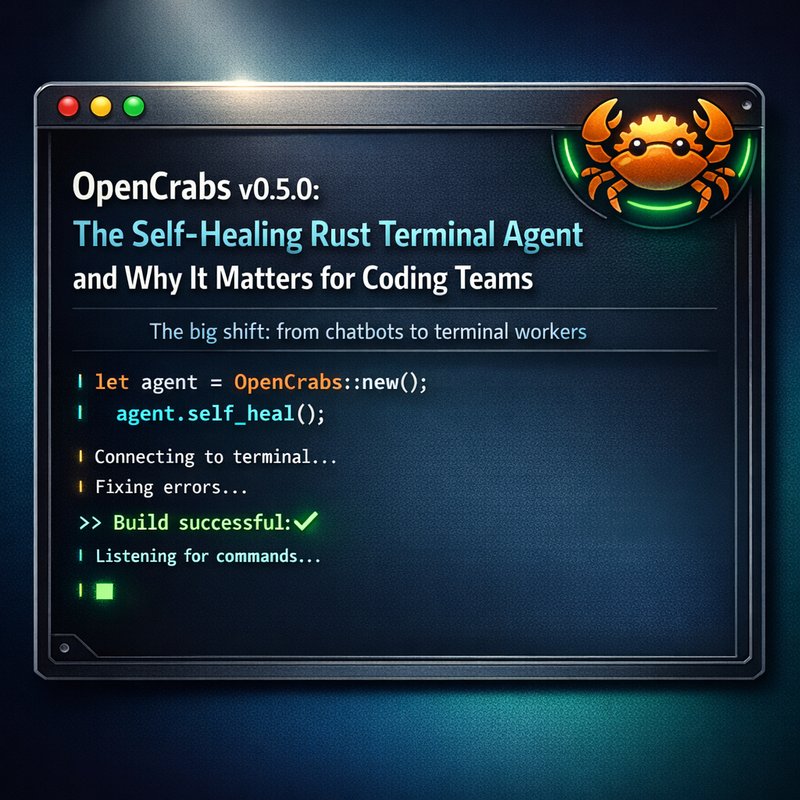
If you want a concrete example of how agents can get tricked by ambiguous intent signals, OpenCrabs has been discussing “phantom intent” fixes in recent updates on its repo and release notes.
You can check the OpenCrabs repository for the general direction and the kind of issues they fixed:
https://github.com/adolfousier/opencrabs
A simple evaluation loop you can run in a day
You don’t need a month-long benchmark project.
You need a tight loop.
Here’s a practical approach.
Step 1: Choose 10 tasks that look like your real work
Mix these task types:

- bug fix with a failing test
- small refactor with style expectations
- “add feature” based on a ticket
- documentation update with accuracy requirements
- “unknowns” task where logs are missing
Agentic frameworks & coding agents should handle variety, not just one demo.
Step 2: Define scoring that your team can agree on
Keep scoring simple:
- Workflow followed (yes/no)
- Tests passed (yes/no)
- Constraints respected (yes/no)
- Verifiable evidence included (yes/no)
- Assistant asked for missing info (yes/no)
You can calculate a total score, but the main goal is visibility.
Step 3: Run the same tasks with different settings
Change only one thing per run:
- tool permission level
- number of allowed steps
- confirmation prompts
- retrieval method (repo docs vs plain files)
- “stop and ask” thresholds
That is how you learn what actually matters in agentic frameworks & coding agents.
Step 4: Do a “postmortem” on failures
For each failure, record:
- root cause category (planning, tool, context, safety)
- what the agent did right
- what it did wrong
- how your next iteration prevents it
This avoids repeating the same mistakes.
And honestly, it’s faster than endlessly rewriting prompts.
How Neura can fit into practical agent workflows
If you want a starting point for building real workflows and not just talking about them, Neura is one option to explore for practical automation.
For example, you can route work to specialized agents using Neura’s approach with Router Agents (RAG plus Reasoning, Decision and Action), which aim to send the request to the right capability instead of forcing the same generic flow every time.
Start here for the main overview:
https://meetneura.ai
If you’re thinking about content and research automation around agentic development, Neura Artifacto and Neura ACE can help with related tasks like turning research into structured outputs, building knowledge trees, and generating content drafts.
- Neura products overview: https://meetneura.ai/products
- Case studies: https://blog.meetneura.ai/#case-studies
And if your team wants an actual content workflow that stays organized, Neura ACE is built for multi-agent content execution with web research and SEO-focused output generation:
https://ace.meetneura.ai
This is not the same thing as a coding agent that pushes PRs.
But it can help with the “human glue” work around agent builds: documentation, research summaries, technical writeups, and structured planning deliverables.
Agentic frameworks & coding agents for teams: what to decide early
Before you let an agent loose, decide on these rules.
Pick your trust level: draft, review, or auto-merge
A lot of teams start with “draft only.”
That means the agent creates a patch or PR description, but a human reviews and merges.
Then step up gradually:
- review after tests pass
- partial automation for safe file scopes
- auto-merge only for low-risk tasks
The goal is not full autonomy on day one.
It’s controlled autonomy.
Set tool permissions like you mean it
Tool permissions are the fastest way to prevent disaster:
- allow read-only access to most files initially
- restrict write access to specific directories
- limit shell command scope
- require approvals for network actions
Agentic frameworks & coding agents should be “capability-limited” until proven safe.
Decide how the agent talks to humans
Human-friendly output matters more than you think.
Good agent responses include:
- what it will change
- why it will change it
- what tests it ran
- what it needs from you if blocked
If the agent output is vague, developers won’t trust it.
Real-world testing checklist for coding agent readiness
Use this checklist before you roll anything to real repos.
Readiness checklist
- The agent creates a patch or PR, not just a text plan.
- The agent runs tests with the correct commands.
- Logs and evidence are included.
- The agent never changes files outside your allowed scope.
- The agent asks questions when context is missing.
- The agent can recover after test failures.
- You have a rollback plan (at least git revert).
- You can reproduce what happened from logs.
If any of these are missing, treat it as a prototype, not a production tool.
What the latest search signals: where the market is heading
The search results you shared point to a continuing trend: agentic frameworks & coding agents are becoming the center of tool-building.
Also, stable versions and active updates show that teams are taking this seriously and iterating fast.
In other words, the market is moving from “cool demo” to “repeatable workflow.”
And that means the winners will not just be the models.
They will be the teams that build strong safety layers, tool reliability, and evaluation loops.
If you want more context from those discovery pages, you can start with:
-
redlinesoft.net search result page (agentic frameworks overview)
https://vertexaisearch.cloud.google.com/grounding-api-redirect/AUZIYQGUIcAfUSUGz3fnAkz3mC14axwFodxXo_g_jEIUYNB97SPEYQULI6S6GVshKpujGFILp8omgH1taMVSYLpVhvvpAWoQewciTbx-0vOB2LPPniJtkL0g8pcssTJPRV3dZHMF-F-zfPuw9aTK1YjAorK-YDXzp84o -
opencode.asia stable version discovery result page
https://vertexaisearch.cloud.google.com/grounding-api-redirect/AUZIYQH31ZYOYwdwHbvhrblV_xhIATdupt-Nn2vYHeSWxfBSWChB-SvbdDhM4y_GefM7ECJNxY2FHzMU_Mn6wNhSIIjZnaFvHixMjZxalMLOtaMCfUJU98Hl5-q4zuzaqaquR9t62Rmi5_OMD9V4WQDqZpDxEwd5fkrn
Common questions teams ask about agentic frameworks & coding agents
“Do we start with a big model or a small one?”
Start with what your evaluation loop can support.
If agentic frameworks & coding agents cost too much per task, you’ll stop using them.
A smaller model plus strong tools and guardrails can beat a bigger model that wastes steps.
“Will this replace developers?”
Not in a honest way yet.
What these systems do well is reducing the boring parts:
- drafting code
- generating explanations
- preparing PR descriptions
- running and interpreting tests when wired correctly
Developers still own design, tradeoffs, architecture, and review.
“How do we avoid risky changes?”
Limit tool permissions, restrict file scope, require verifiable evidence, and use “draft first” policies.
That is how agentic frameworks & coding agents stay useful instead of scary.
Conclusion: aim for testable autonomy, not magic
Agentic frameworks & coding agents are getting more capable, but the teams that move fastest aren’t chasing the flashiest demo.
They test reliability in small, repeatable loops.
They separate planning quality from tool execution.
They require verifiable outputs and clear human handoffs.
And they keep guardrails tight until the agent proves it can stay inside the rules.
If you take one thing from this: don’t start by rewriting prompts.
Start by setting your evaluation checklist, running a small task set, and measuring what actually happens.
Then iterate.
That is how agentic frameworks & coding agents become a real part of your engineering workflow.