
Agents are getting better at doing work on their own. And lately, two changes stand out: new “auto mode” behavior that shifts classification to the server side to cut overhead, and improved handling of “phantom intent” in self-hosted agents like OpenCrabs. This article explains Self-Improving Agents: server-side auto mode and phantom intent in plain English, and shows you how to think about safer automation when your AI starts acting independently.
If you have ever sent an agent a command like “check the status” and it suddenly starts doing something else, you already know the problem. The agent might “feel” the intent, but it’s really guessing. That’s where Self-Improving Agents: server-side auto mode and phantom intent become a big deal. It’s not just about smarter models. It’s about routing, timing, and handling the tiny short messages that humans send without thinking.
Why “Auto Mode” Changed: Classification Side Matters
Recent updates point to a specific product behavior shift. In some systems, “auto mode” used to require extra token work because classification happened locally.
Now, the new version defaults to a server-side classifier for “auto mode,” eliminating the token overhead previously charged to users for local classification. In other words, the agent still tries to figure out what you want, but the heavy lifting happens on the server, not inside your token budget.
That matters for Self-Improving Agents: server-side auto mode and phantom intent for one simple reason. When classification costs tokens, you get tradeoffs:
- You can classify more often, or you can save tokens.
- You can be fast, or you can be careful.
- You can keep more steps in context, or you cut steps to reduce cost.
When classification moves server-side, you often get more consistent routing. Your local agent can focus on executing rather than constantly re-deciding what category your request belongs to.
Local vs server-side classification: the real-world difference
Let’s say you ask an agent:
- “Auto run build checks.”
- “Do the next step.”
- “Use the template.”
Those are short. Short prompts are exactly where classification can get shaky.
Server-side classification can use:
- richer signals from logs,
- standardized routing rules,
- and a more stable environment.
Even if the underlying model is the same, the path from “text you typed” to “tool you should run” becomes more uniform.
If you are building systems around Self-Improving Agents: server-side auto mode and phantom intent, this shift is useful. It lowers the chance that your execution layer starts from a wrong guess.
What you should do with this information
You might be thinking, “Cool, but how does this help me?”
Here are practical steps:
- Treat “auto mode” as a routing feature, not just a model setting.
- Track when classification chooses wrong actions.
- Compare behavior between local and server-side runs when you can test it.
If you run self-hosted workflows, this also changes your architecture choices. You may want a dedicated classifier service even if your reasoning model is local.
For more background on agent routing and multi-step actions, you can explore Neura’s approach to agent workflows here:
https://meetneura.ai/products
And if you like the idea of connecting multiple providers through a single endpoint, Neura Router is another related piece:
https://router.meetneura.ai
What “Phantom Intent” Actually Means (And Why It Happens)
Now let’s talk about phantom intent, because it’s one of the most common failure modes in self-hosted agents.
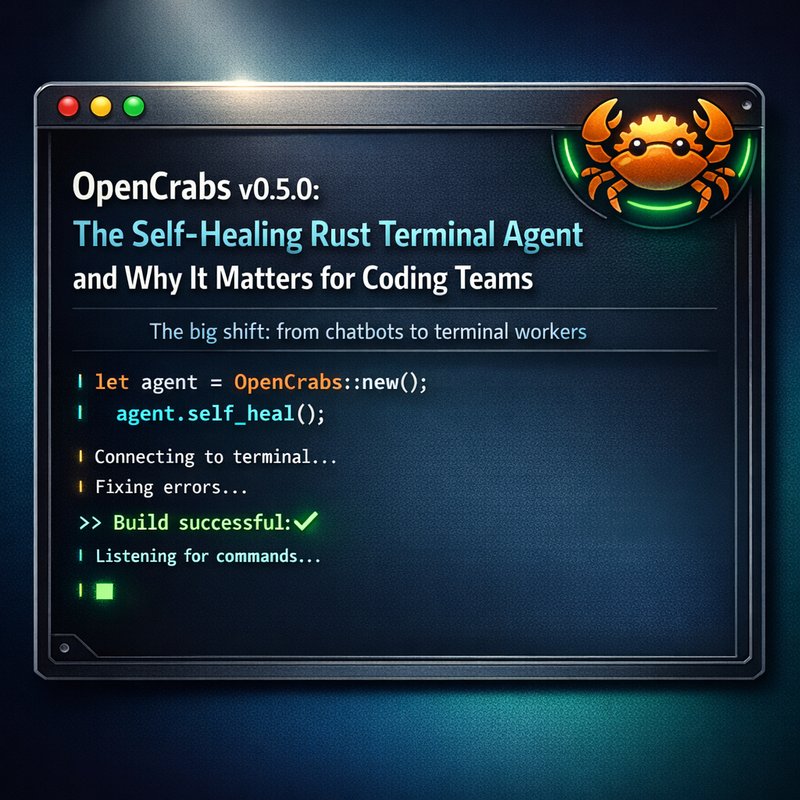
OpenCrabs updates mention improvements that target phantom intents across supported languages. A phantom intent is when the agent detects something that looks like an intention, but it’s really an announcement, a small phrase, or a partial message.
So instead of doing the real task you asked for, the agent starts reacting to a “fake” signal.
Why phantom intent is common
Phantom intent shows up when:
- Messages are short.
- The agent reads tool output and treats it like user intent.
- The agent sees “work started” text and interprets it as a new command.
- Multi-language prompts cause matching rules to behave differently.
It’s also common when your system uses streaming or “edit updates” (for example, Telegram edit flows). The agent may see intermediate versions of the message.
That leads to behavior like:
- “Checking CI status.” then it thinks that phrase is a command on its own.
- An edit partially arrives, and the agent reacts, then the edit completes.
OpenCrabs: the update that targets phantom intent
The OpenCrabs changelog includes fixes like:
- Multilingual phantom self-heal: intent-phrase matching scans all languages at once instead of gating on language detection.
- Brief work announcements are now caught as phantom intents.
- Multi-sentence turn announcements: the agent can announce work and still do the real work in the same turn, with early return behavior so the turn is not flagged as a phantom.
Here’s why this is important for Self-Improving Agents: server-side auto mode and phantom intent:
- “Phantom intent” is not solved only by better reasoning.
- It’s solved by better message handling and better intent detection rules.
- It’s solved by learning what phrases are safe to ignore.
If you want to look at the exact source of these changes, check the OpenCrabs repo:
https://github.com/adolfousier/opencrabs
And the project landing:
https://opencrabs.com
The Hidden Skill: Intent Routing Rules Beat Pure Reasoning
One surprising thing I’ve noticed while reading these updates is that a lot of the quality comes from routing logic, not raw math power.
When people say “the model is smarter,” that can be true. But phantom intent fixes are often about pattern matching and message timing rules.
So the “self-improving” part is really:
- the system learns what patterns are safe,
- the system learns when not to treat text as a command,
- and the system keeps execution stable even when the environment is messy.
This is why Self-Improving Agents: server-side auto mode and phantom intent should be viewed as an engineering problem.
A simple mental model for agent safety
Think of an agent as 4 layers:
- Input handling (did you receive a final message or a partial update?)
- Intent detection (is this phrase a real request or a harmless announcement?)
- Tool selection (which action should run?)
- Execution and feedback (did the tool run correctly?)
Phantom intent fixes live mostly in layer 2 and layer 1.
Server-side auto mode classifier improvements usually strengthen layer 2 and layer 3 (routing).
So together, they reduce “wrong action” incidents.
Temporal Behavior: When “Now” Triggers the Wrong Thing
There’s a second angle here. Many agents run with a timing loop, and short phrases can arrive milliseconds apart.
OpenCrabs also includes fixes related to “settle windows” for Telegram edits. It waits about 2 seconds of edit silence before acting. That’s basically telling the agent:
“Don’t react until the message stops changing.”
That kind of timing control is a hidden guardrail against phantom intent.
Why this matters even outside Telegram
Even if you don’t use Telegram, you have similar risks:
- web sockets sending partial updates,
- streamed tool logs,
- UI frameworks updating text,
- chat platforms that allow edits.
If your agent reads intermediate states, you risk triggering intent detection on fragments.
So if your goal is Self-Improving Agents: server-side auto mode and phantom intent, you should treat “message finalization” as a first-class feature, not an afterthought.
“Reasoning Mode” and Why Long Thought Trees Still Need Guardrails

One search result highlights DeepHermes-3-Mistral-24B-Preview updates. It mentions a “Reasoning Mode” toggled via system prompt, where the agent can use long chains of reasoning enclosed in <think> tags before answering.
That sounds great, right? More reasoning should reduce mistakes.
But here’s the thing. More reasoning can also make it easier for the agent to “overfit” to weird input formats.
So reasoning mode still needs input safety rules:
- detect intent phrases correctly,
- ignore announcements,
- and handle multi-language patterns.
In other words, Self-Improving Agents: server-side auto mode and phantom intent is not “either routing rules or reasoning.” It’s both.
Reasoning decides what to do once intent is correct. Phantom intent fixes decide whether intent is correct in the first place.
Building a Better Self-Improving Loop (Without Breaking Automation)
Now let’s get practical. If you want self-improving behavior, you need a loop that can learn safely without turning every mistake into “future automation.”
A search result notes Hermes Agent integration with a built-in learning loop that creates new skills from repeated tasks. The idea is: if you do the same action pattern enough times, the agent becomes better at it.
That’s powerful. But it’s also risky if the learning loop teaches the agent that phantom actions are valid skills.
What “safe self-improvement” looks like
A safe loop often has these checks:
- Only learn from actions that were confirmed correct by the user or by a deterministic result.
- Don’t learn from short “announcement” messages.
- Log intent classification confidence and route decisions.
- Separate “skill learning” from “tool execution.” Let them have different thresholds.
A simple workflow for a safe learning agent
Try this pattern:
- Run your agent with improved intent detection (phantom intent filters).
- Log every action with:
- detected intent,
- tool selected,
- final result status.
- Only create a new skill when:
- the intent detection matched the “real” user request,
- and the tool output was successful and complete.
- If you can, ask for a quick confirmation the first time.
This way, your self-improving loop becomes a real improvement engine instead of a mistake multiplier.
For Neura’s overall agent ecosystem and how router agents handle different request types, you can also explore Neura’s main hub:
https://meetneura.ai
And if you want to see how Neura case studies are structured, browse:
https://blog.meetneura.ai/#case-studies
Putting It Together: A Checklist for Deploying These Ideas
If you are building or deploying an agent, you can use this checklist to reduce chaos and improve execution quality.
Intent and auto mode
- If you use auto mode, ask: is classification local or server-side?
- If classification is local, estimate token overhead and routing consistency.
- If classification is server-side, verify audit logs so you can debug misroutes.
Phantom intent handling
- Add explicit filters for “work started” announcements.
- Detect multi-sentence patterns where the first sentence is an announcement, and the next sentence contains the real job.
- Scan all supported languages for intent phrase matching (instead of gating on language detection) when you use multilingual commands.
Temporal stability
- Wait for message edit streams to settle before acting.
- Treat partial tool outputs as non-intent unless marked final.
- If your chat platform supports edits, store the final message version.
Learning loop safety
- Learn only from confirmed correct actions.
- Don’t allow “announcement phrases” to seed new skills.
- Separate thresholds for learning vs execution.
This checklist is what turns Self-Improving Agents: server-side auto mode and phantom intent from theory into stable automation.
Real Example Scenarios (Because This Happens Daily)
Let’s make phantom intent feel less abstract.
Scenario 1: The “Checking now” trap
You type:
- “Checking CI status.”
Your agent should reply with results or run a check.
But sometimes streaming behavior makes the chat system send “Checking CI status” and later sends “Now run the tests.” If intent detection triggers at the first phrase, the agent might:
- start the wrong tool,
- or stop because it thinks your message is just informational.
OpenCrabs updates describe changes to catch brief work announcements as phantom intents and handle multi-sentence turns.
That is exactly the kind of fix you want in your pipeline.
Scenario 2: Multi-language quick commands
You type a short command in another language.
Intent phrases might match in one language but not others if your system gates by language detection.
OpenCrabs mentions multilingual phantom self-heal that scans all languages at once. That reduces mismatch failures.
So your intent detection becomes less fragile.
Scenario 3: Auto mode misroutes a “next step”
In auto mode, you might type:
- “Auto run it.”
- “Next action.”
If classification is expensive or inconsistent, the agent might classify too broadly and choose a tool you did not mean.
Moving classification server-side can help because it can standardize routing.
The Counter-Argument: More Guards Can Slow Agents Down
You might wonder: do phantom intent filters and settle windows make agents slower?
Sometimes yes.
But there’s a tradeoff. In automation, it’s usually better to be slightly slower and correct than fast and wrong.
False tool calls waste time, confuse your logs, and can create real operational risks.
So the goal is not “remove all latency.” The goal is “reduce wrong triggers.”
That makes Self-Improving Agents: server-side auto mode and phantom intent a reliability win.
Conclusion: Self-Improving Agents Need Better Routing and Better Timing
The biggest takeaway from recent updates is that self-improving agents are not just about smarter models.
They improve when:
- “auto mode” classifies requests more reliably, sometimes using server-side classifiers to reduce token overhead,
- phantom intent detection gets better, especially across languages and multi-sentence announcements,
- and temporal stability prevents agents from reacting to partial message edits.
If you remember one thing, make it this: Self-Improving Agents: server-side auto mode and phantom intent is where real-world quality starts. The less your system guesses, the more it can safely learn.
And if you’re shipping agents to users, focus on input hygiene, intent routing, and safe learning first. That’s where the biggest gains usually show up.