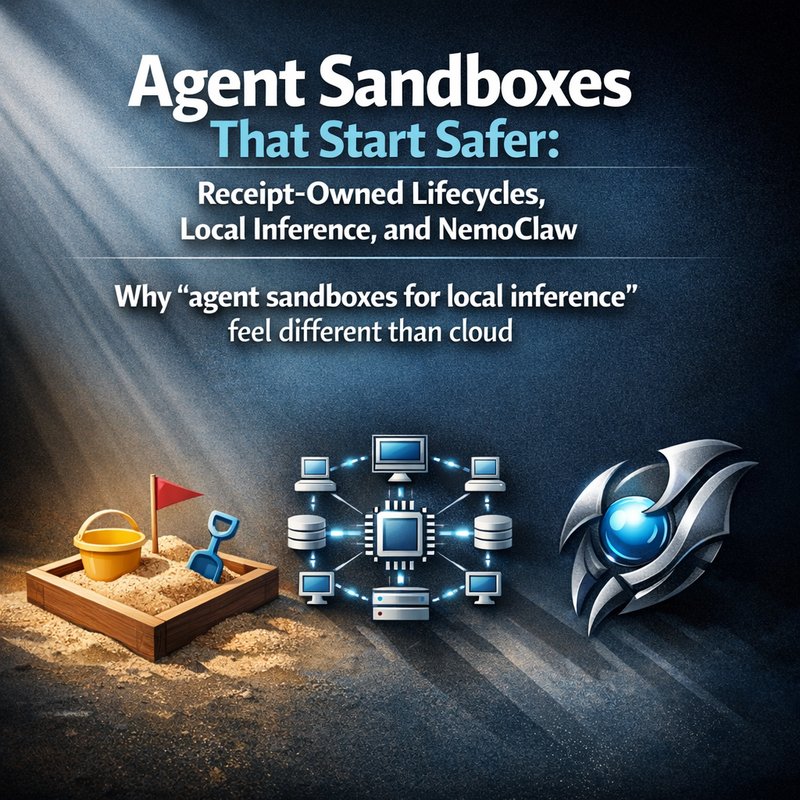
If you build AI agents that run on your own machine, you already know the scary part. One bad setup and your agent grabs the wrong permissions, leaks data, or runs in an unsafe environment. That’s why the big idea behind agent sandboxes for local inference matters so much: it changes how the agent lifecycle is owned, started, and routed. Recent work like NVIDIA’s NemoClaw pushes a new safety model using a receipt-owned lifecycle authority, so sandboxes start in a controlled way and inference routing is less chaotic.
This article is a practical, developer-friendly guide to agent sandboxes for local inference and what you can copy into your own agent systems. We’ll use the NemoClaw approach as the main reference, then go step-by-step through a sandbox design you can implement: identity, lifecycle ownership, routing backends, permissions, and safe teardown. I’ll keep it simple, with real checklists you can use during implementation.
Why “agent sandboxes for local inference” feel different than cloud
Cloud agent platforms already try to separate customers, requests, and tools. But local inference is different. You are often running:
- On a developer laptop
- In a private server room
- Inside client networks with strict rules
- With your own keys, tokens, and file access
So the pressure is on. When an agent runs locally, you need to answer these questions fast:
- Who is allowed to create the sandbox?
- Who is allowed to route requests to a model provider?
- What permissions does the agent have inside the sandbox?
- How do you ensure the sandbox gets cleaned up even after failures?
That’s where agent sandboxes for local inference start to become more than “nice isolation.” They become the backbone of safety.
NVIDIA’s NemoClaw describes a receipt-owned lifecycle authority concept that manages agent sandboxes and improves local-inference onboarding by tightening how the routing and sandbox lifecycle connect to an authority. The source is here: https://github.com/NVIDIA/NemoClaw
Agent sandboxes for local inference are still evolving. But the direction is clear: lifecycle should be owned and verifiable, not “best effort.”
The core concept: receipt-owned lifecycle authority
Let’s translate the name into normal language.
A “receipt” is basically proof. Proof that a specific request, job, or agent run was issued by the system in the first place.
A “lifecycle authority” is who decides the sandbox rules during the whole run. Not just at creation time, but across the entire lifecycle: start, run, tool calls, model routing decisions, and teardown.
If you build agent sandboxes for local inference, the common failure mode looks like this:
- The sandbox starts.
- The agent decides it needs a different model or a different provider.
- Routing happens using a loose permission check.
- The agent ends up calling something outside its intended scope.
The receipt-owned lifecycle authority idea tries to close that gap. A sandbox run gets tied to a lifecycle owner identity using a receipt, so provider routing and execution stay aligned with the same authority.
You can think of it like this:
- The sandbox is not just a container.
- It’s a contract between “who allowed the run” and “what the agent is allowed to do.”
Source again: https://github.com/NVIDIA/NemoClaw
What “receipt-owned” improves for local agents
If you’re skeptical, fair. “Receipt-owned” might sound like architecture marketing. So here are the concrete improvements you should expect from agent sandboxes for local inference systems that use lifecycle authority patterns.
1) Safer sandbox identity across reroutes
Local setups often switch between:
- CPU and GPU
- Different model sizes
- Different providers or runtimes
- Different versions of the same model
With agent sandboxes for local inference, reroutes can break safety assumptions. Receipt-owned lifecycle authority forces reroutes to remain inside the same lifecycle permission envelope.
2) Less “first-time setup chaos”
Local onboarding usually breaks because people miss one detail:
- a missing config
- wrong permissions
- keys loaded in the wrong place
- inconsistent sandbox defaults
When lifecycle authority is built into the process, the sandbox can be created with the right security posture every time, not “only when the dev remembers.”
3) Better audit trails
Even if you never build a full compliance system, you can log receipts and lifecycle decisions. That helps debugging.
When something goes wrong, you can answer:
- Which authority started this sandbox?
- Which routing decisions were allowed?
- Did the sandbox teardown happen?
These are practical audit questions, not theoretical ones.
A step-by-step sandbox design you can implement
Now let’s build a design you can use. This is not meant to copy NemoClaw perfectly. It’s meant to give you a buildable blueprint for agent sandboxes for local inference that matches the same safety direction.
Step 1: Define a Run Receipt object
Create a receipt record for every agent execution “run.” It should include:
- run_id (unique)
- lifecycle_owner_id (who allowed it)
- allowed_actions (tool permissions, file paths, network access)
- allowed_model_routes (which providers or model endpoints are allowed)
- expiry_time (how long it’s valid)
- guidance_version (which policy set was used)
When your agent tries to do something, it must include the run receipt reference. Your sandbox runtime validates it.
Step 2: Bind the receipt to the sandbox at creation time
At sandbox creation:
- Generate sandbox_id
- Store sandbox_id and run_id mapping
- Store a sandbox session policy derived from the receipt
This binding matters. Without it, you might accidentally reuse a sandbox for a run that has different allowed actions.
Step 3: Enforce permissions on every tool call
Agent tool calls are where things go wrong. So create a single enforcement layer.
For local inference, typical tools include:
- file read/write
- executing commands
- calling web APIs
- accessing a database
- sending outgoing messages
Your sandbox runtime should check:
- Does the receipt allow this tool?
- Is the target resource within allowed scope?
- Is the run receipt still valid (not expired)?
Step 4: Enforce routing rules for model providers
In many agent stacks, routing happens inside the agent. That’s dangerous.
Instead, make routing a managed step:
- The agent requests a “model choice” or “provider”
- The runtime checks if that route exists in receipt.allowd_model_routes
- Then it executes routing inside the sandbox
This is the heart of agent sandboxes for local inference: routing stay tied to lifecycle authority, not to agent trust.
Step 5: Guarantee teardown with a finalizer
Finally, cleanup. People underestimate teardown until something leaks.
Add:
- a timeout kill switch
- a cleanup finalizer that runs even after errors
- deletion of temp files and cached secrets

Log:
- teardown_status
- duration
- last tool call id
- model route used
So when you debug later, agent sandboxes for local inference are visible, not mysterious.
A simple local reference architecture (easy mental model)
Here’s a clean mental model for building this.
Components
- Agent Client
- Run Receipt Service (or module)
- Sandbox Runtime
- Tool Executor
- Model Router Gate (enforces receipt)
- Logger/Audit Store
Flow
- Client asks for a run.
- Receipt service issues run receipt and allowed policy.
- Sandbox runtime creates sandbox bound to receipt.
- Agent runs inside sandbox.
- Every tool call and model routing request goes through enforcement checks tied to receipt.
- Sandbox runtime tears down on completion or failure.
This architecture makes agent sandboxes for local inference predictable.
Practical checklist for developers building safe local agents
Use this when you’re designing your agent sandboxes for local inference feature. Try to answer yes to most items.
Sandbox + lifecycle ownership
- Do you have a run receipt or equivalent proof token?
- Does the sandbox runtime bind itself to the receipt at creation?
- Are lifecycle decisions logged by run_id and sandbox_id?
Permissions
- Are tool permissions explicit instead of “whatever the process can do”?
- Are file operations scoped by allowed paths?
- Is network access blocked by default?
Routing safety
- Is provider routing enforced by the runtime, not by the agent?
- Can the agent request routes it is not allowed to use?
- Do you log provider route decisions?
Failure + cleanup
- Does teardown always run even if the agent crashes?
- Do you delete temp files and cached secrets?
- Do you have timeouts and a kill switch?
Observability
- Can you trace a tool call to a receipt?
- Can you trace a model route to a receipt?
- Do you store enough metadata to replay failures safely?
If you can check these boxes, your agent sandboxes for local inference will be much harder to break.
Common mistakes (and how to avoid them)
Let’s be honest. Teams do these things a lot, especially when moving fast.
Mistake 1: “We trust the agent to route correctly”
Don’t. Agents should request things, but the runtime should decide. If you let the agent choose providers freely, safety breaks the moment a prompt changes.
Mistake 2: Putting secrets directly in the sandbox
If the sandbox process can read keys, a bug in the agent can expose them.
Instead, scope secrets:
- minimal secrets per run
- read-only where possible
- short-lived where possible
- never log secrets
Mistake 3: Logging everything including tool inputs
Tool inputs can include file paths, tokens, or private data.
Log metadata, not raw secrets.
Mistake 4: Reusing sandboxes across runs
Reusing a sandbox breaks your assumptions about lifecycle decisions.
For agent sandboxes for local inference, treat each run as its own world.
Where NemoClaw fits into real-world developer work
NemoClaw is useful because it points at a safety direction for local inference onboarding. The repository is the best starting point: https://github.com/NVIDIA/NemoClaw
The concept is not only academic. Developers want:
- less fragile setup
- clearer permission boundaries
- smoother local inference switching
Receipt-owned lifecycle authority aims to do exactly that by connecting sandbox lifecycle and routing decisions under a single authority concept.
If you’re building local agent sandboxes for local inference, this is the kind of design you want to learn from even if you implement it differently.
How to test your sandbox safety (without guesswork)
Testing is where most “safety” plans get proven or disproven.
Test 1: Tool permission tests
Try these scenarios:
- agent tries to read a disallowed file
- agent tries to run a shell command outside allowed commands
- agent tries to call a web API without network permission
Expected: tool calls fail inside sandbox with a clear error tied to receipt_id.
Test 2: Routing rejection tests
Try:
- agent requests an unapproved model provider
- agent requests a route not in allowed_model_routes
- agent tries to route after receipt expiry
Expected: routing request denied and logged.
Test 3: Teardown tests
Try:
- kill the agent mid-run
- force a tool error
- force a routing error
Expected: sandbox cleanup still happens, and temp directories are removed.
If your agent sandboxes for local inference pass these tests, you’ll sleep better.
Conclusion: receipt-owned sandboxes are the next safety baseline for local agents
The push toward agent sandboxes for local inference is not just about “running locally.” It’s about running safely and predictably, even when routing and tools change during a run. The receipt-owned lifecycle authority idea in NVIDIA’s NemoClaw gives a strong direction: tie sandbox lifecycle to a verifiable authority, then enforce both tool permissions and model routing from that same authority.
If you’re building agent systems now, don’t treat sandboxing as a one-time container setup. Treat it like a lifecycle contract. That’s the real shift.
For more Neura updates and agent workflow ideas, you can browse https://meetneura.ai and see how teams think about routing and automation in practice at https://meetneura.ai/products.