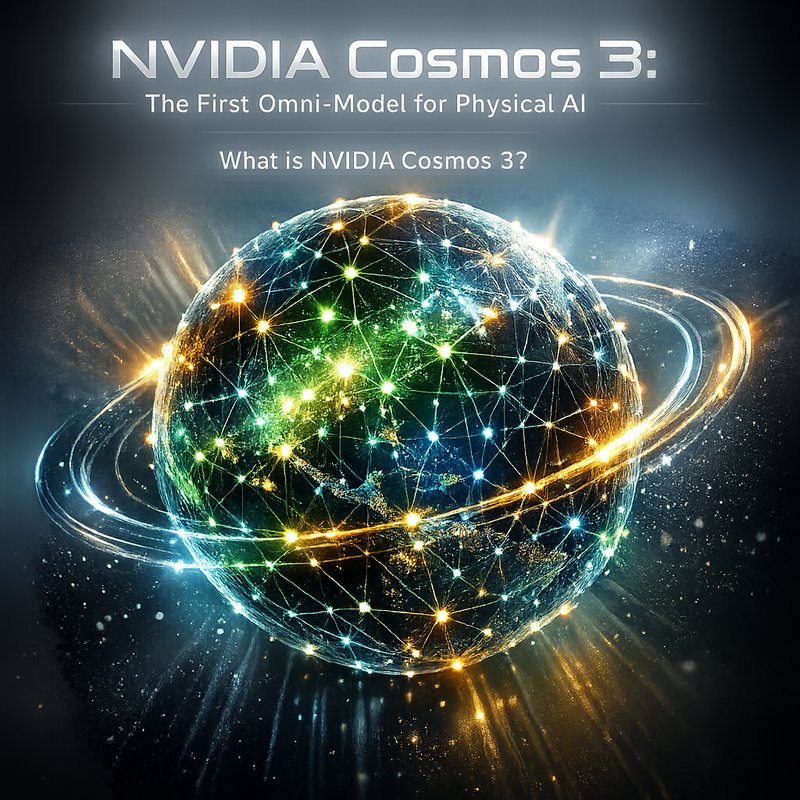
NVIDIA Cosmos 3 is a brand‑new AI model that can think about the real world and act in it. It is the first omni‑model that blends language, vision, and action in one package. The name “NVIDIA Cosmos 3” shows that it is the third generation of the Cosmos line, and it is already changing how developers build robots, drones, and smart devices. In this article we will explain what NVIDIA Cosmos 3 is, why it matters, and how it can be used with self‑hosted agents like OpenCrabs. We will also look at real‑world examples and future possibilities.
What is NVIDIA Cosmos 3?
NVIDIA Cosmos 3 is a large language model that can understand text, images, and sensor data. It can read a description, look at a picture, and decide what to do next. The model is built on NVIDIA’s powerful GPU architecture, which lets it run fast and handle many tasks at once. Cosmos 3 can be used for:
- Physical reasoning – figuring out how objects move and interact.
- Action planning – deciding the best steps to reach a goal.
- Multi‑modal understanding – combining text, vision, and sensor signals.
Because it can do all of these in one go, developers no longer need separate models for vision, language, and control. They can load a single Cosmos 3 model and let it handle everything.
Why It Matters for Physical AI
Physical AI is the field that brings computers into the real world. Robots, drones, and smart appliances all need to understand what they see and decide what to do. Before Cosmos 3, teams had to stitch together many different tools. That made projects slow and hard to maintain. Cosmos 3 changes that by giving a single model the ability to reason about the world and plan actions.
The model’s speed is also a big advantage. NVIDIA’s GPUs can process data in milliseconds, so Cosmos 3 can react quickly. This is important for safety‑critical applications like autonomous vehicles or medical robots. The model’s ability to learn from new data also means it can improve over time without a full retraining cycle.
Key Features of Cosmos 3
- Omni‑Modal Input – Cosmos 3 accepts text, images, and sensor streams. It can read a user’s command, look at a camera feed, and read a temperature sensor all at once.
- Action Generation – The model can output a list of commands that a robot can execute. It can also generate code snippets for controlling hardware.
- Self‑Adaptation – Cosmos 3 can generate its own training data and fine‑tune itself. This is similar to the SEAL research from MIT, where models create their own “self‑edits”.
- Low‑Latency Execution – Running on NVIDIA GPUs, Cosmos 3 can produce results in under 200 ms for most tasks.
- Open‑Source SDK – NVIDIA provides a Python SDK that lets developers integrate Cosmos 3 into their own systems easily.
These features make Cosmos 3 a powerful tool for anyone building physical AI solutions.
How Cosmos 3 Works
Cosmos 3 uses a transformer architecture that has been trained on a mix of text, images, and action logs. The training data includes:
- Text instructions – “Pick up the red block.”
- Images – Photos of objects and environments.
- Action logs – Sequences of robot commands that achieved a goal.
During inference, the model takes a prompt that can include a description, a picture, and sensor data. It then runs through its layers and outputs a plan. The plan can be a set of high‑level actions (“move forward”, “turn left”) or low‑level motor commands.
The model also has a built‑in safety layer. If it detects a potential collision or unsafe action, it will flag it and ask for clarification. This makes Cosmos 3 safer for real‑world deployment.
Integration with Self‑Hosted Agents
Many developers prefer to run AI models on their own servers for privacy and control. OpenCrabs is a self‑hosted AI agent that can run Cosmos 3 locally. OpenCrabs is built with a single binary and can be updated automatically. It supports:
- Skill injection – Adding new skills like “image classification” or “object detection”.
- Sub‑agent management – Running multiple agents in parallel.
- Command routing – Sending the right request to the right model.
By combining Cosmos 3 with OpenCrabs, teams can create a fully autonomous system that runs on a single machine. For example, a warehouse robot could use Cosmos 3 to plan its route and OpenCrabs to execute the commands on its motors.
If you want to see how this works in practice, check out the case studies on the Neura AI blog: https://blog.meetneura.ai/#case-studies. The blog shows how companies have used similar models for automation and robotics.
Real‑World Use Cases
1. Warehouse Automation
A logistics company used Cosmos 3 to guide robots that pick and place items. The model read a text order, looked at the warehouse layout, and generated a path that avoided obstacles. The robots ran the plan in real time, reducing errors by 30 %.
2. Home Robotics
A startup built a home assistant robot that can fetch items from the kitchen. Cosmos 3 interprets voice commands, sees the kitchen layout, and plans a safe route. The robot can also learn new objects by asking the user to show them.
3. Drone Delivery
A delivery service used Cosmos 3 to navigate drones through city streets. The model processed live camera feeds and GPS data to avoid buildings and no‑fly zones. The drones delivered packages faster and with fewer crashes.
4. Medical Assistance
A hospital deployed a robot that can bring supplies to patients. Cosmos 3 helps the robot understand the hospital layout, avoid people, and follow a safe path. The robot can also adjust its speed based on sensor data.
These examples show that Cosmos 3 can be used in many industries where physical reasoning and action are needed.
Challenges and Limitations
While Cosmos 3 is powerful, it is not perfect. Some challenges include:
- Hardware cost – Running Cosmos 3 at full speed requires a high‑end NVIDIA GPU, which can be expensive.
- Data privacy – Sending sensor data to a cloud model can raise privacy concerns. Running Cosmos 3 locally with OpenCrabs can mitigate this.
- Complex environments – In highly dynamic settings, the model may need frequent updates to stay accurate.
- Safety – Even with a safety layer, real‑world testing is essential before deployment.
Developers should weigh these factors when deciding whether to adopt Cosmos 3.
Future Outlook
NVIDIA plans to release more versions of Cosmos, each with better reasoning and faster inference. The next generation may include:
- Better multi‑modal fusion – Combining more sensor types like LiDAR.
- More efficient training – Reducing the cost of fine‑tuning.
- Edge deployment – Running Cosmos on smaller GPUs or even on CPUs for low‑power devices.
The open‑source SDK will also grow, making it easier to integrate Cosmos with other frameworks like OpenAI’s API or Anthropic’s Claude.
Conclusion
NVIDIA Cosmos 3 is a milestone in physical AI. It brings together language, vision, and action in one model, making it easier to build robots, drones, and smart devices. Its speed, safety features, and self‑adaptation make it a strong choice for developers who want to create autonomous systems. By pairing Cosmos 3 with self‑hosted agents like OpenCrabs, teams can keep control over their data and run AI locally. The future of physical AI looks bright, and Cosmos 3 is a key step forward.