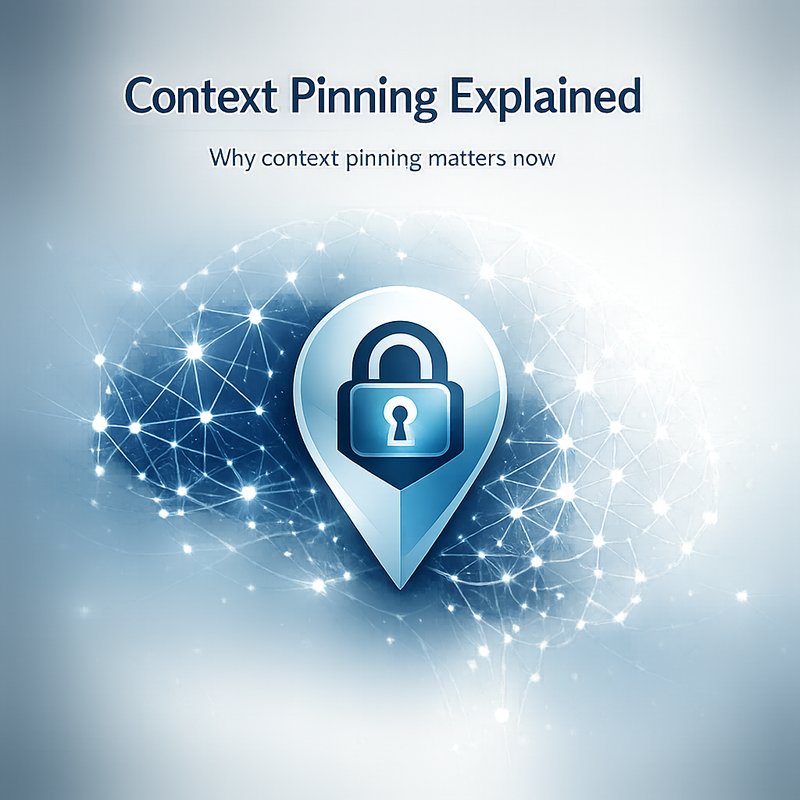
Context pinning is a simple idea that cuts cost and keeps large prompts ready for fast reuse.
Context pinning means you store a big system prompt or a long block of context once, then reuse it across multiple calls without resending it every time. Context pinning works well when you have long prompts, session memory, or many small AI calls that share the same background info.
In this article I will explain what context pinning is, why it matters, how to add it to your apps, and real use cases you can try today. I will also show how this idea fits with new agent tools, browser models, and self hosted agents like OpenCrabs.
Why context pinning matters now
Large models can take a lot of tokens to read and write.
If your app sends a 50k token system prompt every time a user asks a question, you pay for those tokens again and again. That gets expensive fast.
Context pinning keeps that long prompt on the server or session layer so you only send the small user message each time. That saves money and often cuts latency.
Big recent moves in the field show why this is important.
- New services like Stormap offer native session pinning so developers can pin huge prompts and cut costs by about 90%. You can read about that on stormap.ai.
- Agent platforms, like Hermes Agent and other open source agents, are handling huge token loads daily. Having pinned context helps them manage costs and scale. See Hermes Agent reporting on Medium and community updates.
- On-device models such as Google Chrome’s Gemini Nano change where and how you keep context. When the model runs locally, pinning designs shift from cloud sessions to local stores. CNET covered Gemini Nano shipping to Chrome as an example.
Context pinning is a new basic skill for developers building long context apps, agent systems, or products that use big system prompts.
How context pinning works in plain terms
Here is a simple model.
- App boots up a session for a user or a task.
- App uploads or stores a large system prompt, knowledge base, or memory block in that session.
- Session gives you a short session token or pin ID.
- Later, when you call the model, you send the small user message and the pin ID.
- The LLM provider or your middleware fetches the pinned context and prepends it, without your app resending it.
That means your app only sends 10 to 100 tokens per call, while the model still sees the full context.
Some providers expose this as native session pinning. Others let you build it in your own router or gateway.
Types of context pinning
There are a few common ways to pin context.
- Session pin on the server: store the long prompt in memory or a fast cache and reference it by ID for calls.
- User-level persistent pin: the pinned context follows a user across sessions for long-term personalization.
- Task-level pin: pin context per task or workflow, like an onboarding flow or a long form review.
- On-device pin: store the context securely on device and attach it to local model calls.
Each type fits different use cases. Session-level pinning is simple and great for chatbots. User-level is for personal assistants. On-device is for privacy or offline apps.
Where context pinning fits with agents and long context models
Agent systems often need large, consistent views of the task.
If an agent runs with many tools, instructions, and safety rules, that is a lot of text to keep sending. Context pinning lets the agent access those rules without extra token cost.
Recent agent updates show this in action.
- Hermes Agent and similar agent frameworks are processing very large token volumes. Pinned prompts let them scale without huge cost increases. See Hermes Agent’s usage reports on Medium.
- Open source agents like OpenCrabs are adding session and memory features that benefit from pinned prompts. Check OpenCrabs releases and changelog for memory and provider updates on GitHub.
- Workflow tools such as n8n now validate prompts and add tool-level gates to prevent wasted calls. That makes pinning more useful because you are not sending bad prompts repeatedly. See the n8n update on GitHub.
Pinning is an enabler for practical agent systems. It works well with tools that route requests, apply safety gates, or keep local reasoning state.
How to design a context pinning system
Here is a step by step plan you can follow.
-
Identify what to pin.
- System prompts, instruction sets, policy text.
- Knowledge snippets like product catalogs or user profiles.
- Safety checks and tool descriptions.
-
Choose a storage mode.
- Short lived session cache for chat sessions.
- Indexed storage for reuse across users.
- Local device store for on-device models.
-
Create a pin API.
- POST /pins to create a pin with metadata.
- GET /pins/{id} to fetch the pinned content server side.
- DELETE /pins/{id} if you want to expire pins.
-
Make your router attach pins.
- When your app asks the model, send pin ID instead of full text.
- Router fetches pinned text and composes the final prompt.
- Send the combined prompt to the model.
-
Add versioning and compaction.
- Store pin versions so you can update instructions safely.
- Compress or chunk very large pins.
-
Audit and log.
- Track pin usage so you know which pins drive cost.
- Remove unused pins.
This approach works whether you call a cloud LLM or a local model.
Example: simple pin API flow
This is high level so it is easy to follow.
- Client creates a long system prompt and posts it to /pins.
- Server stores it in a cache and returns pin_id = abc123.
- Client sends user message with pin_id abc123.
- Router does GET /pins/abc123, prepends pinned prompt to user message, and calls LLM.
- LLM returns answer. Router returns answer to client.
That way, the client never sends the 50k token prompt again.
Cost and latency gains
Pinning changes your cost math.
- Without pinning: you pay for full tokens on each call.
- With pinning: you pay once to store the pin and then only for user tokens on each call, plus the model reads the pinned tokens but many providers charge less or offer session features to avoid duplicate billing.
Some startups report up to 90 percent cost reduction when pinning huge prompts. For teams running many small calls that share the same background, these savings add up fast.
Pinning also helps with latency because your app sends less data and the router can use faster in-memory stores.
Security and privacy notes
Pinning stores large prompts that may include private info.
- Encrypt pinned content at rest if it includes sensitive data.
- Use access controls so only the right sessions or services can fetch a pin.
- If you pin user personal data, respect privacy rules and let users revoke pins.
- For on-device pinning, use secure storage and clear pins when the app logs out.
Treat pins like any other cached secret. Follow good security hygiene.

Real tools and trends to watch
A few new tools and releases show how this practice is spreading.
- Stormap has introduced native pinning to save costs for massive prompts. Visit stormap.ai to learn more.
- Agent platforms are scaling with pinned context. Hermes Agent’s growth is covered on Medium.
- OpenCrabs is adding memory and provider features that make pinning practical on self-hosted agents. See updates at the OpenCrabs GitHub repo.
- Browser models like Chrome’s Gemini Nano change some assumptions because models run locally. Read about Gemini Nano on CNET.
- New multimodal models such as Lance from Bytedance show how big models will need efficient context handling for images and video as well. See Lance on Hugging Face.
If you build agents or apps, watch these tools and plan for pinning.
Integration tips with common stacks
A few concrete tips for popular setups.
-
If you use a router or gateway like Neura Router, add a pins service that maps pin_id to text and hooks into the router before calling the model.
- See Neura Router for idea of how a router handles many models: https://router.meetneura.ai
-
If you have many models, use a provider mapping so pins only contain tokens the target model understands.
- Some providers support session objects natively; others need middleware.
-
If you run self-hosted agents like OpenCrabs, choose the FTS5-only memory mode when disk or RAM is tight, and use pinning for large prompts that do not need vector search.
- Check OpenCrabs updates on GitHub for memory modes and provider changes.
-
If you use content generation tools, create templates for pinned prompts so you can update them without touching each client.
-
If your app needs search over pinned knowledge, create small vector indexes and keep the full text as a pinned blob for the model to read when needed.
Sample developer checklist
- Decide what to pin.
- Pick storage: in memory, cache, or database.
- Create pin lifecycle rules and TTL.
- Make a pin API with secure auth.
- Add router logic to resolve pins at call time.
- Add logging and cost tracking.
- Test with real usage patterns and size limits.
- Add UI controls for ops to inspect and update pins.
Use cases that benefit most
- Customer support agents that use a long product manual.
- Legal or compliance agents that must include long safe operation rules.
- Tutors and study guides where each lesson has large background text.
- Enterprise assistants that need to include company policies and custom data.
- Agents that control tools and need shared tool descriptions.
On-device models and pinning
On-device models like Gemini Nano change the model location but not the need for context.
- When a model runs on device, pinning moves to local storage.
- You can store the pinned prompt in a small local database and reuse it for calls.
- Local pinning reduces cloud cost and can improve privacy.
Make sure to encrypt and manage device storage and to avoid putting extremely sensitive secrets into pinned text without user control.
Common pitfalls and how to avoid them
- Pinning stale content: add versioning and TTL so you do not keep old instructions.
- Letting pins grow unbounded: compress, chunk, or archive old pins.
- Over-pinning small things: pins work best for large, shared text.
- Security leaks: audit who can read pins and what they contain.
How pinning fits with memory and embeddings
Pinning and memory solve different problems.
- Pinning holds the full text so the model can read it directly.
- Embeddings let you search and retrieve smaller passages.
Use both: use embeddings to find short relevant chunks and a pinned block for base instructions. This reduces prompt size while keeping consistent rules.
OpenCrabs and other tools now support mixing embedding modes and FTS5-only modes so you can adapt to host limits. See OpenCrabs changelog on GitHub.
Practical example: support agent flow
- Create pin with product manual and safety rules.
- On each user chat, retrieve top embeddings for the user question.
- Attach pin ID and the small retrieved passage to the user message.
- Router composes final prompt: pinned manual + retrieved passage + user query.
- Model answers with the full context in place.
This keeps the heavy manual pinned and only sends small retrieved passages per question.
How to measure success
Key metrics to track.
- Token cost per user session.
- Average latency per call.
- Pin hit rate: how often a call used a pin vs bypassed it.
- Storage cost for pins.
- Error rate changes after pin updates.
Track before and after pinning to show cost savings.
Where to learn more
- Stormap native session pinning notes on stormap.ai show how providers are adding first class support.
- Hermes Agent reports and analysis on Medium show agent scale patterns.
- OpenCrabs changelog on GitHub shows self-hosted agent memory and provider work.
- Neura Router and other routing tools show how to connect many models and pins: https://router.meetneura.ai
- Neura ACE can help generate content and flow templates for pinned prompts: https://ace.meetneura.ai
Final checklist before you launch
- Do you know what text you will pin?
- Do you have a secure store for pins?
- Do you test pin updates and versioning?
- Is the router able to fetch pins quickly?
- Are logs in place to track pin usage and cost?
- Did you add a way to expire or delete pins?
If yes, you are ready to adopt context pinning and save tokens.
Conclusion
Context pinning is an easy change that gives big wins when you work with long prompts or agent systems.
It saves cost, reduces latency, and keeps your app workflow simple.
If you build agents, run many small calls, or need consistent instructions across many requests, try context pinning today.
You can start small with a pinned system prompt per session and expand to user pins or task pins as you learn what works.
Use secure storage, add versioning, and measure cost savings.
Context pinning is a practical tool for better long context apps.