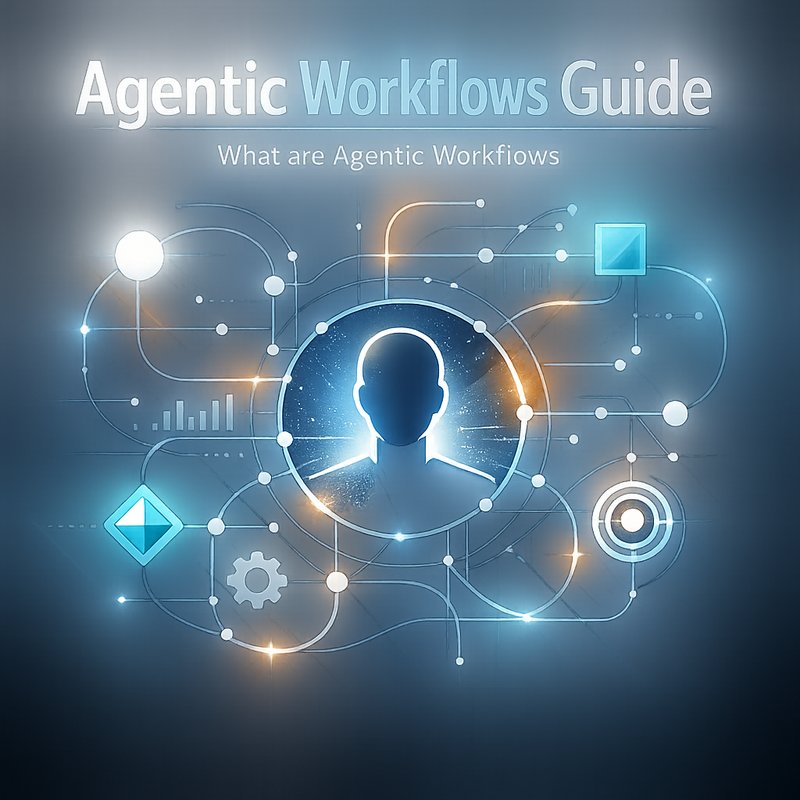
Agentic Workflows are changing how teams get work done with AI agents.
This article explains what Agentic Workflows are, why they matter, and how to build them step by step.
You will get practical tips, tool suggestions, and real use cases.
We will keep things simple and clear so you can put ideas into action fast.
What are Agentic Workflows
Agentic Workflows are chains of small AI agents that work together to finish a task.
Each agent has a job, like reading a document, calling an API, or testing an app.
Agents pass results to each other until the work is done.
Think of them like a team where each person has a clear role.
Agentic Workflows make complex jobs easier.
They can work without a person watching every step.
That means faster results and fewer mistakes for routine tasks.
You might already use single agents inside tools, but Agentic Workflows link many agents to handle bigger jobs.
Why Agentic Workflows matter now
Agentic Workflows are getting big this month.
New models like GPT-5.5 and tools such as Hermes Agent and OpenCrabs are helping teams run more powerful agent chains.
Companies use Agentic Workflows for things like building regulation checks and automated testing.
This is happening because models have larger context windows and better tool use.
That combination makes agent chains reliable and useful for real work.
People want faster ways to build apps.
Vibe Coding tools let you create apps by chatting.
Agentic Workflows can run pieces of those apps on their own.
That makes it possible to build, test, and ship features faster.
Key parts of an Agentic Workflow
Agentic Workflows need clear parts to work well.
Here are the main parts and why each matters.
- Agent
- A small AI program with a clear task.
- Example: a browser agent that fills out a form.
- Orchestrator
- The director that runs agents in order.
- It handles retries and errors.
- Tools
- APIs, browser control, code runners, or databases agents use.
- Memory
- Where the workflow stores facts and past results.
- This helps agents pick up where others left off.
- Observability
- Logs and metrics to see what happened and why.
- Helps debug failures and improve performance.
- Governance
- Rules about what agents can and cannot do.
- This keeps systems safe for users and company data.
Real examples of Agentic Workflows today
Here are some real world uses to spark ideas.
-
Building regulation checks
- Contractors use agents to read plans, check rules, and mark issues automatically.
- This can cut inspection time from days to hours.
- Source examples include recent news about this use on industry sites.
-
Autonomous web tasks
- Google released a local Chrome agent that can navigate pages and run JavaScript.
- This makes it easier to automate form filling and data collection without sending everything to the cloud.
-
App creation with Vibe Coding
- Tools like Anything, Rork, and Vibecode let users write apps by chat.
- Agentic Workflows can run testing, packaging, and deployment steps automatically.
-
Content production
- A group of agents can research, draft, edit, and publish an article.
- Each agent focuses on a single step and hands off results.
How to design an Agentic Workflow
Designing a workflow takes a few clear steps.
Here is a simple plan you can follow.
- Define the goal
- Be specific about the task and the desired output.
- Example: "Find missing fields in permit applications and produce a report."
- Break the work into agents
- Decide small steps like fetch, parse, check rules, and summarize.
- Keep each agent narrow and testable.
- Choose tools and models
- Pick a language model and tool APIs.
- Consider speed, cost, and privacy.
- You might use GPT-5.5 for reasoning and a local browser agent for scraping.
- Build memory and state
- Use a simple store for facts, logs, and context.
- This helps agents avoid repeating work.
- Create an orchestrator
- The orchestrator runs agents in order and handles retries.
- It should log actions and decisions.
- Add safety rules
- Limit what agents can access or execute.
- Use a governance layer like the new Agent Control Standard for runtime checks.
- Test with small data
- Start with a small batch of tasks.
- Fix issues before scaling.
- Monitor and improve
- Collect logs and user feedback.
- Tune prompts, adjust agents, and add checks as needed.
Tools and platforms to build Agentic Workflows
You can use many tools to build workflows.
Pick what matches your needs and skills.
-
Models
- GPT-5.5 for long context and better tool use.
- Gemini 3.5 Flash for fast responses.
- Choose model by cost, speed, and safety features.
-
Agents and frameworks
- Hermes Agent and OpenClaw are popular hosted agents.
- OpenCrabs is a self-hosted option you can run locally. See the OpenCrabs GitHub for details.
- Koog is a new framework for building agents in Kotlin and Java.
-
Local browser automation
- Google Browser Use AI shows local browser agents that do tasks without heavy cloud calls.
-
Observability and telemetry
- Use OpenTelemetry and simple logging to trace actions.
- Koog includes OpenTelemetry support out of the box.
-
Self-hosted tools
- OpenCrabs offers multi-profile support so you can separate sessions and memory.
- Self-hosting can reduce cloud costs and keep sensitive data local.
-
Enterprise governance
- Agent Control Standard is a new open framework that helps keep agents from doing unauthorized actions.
- Use that or a similar guardrail for serious deployments.
How Neura fits into Agentic Workflows
Neura AI has a set of router agents that can help build and run Agentic Workflows.
If you use Neura, these pieces can speed adoption.
-
Router Agents
- Route requests to the right tool or model based on intent.
- This is helpful for multi-agent orchestration.
-
App integrations
- Neura connects many apps and can feed data into agent chains.
- Check Neura Router and product pages for details: https://meetneura.ai and https://meetneura.ai/products
-
Specialized agents
- Neura has agents for speech, image, and document analysis that slot into a workflow.
- For example, a transcription agent from Neura TSB can feed text to a check agent.
-
Case studies
- Look at Neura case studies to see how agents can solve real problems: https://blog.meetneura.ai/#case-studies
You do not need to use Neura, but it can save time when you want many integrations and a single place to manage agents.
Safety, privacy, and governance
Agentic Workflows often touch sensitive data.
You must plan for safety and privacy from day one.
-
Least privilege
- Give agents only the access they need.
- Use tokens that expire and are scoped to specific tasks.
-
Runtime checks
- Add checks that stop an agent if it tries to run an unauthorized command.
- The Agent Control Standard can help with runtime governance.
-
Audit logs
- Keep logs of decisions and tool calls.
- Make logs easy to query so you can find errors fast.
-
Human in the loop
- For risky tasks, require human approval at certain steps.
- Humans handle edge cases and final decisions.
-
Data locality
- If rules require data to stay on premises, use self-hosted agents like OpenCrabs or local browser agents.
Cost and performance tips
Agentic Workflows can use many calls to models and tools.
Here are tips to keep costs low and speed up flows.
-
Use caching
- Cache results from expensive calls.
- Avoid re-running the same check for the same input.
-
Mix models
- Use cheaper small models for simple steps and bigger models for complex reasoning.
-
Batch work
- Group small tasks into a single call when possible.
-
Monitor usage
- Track tokens, API calls, and tool runs.
- Set alerts for cost spikes.
-
Use local tools for heavy rules
- Run simple rules and searches locally instead of calling a model.
Example architecture for a permit check Agentic Workflow
Here is a simple high level architecture you can copy.
-
Input agent
- Uploads plan documents and metadata.
- Stores items in a task queue.
-
Parser agent
- Extracts text and key fields using document analysis.
- Uses a local OCR or Neura TSB for transcripts.
-
Rule check agent
- Runs a set of deterministic checks with a rules engine.
- For complex decisions, calls a reasoning model.
-
Reasoning agent
- Uses GPT-5.5 or similar to explain ambiguous cases.
- Writes a short summary and recommended action.
-
Reporter agent
- Builds the final report and notifies a human reviewer.
-
Orchestrator
- Manages retries, logs, and error handling.
This setup helps teams scale checks, reduce manual work, and keep human reviewers focused on hard cases.
How to scale Agentic Workflows
When you are ready to scale, take these steps.
-
Add monitoring and dashboards
- Track failures, latency, and throughput.
-
Use multi-profile sessions
- Keep separate sessions and memory per tenant or project.
- OpenCrabs and similar tools now support multi-profile setups.
-
Harden your pipeline
- Add backoff and retry strategies.
- Put limits on agent runtime so a bug does not run forever.
-
Automate testing
- Test agents with unit tests and integration runs.
- Use replay data to confirm changes do not break jobs.
-
Track model drift
- Keep an eye on how models behave over time.
- Re-evaluate prompts and tools as needed.
Common mistakes and how to avoid them
Here are mistakes I see teams make and how to avoid them.
-
Too big agents
- Problem: Agents that do many jobs are hard to test.
- Fix: Split work into small agents with clear inputs and outputs.
-
No logging
- Problem: When things fail, you do not know why.
- Fix: Add structured logs for each agent call.
-
No governance
- Problem: Agents may call tools they should not use.
- Fix: Add runtime governance and limits.
-
Ignoring cost
- Problem: Model calls grow without checks.
- Fix: Use cheaper models and caching.
Quick start checklist
If you want to build your first Agentic Workflow today, follow this checklist.
- Pick a small, repeatable task.
- Write a clear goal and success criteria.
- Break the task into 3 to 6 agents.
- Choose models and tools for each agent.
- Add a simple orchestrator and logging.
- Run tests and measure cost and speed.
- Add safety checks before full rollout.
Where to learn more
You can find more resources from the projects and tools named in this article.
Check OpenCrabs on GitHub for self-hosted agent ideas: https://github.com/adolfousier/opencrabs
Learn about new model updates from OpenAI and Google.
Keep an eye on projects like Koog and Hermes Agent.
If you want a neat place to try multi-agent ideas with many integrations, see Neura Router and Neura ACE: https://router.meetneura.ai and https://ace.meetneura.ai
Final thoughts
Agentic Workflows let teams stitch small skills into useful systems.
They are practical today because new models and tools can work together better.
Start small, add safety, and measure what matters.
If you follow the steps here, you will be able to build reliable workflows that save time and cut errors.