AI agents are getting more powerful at runtime, but that also means a bigger risk: one wrong action can move real money.
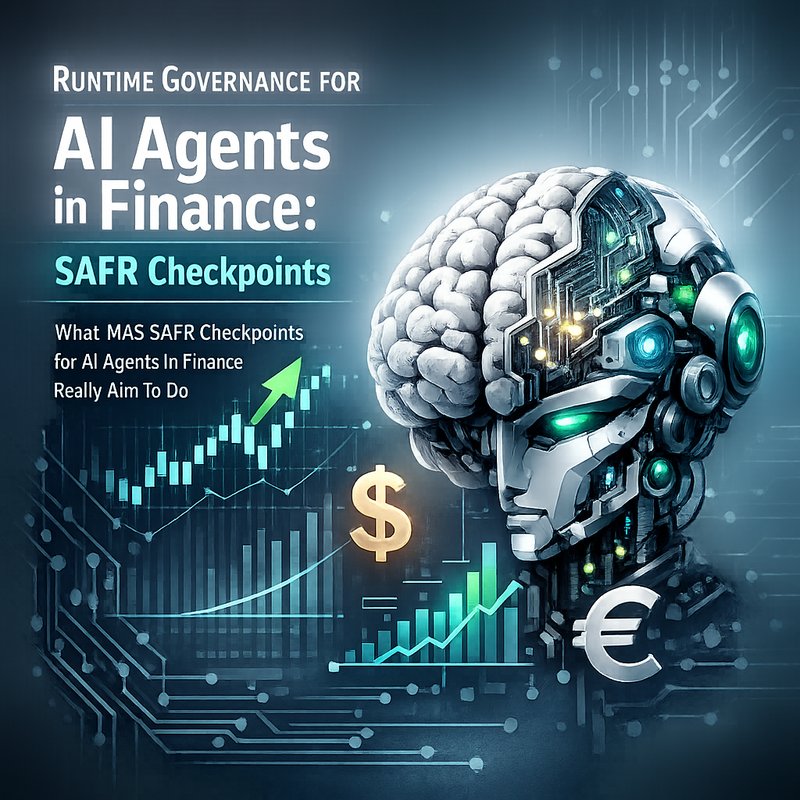
The new SAFR checkpoints for AI agents in finance are designed to stop that problem before it happens.
This article breaks down what MAS’s SAFR approach means for agent-assisted payments, where governance “checks” happen in real time, and how developers can build safer agent workflows using evidence logs, output validation, and action gating.
Along the way, we’ll also connect this to what’s changing across the agent tooling world right now, like better runtime harnessing, compliance monitoring ideas, and more serious structured tool calling.
If you’re building agents for fintech, payments ops, or wealth workflows, SAFR checkpoints for AI agents in finance is the kind of topic you actually want to understand.
What MAS SAFR Checkpoints for AI Agents in Finance Really Aim To Do
The Monetary Authority of Singapore (MAS) and partners released a white paper on Safeguards for Agentic Finance at Runtime (SAFR).
The core idea is simple: do not just “trust” what an AI agent says.
Instead, check what it’s about to do, at the moment it tries to take action.
Why “runtime” matters more than “training”
Most AI safety talk focuses on training time.
You train the model, align it, test it, and then release it.
But with agentic systems, the danger often shows up later, when the model is actively taking steps in tools and real systems.
Here’s what runtime adds:
- The agent might see unexpected inputs (a new invoice format, unclear user intent, edge cases).
- Tool outputs can be surprising (missing fields, partial data, another system timing out).
- The agent can chain actions, and the earlier mistake can ripple.
So runtime governance needs to be ready for the moment decisions happen.
(Source: MAS media release) https://www.mas.gov.sg/news/media-releases/2026/mas-partners-industry-to-develop-safeguards-for-ai-agents-in-finance
What a “governance checkpoint” looks like
A practical way to think about a SAFR checkpoint is this:
- The agent plans an action (for example: “send payment,” “execute transfer,” “update wealth instruction”).
- Before execution, a checkpoint checks rules and expected formats.
- If the checkpoint fails, the agent must stop, request clarification, or route to a human review path.
This is closer to “air traffic control” than “spell checking.”
The SAFR Checkpoint Pipeline You Can Copy in Your Own System
You don’t need to copy MAS’s system line for line to get the benefit.
You can build an agent pipeline that follows the same safety mindset.
Below is a checkpoint pipeline approach you can adapt.
Step 1: Create structured action requests (not plain text)
When agents communicate internally, they often produce text like:
“I will process the payment now.”
That’s not checkable enough.
Instead, you want action requests that are structured, so governance can validate them.
Think of fields like:
- amount
- currency
- beneficiary
- payment reference
- allowed channels (bank transfer vs. card vs. internal ledger)
- time window
- user intent category
Why this matters for SAFR checkpoints for AI agents in finance:
the checkpoint must be able to verify what it’s about to do, with clear inputs.
Step 2: Validate tool outputs with strict schemas
A common failure mode happens when tool outputs are slightly wrong or incomplete.
Example: a tool returns a payment destination but omits the country code, or returns a field type mismatch.
So your governance checkpoint should include output validation, like:
- schema validation for JSON results
- checks for missing required keys
- type checks
- range checks (for example, amount is positive and under expected thresholds)
This is also why compliance teams are pushing for automated monitoring and “programmatic output checks” rather than manual review only.
Recent focus in the agent tooling world points to automated compliance gap spotting using schema validation ideas (the SAFR direction is aligned with that kind of tooling).
Step 3: Gate execution by policy rules
Now the real “checkpoint” happens.
Before the agent runs a tool call that changes money, it should pass through a policy layer.
Policy examples for finance workflows:
- customer verification rules already met
- risk flags
- allowed recipient lists
- forbidden combinations (example: certain fees only allowed with certain account types)
- multi-step confirmations for higher-risk actions
The key thing is that governance should not rely on the model’s self-talk.
It should rely on rules you can explain and test.
Step 4: Save evidence logs that are tamper-evident (when possible)
In regulated environments, you often need proof later.
So a SAFR-style system needs evidence:
- what the agent requested
- what the checkpoint checked
- what rules it applied
- what the final decision was (allow, block, ask for more info)
- which tools returned what
Even if you don’t implement full tamper-evident evidence right away, design your logs so you can add stronger evidence later.
A good sign is when your agent can produce a “decision trail” that an auditor can follow without playing detective.
Step 5: Use “stop and ask” paths instead of guessing
When the checkpoint blocks an action, the agent should do one of these:
- ask the user for missing details
- fetch a compliant source of truth
- route to a human approval step
- stop and safely roll back any partial steps (when supported)
A lot of agent systems fail here by trying to “make it work” after a partial mismatch.
That means your checkpoint should push the agent into safe alternatives.
What Changes for Developers Building Agent-Assisted Payments
Finance agents aren’t like “chatbots with opinions.”
They’re systems that touch money movement tools.
So SAFR checkpoints for AI agents in finance push developers to design differently.
Here are the biggest practical shifts I see.
1) Tools must be predictable and checkable
If a tool returns messy or mixed-format output, governance gets harder.
Structured tool calling and consistent formats are not just developer convenience anymore.
They become safety plumbing.
This also matches what’s showing up in recent agent tool releases: more attention to structured tool calls and runtime harnessing.
2) “Reasoning” must be separated from “execution”
Some agents do internal reasoning.
But that reasoning should not be directly treated as the final authority for actions.
Governance should look at:
- the requested action
- validated fields
- policy outcomes
Then execution happens only when policy says yes.

3) You need more than monitoring, you need enforcement
Monitoring tells you that something went wrong.
Enforcement tries to stop it before it happens.
SAFR’s runtime approach is closer to enforcement because it focuses on checkpoints before execution.
How Current Agent Tooling Fits Into SAFR Checkpoints
SAFR is a finance-specific idea, but the runtime governance pieces connect to broader agent ecosystem upgrades.
Here are notable themes from the recent tool updates highlighted in the search results.
Harnessing and session control for safer runtime testing
OpenClaw released an update that includes:
- GPT-5.6 model family support
- external harness attachment using
openclaw attach - event-driven cron behavior so agents can wake based on command completion
Why it matters for SAFR checkpoints for AI agents in finance:
- In finance, you want to test agent behavior under controlled harnesses.
- You also want reliable ways to run checkpoints and see outcomes after the related command finishes.
And the overall direction is: better runtime control, better test repeatability, better gating.
Source: OpenClaw release notes https://github.com/openclaw/openclaw/releases/tag/v2026.7.1-beta.1
Better structured tool calling in specialized agent stacks
A lot of agent failures come from “tool calls” that are treated like text.
Some recent updates described improvements like tool-call parsing for custom model wrappers, which makes tool_use succeed instead of failing silently.
For finance, silent failures are dangerous.
If an agent thinks it has called a tool and it didn’t, it might compensate by guessing or repeating.
That pushes you toward checkpoints that also verify whether actions truly happened and whether tool call structure is valid.
Automated compliance monitoring ideas
The search results mention a shift toward automated compliance monitoring within frameworks like SAFR, with tools like schema validation to catch gaps before regulators do.
That aligns perfectly with checkpoint pipeline step 2 and 4:
- validate outputs
- create evidence
- gate actions
Agent privacy ideas and safety mode flags
Other trust-adjacent release themes include “safe mode” and privacy checks like heartbeat verification.
Even if your finance checkpoint system is separate from model safety flags, the spirit is the same: verify behavior and verify signals, not just trust the model.
A Simple Example: How an Agent Should Handle a Payment Instruction
Let’s walk through a realistic flow.
The request
A user says:
“Send $2,450 to my Singapore account for my quarterly bill.”
The agent might do these steps:
- Extract amount, currency, and recipient.
- Look up recipient details in a trusted system.
- Prepare a payment tool call.
- Execute the payment tool.
Where SAFR checkpoints for AI agents in finance should intervene
At least three checkpoint points matter:
Checkpoint A: Before payment tool execution
- Is amount within allowed range?
- Is recipient verified?
- Is currency correct?
- Does the payment reference match required format?
If anything fails, the agent should stop or ask for correction.
Checkpoint B: After tool call result returns
- Did the tool actually accept the payment?
- Are required fields present in the response?
- Does response status match expectation?
If not, trigger a safe fallback like human review or retry with a different safe path.
Checkpoint C: Evidence logging
- Store the decision trail:
- action request
- policy rules used
- validation results
- final decision
This is the “audit tomorrow” part of SAFR thinking.
Common Mistakes Teams Make With Agentic Governance
Even smart teams mess this up.
Here are some errors to avoid.
Mistake 1: Over-trusting the agent’s description
If the agent says “I checked the policy,” that is not the same as a checkpoint enforcing policy.
SAFR checkpoints for AI agents in finance are about enforcing, not storytelling.
Mistake 2: Only validating the input, not the outputs
Tool outputs often drive the next step.
If output fields are missing or wrong, the agent might improvise.
So validate outputs too.
Mistake 3: Letting one failure turn into a wrong action
Example: recipient lookup fails, but the agent tries to proceed anyway.
Checkpoint rules should push the agent into “stop and ask” paths.
Mistake 4: Making logs hard to read
Auditors do not want logs that feel like raw developer debugging.
Logs should be structured, searchable, and tied to the decision outcome.
How to Start Implementing SAFR-Style Checkpoints This Quarter
If you’re building an agent for finance workflows, you can start small.
Phase 1: Add structured action objects
In your agent stack, make sure each money-moving action becomes a structured object with clear fields.
Phase 2: Add schema validation at two points
- validate the action request before execution
- validate the tool response after execution
Phase 3: Add a policy gate with a small rule set
Start with basic policies:
- maximum daily amount
- verified recipient requirement
- allowed payment channels
Phase 4: Build an evidence log format
Log:
- inputs to policy
- results of validation
- allow or block decision
Then later, you can strengthen evidence (like tamper-evident approaches) if needed.
SAFR Checkpoints for AI Agents in Finance: The Big Takeaway
The bigger story is that finance AI is moving from “model safety vibes” to “runtime governance checks.”
SAFR checkpoints for AI agents in finance mean you build agents that can be verified right before they act.
That makes it harder for errors, edge cases, and tool failures to slip through.
And the good news is you can start implementing the same concept now with:
- structured action requests
- schema validation
- policy gates
- evidence logs
- stop-and-ask fallbacks
If you take one thing from this article, make it this:
runtime enforcement beats hope.