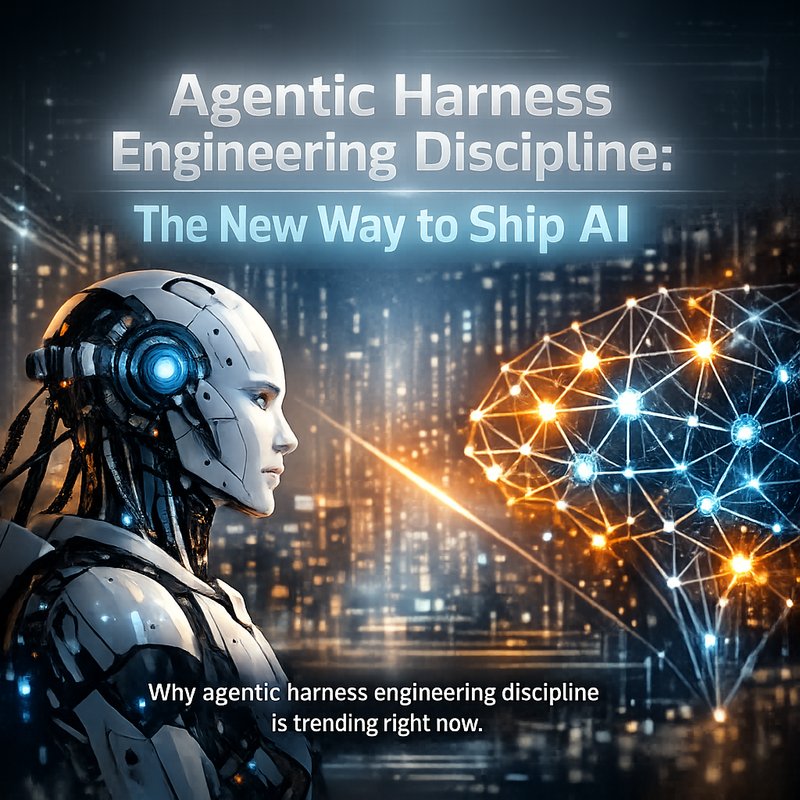
Agentic harness engineering discipline is becoming the “real job” for teams building AI agents, not just picking a model.
In recent months, more companies and researchers have pointed out something practical. Models get the headlines, but the harness around them decides whether your agent is safe, testable, and reliable in messy real life.
This article breaks down what agentic harness engineering discipline means, why it is trending now, and how you can apply it whether you build with open-source tools, internal frameworks, or a mix of providers. I’ll also show you what to test, how to measure failures, and how to design a harness that can run unattended audits without turning your AI workflow into a chaos machine. If you’ve ever had an agent “almost” do the right thing, then stop and think: that is usually a harness problem, not a model problem.
Why agentic harness engineering discipline is trending right now
Let’s be honest. Most teams start with a model and a prompt. They quickly get something demo-worthy.
Then the real world shows up.
- Users ask strange questions.
- Inputs are missing or contradictory.
- Tools fail sometimes.
- Networks time out.
- Your agent gets stuck in loops because it “didn’t know” what to do next.
- Your logs are unclear, so debugging takes forever.
This is why the industry shift is happening from model-centric work to harness-centric work. One report summary you can read over at InnoBU frames it as a new engineering discipline: focus on the test harness, the orchestration, the safety checks, and the evaluation setup, not only the model choice. Source: https://innobu.com (Agentic Harness Engineering Discipline overview).
But here is what makes this trend feel urgent. Recently, we also saw practical advances in multi-agent testing harnesses and the rules around AI transparency and synthetic media.
- Y Combinator open-sourced its internal multi-agent harness named QM under the MIT license. It’s described in a short announcement. Source shown in your results: buttondown.com (YC Open-Sources “QM” Harness).
- The EU is pushing stronger AI disclosure requirements, including clear disclosure of agent interactions and machine-readable watermarks for synthetic content. Source shown in your results: europa.eu.
- Teams are building self-hosted agents and self-healing loops, like OpenCrabs, and they need a harness that can safely run those loops. Source in your results includes opencrabs.com and its repo: https://github.com/adolfousier/opencrabs
So the harness is not a “nice to have” anymore. It’s what lets you ship with confidence.
Agentic harness engineering discipline in plain words
Agentic harness engineering discipline means you treat the agent like software that must pass repeatable tests, not like a chat demo.
Instead of asking only “Will the model answer correctly?”, you also ask:
- Can the agent be run in a headless environment?
- Will it call tools correctly, or does it break when tool schemas change?
- If it fails, does it recover safely or spin forever?
- Are outputs consistent enough to evaluate automatically?
- Are logs and traces easy to understand?
- Does it follow rules about disclosure and watermarking?
- Can it be audited by humans after the fact?
In other words, the harness is your agent’s guardrails, measurement system, and safety net.
A good harness does at least five things:
- Controls the environment (inputs, tool stubs, network limits).
- Checks tool usage (schema correctness, argument validity).
- Runs evals automatically (so regressions get caught).
- Captures evidence (logs, traces, artifacts).
- Handles failures (timeouts, retries, safe stop, fallback paths).
Once you start thinking in those terms, you naturally design around failure modes instead of hoping the model “figures it out.”
The four layers of a harness (the part everyone forgets)
Most teams build something that looks like an agent. But harness quality is about layers.
1) Input layer: real-world mess gets simulated
A harness must generate input variations. Not only “happy path” prompts. For example:
- Missing fields
- Wrong language
- Very short requests
- Very long requests
- Conflicting instructions
- “Try again” loops
- Tool-related requests with malformed arguments
If you do not simulate mess, your evals become a fantasy test.
2) Orchestration layer: control turns, tools, and state
Agents often have state. Your harness needs control over:
- Max turns per run
- Rate limits
- Tool call routing rules
- Turn boundaries (what counts as “done”?)
- Recovery actions (what happens after a tool error?)
When orchestration is weak, the agent looks smart until something breaks, then it gets unpredictable.
3) Tool layer: strict schemas and measurable tool outputs
Tool calling failures are common. The harness should validate:
- Tool arguments match expected schemas
- Output types match what downstream steps expect
- Errors are classified (retry vs fail fast)
- Calls are logged with correlation IDs
This connects to new open-source updates from communities like OpenCrabs. Their changelog mentions improvements around tool parsing and structured tool calls for specific model formats. For example, tool call parsing and structured tool calls for Xiaomi MiMo were fixed so tool use succeeds instead of falling through as prose. (OpenCrabs changelog context you provided: 0.3.37 updates.)
Even if you do not use OpenCrabs, the lesson is universal: harness code must correctly interpret tool instructions, not guess.
Repo link: https://github.com/adolfousier/opencrabs
4) Evaluation layer: score behavior, not vibes
Finally, you need evals that test:
- Correctness
- Safety policies
- Consistency
- Evidence quality (did it cite sources if required?)
- Compliance requirements (agent disclosure and watermark rules)
The harness should produce a clear “pass or fail” summary, plus per-step logs for debugging.
How Y Combinator’s QM harness fits the picture
One of the most interesting signals in your search results is Y Combinator open-sourcing QM as a multi-agent harness. Source shown: buttondown.com.
Even without pasting the full code here, you can infer the direction: multi-agent harnesses are designed to run orchestrated tests with controlled agents, controlled prompts, and repeatable runs. This aligns with harness-centric engineering discipline.
If you plan to evaluate multi-agent behaviors, you need a harness that can:
- Run multiple agents in sequence or parallel
- Control interaction order
- Capture outputs from each sub-agent
- Enforce stop conditions
- Detect unsafe behavior early and end the run
QM is a good “north star” for what harnesses look like when you care about repeatable experiments.
Practical advice: if you adopt any harness, keep your test cases small at first. Teams often fail by loading huge scenarios too early. Your harness should start by proving basic tool and state behavior under load.
EU disclosure and watermark rules: why your harness must enforce them
From your search results, the EU requirements you highlighted say two big things:
- AI systems must clearly disclose when a user is interacting with an agent.
- Synthetic content (deepfakes, AI-generated text/video) must carry machine-readable watermarks.
Source shown: europa.eu.
Here is the harness connection. If your agent can generate content or interact conversationally, your harness must verify:
- Does the agent disclose itself properly every time?
- Is disclosure consistent across languages and channels (web, email, voice)?
- Are watermarks included where required?
- Are outputs tagged so downstream systems can detect them?
A model prompt alone can fail here. People test prompts, not compliance. Your harness should include compliance checks as part of the evaluation pipeline.
A simple pattern many teams use:
- Run a test where the user requests synthetic content.
- Parse the response to ensure watermark markers exist.
- Verify a disclosure flag exists in the response metadata.
- Fail the test if the required fields are missing.
This is exactly what agentic harness engineering discipline is about. You are not relying on “the model usually follows the rules.” You are requiring the harness to prove it does.
Self-hosted agents and “safe autonomy” need harness discipline
OpenCrabs is one of the more notable examples of self-hosted agent work. Your provided context mentions that it is self-improving, self-healing, fully autonomous, and designed as a single binary with a specific UI library (Ratatui). Source: https://opencrabs.com and repo: https://github.com/adolfousier/opencrabs and X feed: https://x.com/opencrabs
But self-healing autonomy creates a new harness challenge. If your agent can restart itself, retry steps, or self-update, your harness must keep runs safe and auditable.
So a harness for self-healing agents should include:
- Hard time limits (no infinite recovery loops)
- Change logging (what was modified, when, why)
- Rollback strategy (what happens if the fix worsens things)
- Restart verification (did it actually restart the correct binary)
- Phantom intent detection (avoid triggers caused by short announcements)
Your changelog context shows exactly that kind of attention. For instance, it mentions:

- “Evolve restart on Linux” fixing a restart path issue
- “Telegram group bot handling” and settle windows
- “Multilingual phantom self-heal” intent detection across languages
- Catching brief work announcements and not misclassifying them
Even if you never run OpenCrabs, these are examples of harness thinking applied to real operational mess. Harness code must handle partial messages, language ambiguity, tool call formats, and restart edge cases.
That is agentic harness engineering discipline in action.
A step-by-step way to build your first harness (without boiling the ocean)
You do not need a giant framework on day one. You need a harness that helps you safely iterate.
Step 1: Pick one agent workflow and freeze the contract
Choose one workflow, like:
- “Summarize a document and produce a checklist”
- “Answer support questions using provided FAQ content”
- “Generate an article draft with citations”
Then freeze the contract:
- Inputs: allowed fields and formats
- Output: required fields
- Tool calls: list which tools can be used
Your harness should enforce that contract every time.
Step 2: Add deterministic “tool fakes” for eval runs
Instead of calling live external services during early evals:
- Use tool stubs
- Return fixed responses
- Simulate tool failures with controlled error types
This gives you repeatable tests.
Step 3: Add stop conditions and retries
Define:
- Max turns per run
- Max tool calls per turn
- Timeout rules
- When to retry vs when to fail fast
Without this, harness runs become expensive and unpredictable.
Step 4: Capture artifacts automatically
At minimum, capture:
- Prompt used
- Tool calls taken (with arguments)
- Model messages per step
- Final output
- Any compliance fields (disclosure, watermark tags)
This is what turns a debugging nightmare into a solvable incident.
Step 5: Create a small eval set that covers failure modes
Build 30 to 100 test cases, not 3,000.
Include:
- Valid inputs
- Missing inputs
- Conflicting instructions
- Tool schema mismatch scenarios
- “Agent should disclose” scenarios
- “Synthetic content should contain watermark tags” scenarios
Then run them in CI on every change.
If you do this consistently, you will feel the shift from “model experiments” to “engineering discipline.”
Agentic harness engineering discipline and CI audits: the practical benefits
A harness that runs in CI gives you three major advantages:
- Regression detection
- Safer tool changes
- Audit-ready evidence
In today’s AI stacks, you often change one of these things:
- Model provider
- System prompt
- Tool function signatures
- Retrieval data
- Orchestration logic
- Compliance rules
Harness evals catch unintended behavior shifts.
Also, headless audits matter for security. When agents run without a UI, you need confidence that they:
- Do not leak secrets
- Do not execute unsafe actions
- Do not output forbidden content
If your harness already produces evidence, audits are faster.
Counterpoint: isn’t the harness just extra work?
Yeah, it is extra work at first. There’s no magic here.
But here is the tradeoff I’ve seen: without harness discipline, you spend your time chasing issues in production, or you make slow, cautious changes because you fear breaking things.
With harness discipline, you invest upfront:
- You write test cases.
- You build tool fakes.
- You define stop conditions.
- You add compliance checks.
Then you ship faster later because your harness becomes a safety machine.
The bottom line: agentic harness engineering discipline is not “more paperwork.” It’s how you reduce chaos.
What this means for teams shipping AI agents this year
If you are building AI agents in 2025, the likely maturity path is:
- Early stage: model prompt iteration
- Middle stage: harness-based tool and state correctness
- Mature stage: compliance checks, eval automation, evidence capture, multi-agent harnesses
The research you found points in that direction. Harness-centric thinking is becoming standard, not optional.
And the policy signals from the EU reinforce it. If you need disclosure and watermarks, you cannot treat compliance as a one-time prompt tweak. Your harness must enforce it.
How Neura AI teams think about agent workflows (and why harnesses matter)
At Neura AI, we design agent workflows to be easier to run across real tasks and channels.
Our Router Agents approach routes requests based on user intent, and we build specialized apps for tasks like document analysis, transcription, image generation/analysis, and website support.
When you stitch these pieces together, harness discipline becomes even more important because you need consistent tool behavior, consistent outputs, and predictable evaluation.
If you want to explore our platform, start at:
- https://meetneura.ai
- Product overview: https://meetneura.ai/products
- Leadership: https://meetneura.ai/#leadership
- Case studies: https://blog.meetneura.ai/#case-studies
Also, if you want an example of how we structure outputs like writing and formatting, Artifacto is a good place to see how multimodal and content tasks are handled in practice: https://artifacto.meetneura.ai
The point is not that one company solves harness engineering for you. The point is that once you treat agents like real software, the harness decides whether users get reliable outcomes.
That is the heart of agentic harness engineering discipline.
Featured image recommendation (SEO)

Conclusion: Agentic harness engineering discipline is how you ship agents you can trust
Agentic harness engineering discipline is the new way teams ship AI agents that can survive real inputs, tool failures, policy requirements, and multi-step workflows.
It’s not about building bigger prompts. It’s about building a harness that controls your environment, enforces contracts, evaluates behavior, and captures evidence.
If you take one action after reading this, make it simple: add a harness that can run headless evals for one workflow, with strict tool validation and compliance checks. Then expand your eval set based on the failures you actually see.
That’s how you move from “cool demo” to “reliable system.”