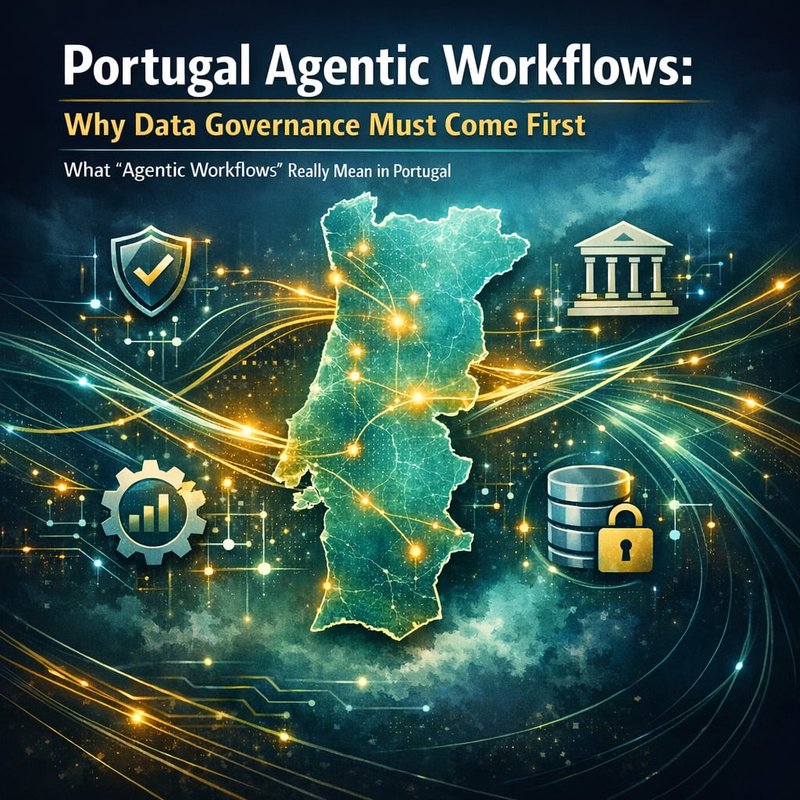
Agentic workflows are moving fast in Portugal right now, and the biggest mistake companies make is thinking they can start with the AI and “fix” the business later.
When you shift from chatbots to agents that do multi-step work like procurement, invoice checks, and customer ticket handling, your data and process setup becomes the real foundation.
Agentic workflows are where the work actually happens. They can pull info, decide what to do next, call tools, and move tasks forward. But if your data is messy, permission rules are unclear, or processes vary by team, the agent will either freeze, guess wrong, or take actions you never intended.
In Portugal, several recent reports and discussions point to the same trend: companies are moving from buying AI licenses toward restructuring governance and underlying business processes before deploying agents. For example, coverage notes demand shifting toward data governance first, then agentic workflows, especially in enterprise environments using tools like ServiceNow and Microsoft Fabric. (Sources mentioned in your results include portugalstartupnews.com and portugalstartups.com.)
Also, Portugal is pushing public sector AI modernization, with agencies supporting automated public services and open models for language and compliance needs. That matters because the public sector has stricter rules than most private teams, so governance lessons show up quickly. (Source: europa.eu.)
This article is a practical guide to understanding agentic workflows in Portugal, why data governance comes first, and how to design an agent program that stays safe, useful, and measurable in day-to-day operations.
What “Agentic Workflows” Really Mean in Portugal
Let’s make it simple.
An agentic workflow is not just “an AI assistant.” It’s an AI system that can follow a chain of steps to complete work.
Instead of answering a question, the agent tries to do the next correct action.
Think of common business tasks:
- Checking purchase orders and matching them to invoices
- Drafting and sending a response to a customer ticket
- Triaging a request, asking a missing question, and then routing it
- Turning a document into structured fields, then updating a system
- Running a multi-step process across tools (tickets, ERP data, email, internal docs)
Portugal’s adoption pattern matches what many countries see. Companies use generative AI for quick tasks like drafting and summaries, but only a smaller group goes deeper into agentic workflows and end-to-end automation. Your search results mention a “depth challenge” where fewer companies have advanced deep automation compared to general adoption. (Sources: devs.com.pt and adalytica.com.)
So why is this happening? Because agents are less forgiving than chatbots.
A chatbot can answer politely even when the input is incomplete. An agent that takes actions needs:
- Clear access permissions
- Reliable source data
- A predictable workflow shape
- Rules for what to do when it’s unsure
That’s why data governance first is not a “nice to have.” It’s the difference between helpful automation and risky automation.
Why Agentic Workflows Fail When Data Governance Is Afterthought
Here’s the hard truth.
Data governance is not just compliance paperwork. It’s the way your organization tells the agent what it can trust.
In real deployments, agentic workflows stumble for practical reasons:
1) The agent can’t find the right truth
If customer records are duplicated, addresses are inconsistent, or invoice numbers don’t match formats, the agent will pick one version.
And then it might update the wrong record.
2) Permissions are unclear
Even if the agent “understands” the task, it may still not have the correct access.
Sometimes the agent can read a file but not write updates. Other times the permission is team-based, not role-based. The agent may not know the difference and will either fail or delay.
3) Workflow steps differ by department
Procurement flows can vary across regions or product lines.
So when a single agent is asked to “handle invoice reconciliation,” it needs a shared workflow definition.
If your workflow is custom in five places, your agent needs either configuration or routing logic for each path.
4) Data goes stale
A task like “check delivery status” depends on data freshness.
If your systems update at different times or you have gaps, the agent may act on old information.
Now, you might wonder, isn’t there a way to just give better prompts?
Prompts help with reasoning. They do not fix missing permissions or wrong data sources.
This is why your search results repeatedly point toward restructuring business processes and governance before pushing agents live. (Sources: portugalstartupnews.com and portugalstartups.com.)
The Portugal Angle: Adoption Is Rising, but “Depth” Needs Structure
Portugal is not behind. Several sources in your results suggest strong movement in gen AI adoption.
At the same time, the depth of automation is still limited for many organizations. That gap is where agentic workflows become both promising and hard.
Here’s what stands out in the coverage you provided:
- AI adoption among Portuguese businesses is rising.
- Many organizations still focus on beginner use cases like summaries and drafting.
- Only a smaller part builds advanced automation like agentic workflows, multi-model orchestration, or deeper ERP integrations.
- SMEs often struggle more due to tight margins and less dedicated AI talent.
(Source: devs.com.pt; and adalytica.com for the depth and SME vulnerability angle.)
That means Portugal’s next wave is not only about building AI apps. It’s about:
- Better data catalogs
- Cleaner integration between business systems
- Shared workflow standards
- Safer action policies
And because public administration modernization is also in progress, governance conversations will likely move faster than in purely private settings. (Source: europa.eu via ARTE and the National AI Agenda coverage in your results.)
A Practical Governance-First Plan for Agentic Workflows
Now let’s get actionable.
If you are planning agentic workflows in a Portuguese company, here’s a simple sequence that works in real projects.
Step 1: Pick one workflow with a clear “success” definition
Choose something that has:
- A defined start event (like “invoice received”)
- A defined expected outcome (like “invoice matched or flagged with reason”)
- A limited set of systems involved
Good candidates often include:
- Invoice receipt checks
- Ticket triage and routing
- Document classification and field extraction
- Customer support FAQ responses with escalation rules
Avoid starting with the workflow that people complain about most. That workflow may be messy and political. Agents amplify existing problems.
Step 2: List your data sources and decide your “source of truth”
Write down every system the agent will use:
- ERP for purchase order status
- Accounts payable system for invoice records
- Customer database for customer identity
- Ticketing tool for outcomes
Then pick:
- Which system is truth for each field
- What happens if fields disagree
- How you will handle duplicates
This is the heart of data governance for agentic workflows.
Step 3: Define permissions at the action level
Don’t only think “can the agent log in.” Think:
- Can it read invoices?
- Can it update invoice status?
- Can it send emails?
- Can it create a new ticket?
- Can it close tasks automatically?
Design your agent policies so sensitive actions require either:
- A human approval step
- Or a strict confidence threshold plus audit logs
Step 4: Standardize workflow steps or build routing rules
Agents need consistent “next steps.”
If your workflow differs across teams, you have two options:
- Standardize the workflow across teams
- Or implement routing logic so the agent selects the correct workflow template
Routing is often easier than forcing everyone to change overnight.
Step 5: Add guardrails for uncertainty
Agentic workflows should detect when they are not sure.
Examples of uncertainty rules:
- If a match score is below a threshold, flag for manual review
- If the required fields are missing, ask a follow-up question before acting
- If data is stale, stop and request a refresh
The key is to avoid “guessing and trusting.”
Step 6: Track outcomes like an operations team, not like an AI team
Instead of only tracking model behavior, track:
- How many tasks completed correctly
- How often tasks were escalated
- Where the workflow got stuck
- Which data source caused most failures
This keeps the project grounded in operations.
How to Build Safe Agentic Workflows With Tool-Calling and Logging
A strong architecture makes agentic workflows safer by design.
Here’s a common approach you can copy conceptually:
1) Separate “reasoning” from “actions”
The agent should plan actions using reasoning, but it should not instantly execute everything.
A good pattern is:
- Agent decides what to do
- System verifies permissions and required inputs
- System runs the tool call
- System logs the result
- Agent updates the next step
This reduces the risk of accidental actions.
2) Log everything the agent did
Logging is not optional.
For agentic workflows, you need:
- Inputs it used
- Decisions it made
- Tool calls executed
- Final outputs
- Any manual approval steps
This helps with troubleshooting and also with internal audits.
3) Use “retrieval” for facts, not for control
If you want safe agentic workflows, retrieval should be used to fetch relevant data, not to silently control your business systems.
Meaning:
- Retrieval provides context and facts
- Business rules decide whether an action is allowed
4) Maintain a workflow audit trail you can read
Your operations team needs something readable.
A log that only engineers can interpret will slow down the real-world response when things go wrong.
So include:
- Plain language summary of what the agent attempted
- Links to the record it changed
- A clear status: completed, escalated, or blocked
Real-World Portuguese Use Cases Where Governance Matters Most
Let’s connect this to the use cases mentioned in your search results.
Agentic workflows are discussed in contexts like:
- procurement
- invoice reconciliation
- customer ticketing
These are the areas where governance matters because actions affect money, service quality, and legal posture.
Procurement and invoice reconciliation
Common governance needs:

- Correct vendor identity
- Matching rules between PO and invoice numbers
- Permissions for updating statuses
- Handling exceptions (partial deliveries, wrong quantities)
If governance is weak, you’ll see mistakes like wrong matches and incorrect payment timing.
Customer ticketing
Common governance needs:
- Access to customer records
- Rules for what the agent can say
- When to escalate to human support
- Handling sensitive data in responses
If governance is weak, you risk leaking private info or giving inconsistent answers.
How Portugal Open Source and Sovereign AI Efforts Change the Conversation
One surprisingly relevant thread from your search results is the push for sovereign and open-source AI initiatives for Portuguese language and compliance needs. These include state backed projects and national AI agendas.
This matters for agentic workflows because governance is easier when you control:
- the model access path
- the data policy boundaries
- the deployment environment
- and how you audit responses
If you are building agentic workflows for Portuguese operations, language quality is not only about “better chat.” It affects the quality of extraction, classification, and routing decisions.
Source in your results: europa.eu coverage of Portugal’s agency work and initiatives like AMALIA.
So the big picture is this: agentic workflows will increasingly look like a governance system plus an automation system, not just a model calling tools.
Common Objections (And Straightforward Answers)
Objection: “We will fix data later.”
Sure, but later usually means never.
Agentic workflows start acting the moment they are connected to tools. That means the first workflow matters most. Pick a workflow where governance can be improved without boiling the ocean.
Objection: “Smaller teams can’t do governance.”
They can start small.
Data governance does not have to be a big program on day one. It can be:
- one source of truth per workflow
- clear permissions for that workflow
- and explicit escalation rules
Objection: “Prompting will solve it.”
Prompts can help the agent interpret text. They can’t fix:
- missing access
- inconsistent IDs
- mismatched schemas
- outdated records
These need process and integration work.
What to Do Next: A Short Checklist for Agentic Workflows in Portugal
If you want a quick starting point, use this list.
Governance-first checklist
- Choose one workflow with clear outcomes
- Identify your source of truth for key fields
- Define permissions per action (read, write, approve, email)
- Standardize steps or create routing templates
- Add uncertainty rules and escalation
- Log tool calls and outcomes in an audit-friendly way
- Review failures as workflow problems, not only model problems
And when you want to explore practical ways to run grounded agents and connect tools, you might also explore Neura’s platform approach. For an overview, see https://meetneura.ai/products . You can also browse related case studies starting here https://blog.meetneura.ai/#case-studies .
This isn’t about replacing your governance. It’s about making sure your agent design is operational, not just clever.
Conclusion: Agentic Workflows Need Process, Not Just AI
Agentic workflows are exciting because they can do real work, not just talk.
But in Portugal, the companies that win won’t be the ones with the fastest AI. They will be the ones that treat governance and process design as the starting point.
When data sources are clear, permissions are defined, workflows are consistent, and actions are logged, agentic workflows become safer and more useful.
When governance is an afterthought, the agent will do exactly what you told it to do, even if it is wrong.
So the best plan is simple: governance first, then agents.
That is the real path to deep automation.