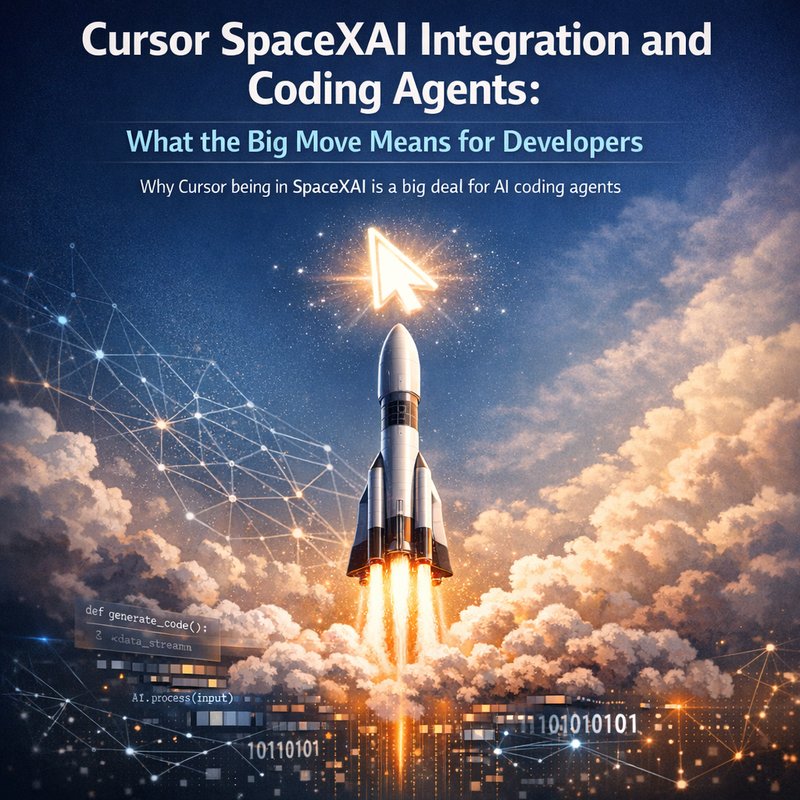
Coding agents are moving fast, and today’s headline is hard to miss. Cursor is now officially part of SpaceXAI, and that matters because it could change how “AI coding tools” behave in real projects, not just demos. When a tool like Cursor gets folded into a larger AI push like SpaceXAI, teams start asking the same question: will this make coding agents more useful, or just more unpredictable?
In this article, we’ll cover what we can reasonably infer from the Cursor and SpaceXAI integration news, why vulnerabilities in coding tools can spread quickly, and what you can do today to keep your build pipeline safer. If you’re curious about AI coding agents and how to use them without gambling your time or codebase, you’re in the right place.
Focus keyphrase: AI coding agents
This matters because AI coding agents sit inside your daily workflow, and small changes to the product or the model routing can affect results, privacy, and security.
Why Cursor being in SpaceXAI is a big deal for AI coding agents
Cursor is not new. It’s been widely used because it feels like an assistant that understands your repository, writes code, and helps you finish tasks faster. The new part is the ownership and integration path. According to the coverage you provided, SpaceX officially completed its $60 billion acquisition of Cursor on August 14, 2026, and Cursor is now integrated into the SpaceXAI division to power “Grok Build” and “Grok Bot.”
That kind of move usually signals one thing: the vendor will likely push harder on model quality, agent orchestration, and product bundling. For AI coding agents, this matters in three concrete areas.
1) Faster updates, but also faster behavior changes
When AI coding agents are tied to a bigger parent platform, releases can speed up. That’s good because bugs get fixed sooner. It’s also risky because your workflow can shift overnight.
If you run Cursor with certain settings, prompts, or repo rules, you may notice differences such as:
- Code suggestions that look more “opinionated”
- Different formatting habits
- More or fewer refactors
- Changes in how it handles multi-file edits
So don’t treat AI coding agents like software you “install once.” Treat them like tools that evolve weekly.
2) More agent features in the editor workflow
Big platforms tend to add more agent behaviors. For AI coding agents, that can mean tighter integration with build steps, deeper use of tools, and better code navigation.
But more automation also increases the chance of doing something you did not intend. This is where safe workflows become non-negotiable.
3) Security and supply chain attention will rise
You also shared a report about a critical vulnerability reported in Cursor, discovered by a team labeled in the source as GLM-5. Even without all the technical details, the timing is the key story.
When a widely used AI coding tool has a vulnerability, people rush to patch. Meanwhile, attackers sometimes test prompts or edge cases to find paths that bypass safeguards.
For AI coding agents, the “danger zone” is usually not just the editor. It’s the chain:
- Editor plugin
- Model calls
- Tool usage (file reads, writes, commands)
- Network requests
- Logging and telemetry
- Extensions and integrations
If any link is weak, the blast radius can be bigger than you’d expect.
The practical question: what changes to expect when AI coding agents get integrated into larger stacks
You might be wondering, “Ok, but what does integration mean for my day-to-day coding?” Good question. Here’s a simple mental model.
AI coding agents usually do two things:
- They generate code text
- They choose actions, like running tests or editing files
When Cursor becomes part of SpaceXAI, the action part can change first, then the text part. That’s because orchestration and routing often get updated before the surface UX.
What you likely notice first
In real teams, these are the early signs of change:
- The agent behaves more like a “planner”
- It starts asking fewer questions before editing
- It expands scope, like touching config files you did not mention
- It treats “fix the bug” as “find the root cause across files”
Some people love this. Others get burned. The solution is not to avoid AI coding agents. It’s to set guardrails so your repo stays predictable.
What to watch in your own workflow
Pick one current project, then watch for these patterns for a week:
- Does it run commands without you explicitly asking?
- Does it create new files or change build config?
- Does it edit lock files or dependency metadata?
- Does it change tests or only production code?
- Does it include secrets accidentally, like API keys or tokens?
This kind of observation turns “AI coding agents feel different” into a checklist you can manage.
Coding agent vulnerabilities are not rare. The real shift is how fast they get exploited.
You shared a source noting a critical vulnerability reported in Cursor. Even if you never share private repos with AI tools, vulnerabilities can still affect you indirectly through:
- shared templates
- malicious extensions
- compromised systems
- leaked tokens stored in logs
- unsafe file handling features
So what should developers do when AI coding agents are in the loop?
Let’s be honest. Most teams don’t have the time to deep-audit every plugin. But you can still reduce risk with simple steps.
A safer workflow for AI coding agents
Use this as a practical baseline.
1) Turn off “auto-execute” features when possible
If your agent can run commands, run them only when you confirm. Even better, set a rule: “No shell commands without me.”
2) Lock down tokens
- Make sure API keys are in environment variables, not in dev files
- Use secret managers when you can
- Rotate keys that were ever exposed in logs
3) Use a clean test gate
- Require a CI test run before code can merge
- Keep a fast “lint and unit tests” job
4) Review agent edits like a teammate
AI coding agents can be smart, but they are not a code review tool. Treat its changes as a draft, then review for:
- dependency bumps
- permission changes
- build pipeline changes
- new network calls
- changes that look like refactors but alter behavior
5) Check extension permissions
Cursor and similar editors often become hubs for extensions. Watch for:
- extensions that can read all files
- extensions that inject scripts into the page
- extensions that request extra network permissions
The bottom line: even the best AI coding agents need human review and pipeline gates.
Open-source coding agents keep pressure on quality, and that affects AI coding agents too
Your search results also point to open-source activity around coding agents. One item states that an open-source coding agent called Open Crabs is self-hosted, built with Ratatui, and described as self-improving and self-healing in the public materials you shared.

Another shared source notes that Gradually.ai remains one of the most-starred open-source coding agents, with 384k+ stars.
Here’s the interesting part for AI coding agents: when open-source projects compete, they expose real-world failure modes and push faster iteration. That can lead to:
- better safety patterns
- more transparent tool-call behavior
- more visible issue reporting and fixes
- faster learning around what breaks
At the same time, open-source projects can also have uneven security maturity depending on who maintains them and how quickly issues get fixed.
So the tradeoff is real: open source can be faster and more transparent, but you still need your own review.
How to evaluate open-source AI coding agents in practice
When you look at a new open-source agent, ask:
- Does it clearly document what tools it can use?
- Does it show tool calls in logs?
- Does it have a sandbox mode for file edits or command runs?
- Are there security issues publicly discussed?
- Is there active maintenance, not just stars?
If the project can’t answer those questions, you can still experiment, but keep it away from secrets and production repos.
“Golden Thread” checks and AI scan tools: a separate but important lesson for AI coding agents
One of your search results mentions a case where TruLens reduces manual compliance checking time by 73%, shrinking a 10-day manual review into a 1-hour automated scan for missing evidence or “Golden Thread” inconsistencies.
This is not directly about coding agents editing files. But it’s a strong signal of where AI is heading. Tools that can scan and compare evidence can reduce human error and missed details.
Now connect that back to AI coding agents.
AI coding agents are great at generating code, but the best teams are using AI also for verification and checks, such as:
- verifying changes match requirements
- checking that tests cover the right cases
- scanning docs for missing updates
- comparing implementation against acceptance criteria
So even if your coding assistant writes faster, you still want AI to help you confirm correctness.
Move beyond “write code faster” in AI coding agents
A simple upgrade: pair your AI coding agents with verification tools.
For example, you can:
- run tests automatically
- generate a short change summary from your diff
- enforce lint rules
- require code owners review for certain paths
This turns AI coding agents into part of a safety pipeline, not a magic wand.
A developer checklist for using AI coding agents safely after major tool changes
If Cursor changes and the ecosystem changes with it, you need repeatable checks. Here’s a checklist you can use with any AI coding agents in your stack.
Before you let the agent touch anything
- Confirm which model it is using (and whether routing is changing)
- Confirm which actions are enabled (read files only vs edit vs run commands)
- Confirm logging settings (what it stores and where)
During agent work
- Keep a running “intent” note: what you want, what you don’t
- Watch for edits in sensitive files:
- package manifests
- build scripts
- deployment configs
- secret files
- Stop the agent if it drifts. It’s faster to restart with better instructions than to review a messy refactor.
After the agent finishes
- Run tests
- Run lint checks
- Scan the diff for risky edits
- Re-read changes in “boring” files like configs. That’s where surprises often hide.
The goal is not to slow down. It’s to keep speed without chaos.
SEO-friendly guide: How to pick the right coding agent workflow for your team
Not every team needs the same AI coding agents workflow. Some teams want minimal changes. Others want deep refactors. Here’s a simple way to decide.
If you want safest workflow
- Small tasks only (one function, one bug, one file)
- No command execution
- Strict diff review
- CI gate required
If you want faster output with controlled risk
- Allow multi-file edits
- Allow read access broadly
- Keep command execution restricted
- Require automated tests before review
If you want max automation (with guardrails)
- Enable more tool usage
- Add human checkpoints at stage boundaries
- Require evidence checks, like doc updates or “golden thread” verification patterns
This is where the TruLens-style lesson fits. You don’t just want code. You want proof that you built the right thing.
What I think is coming next for AI coding agents (and why developers should pay attention)
Here’s my take. When a big platform like SpaceXAI integrates a major editor tool like Cursor, the future of AI coding agents will be less about “can it write code” and more about:
- how it plans work
- how it chooses tools
- how it checks results
- how it handles safety boundaries
That’s why vulnerabilities matter. That’s why “evidence scanning” matters. And that’s why open-source tools matter too. They push the conversation from “cool output” to “reliable workflow.”
If you’re a developer using AI coding agents already, don’t wait for the perfect version. Start using guardrails now, and treat new integrations as a reason to audit your own process.
Conclusion
Cursor being absorbed into SpaceXAI is a signal that AI coding agents are heading toward deeper integration, faster releases, and more automated actions inside your editor. That’s exciting, but it also increases the need for strong safety habits, especially since you also shared reports of a critical Cursor vulnerability.
If you want AI to speed up your work without risking your codebase, use AI coding agents with a checklist: limit tool actions, review diffs like a teammate, run CI, and tighten secret handling. Then let the agent help with verification too, like evidence scanning patterns inspired by tools such as TruLens.