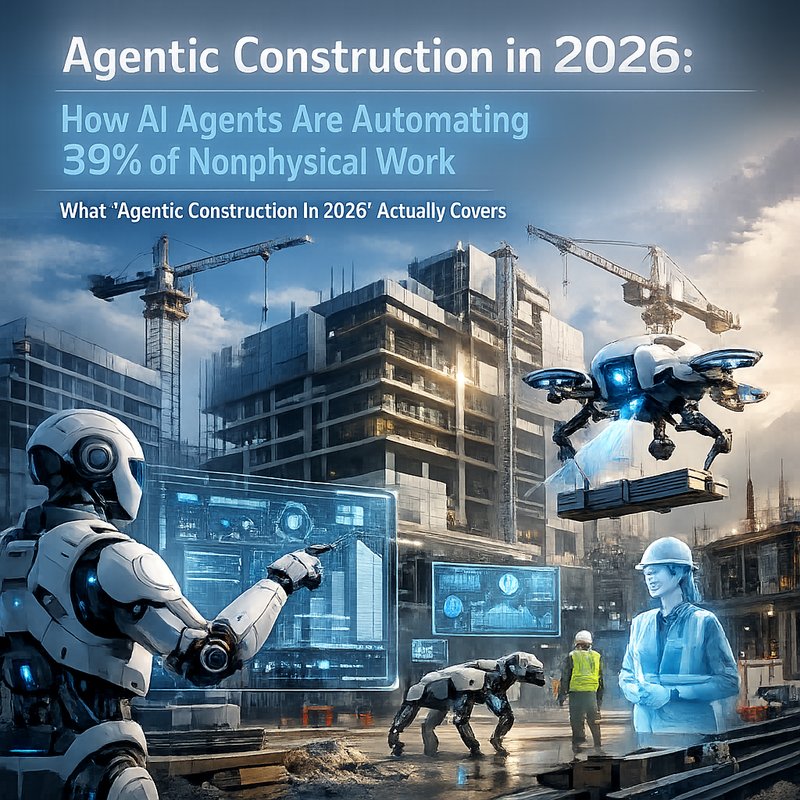
Agentic construction in 2026 is going from “cool demo” to real operations. Lately, reports have been pointing at a big shift: AI agents now automate about 39% of nonphysical construction work. That sounds abstract until you picture the boring parts of building projects. Scheduling. Email follow ups. Documentation. Vendor coordination. Progress updates. All the stuff that never makes it into pretty photos, but still takes time, people, and mistakes.
That’s what agentic construction in 2026 really means in practice. Instead of one person typing everything into spreadsheets, you use AI agents that can plan steps, draft messages, pull info, and hand off tasks when it’s ready. And because these systems can do more than one step, they help teams cut delays and lower “hand-off chaos.”
In this article, I’ll break down what’s happening, why it’s happening now, and what you can do if you want to apply the idea to your own projects, workflows, or teams.
You can also compare notes with how routing and agent tools work inside a real platform, for example at meetneura.ai, plus the way Neura packages agent workflows in https://meetneura.ai/products.
What “Agentic Construction in 2026” Actually Covers
When people hear “construction,” they often picture physical work: pouring concrete, framing, wiring, and so on. But the stat that keeps showing up is about nonphysical work. That’s the paperwork and coordination side.
Think about the typical project flow.
- Someone collects requirements.
- Someone requests quotes.
- Someone checks documents.
- Someone tracks revisions.
- Someone answers questions from stakeholders.
- Someone updates timelines when things change.
- Someone repeats the same “status” messages in different places.
A human can do this. But humans also get interrupted, miss details, and spend time hunting down the last version of a file.
So, agentic construction in 2026 focuses on automating those steps with AI that can act like a coordinator.
Here’s the simplest way to picture it:
Agentic systems combine four skills
- Understand what a person wants (emails, chats, notes).
- Find the right info (documents, past threads, specs).
- Decide the next action (draft reply, request missing data, update a task).
- Do the action (send the message, create the checklist, produce the output file).
That might sound like “just chat.” But the difference is tool use and step-by-step execution.
And if you want a mental model for routing intent versus chat, it’s worth looking at https://router.meetneura.ai because it’s literally about routing requests to the right model or capability.
Why 39% of Nonphysical Work Is Now Reachable
Let’s be honest. You can’t automate 39% of nonphysical work with a single prompt and wishful thinking. It takes multiple improvements working together.
Lately, AI systems have become better at:
- Handling structured documents without getting lost
- Following policies like “ask before you assume”
- Drafting messages that sound human
- Refusing unsafe or irrelevant steps
- Learning from templates and prior examples
- Managing multi-step tasks instead of one-shot answers
At the same time, teams adopted more digital workflows. More documents live in tools like Drive, Notion-like systems, ticketing, and shared calendars. That makes it easier for an agent to pull inputs and post outputs.
The report that points to the 39% automation number also talks about a shift from “superficial productivity” to “domain transformation.” That wording can be corporate, but the meaning is simple.
Early AI helped people write faster.
Now AI helps operations run differently.
That is exactly what agentic construction in 2026 looks like when it’s working well.
The New Workflow Pattern: From Requests to Running Tasks
In many teams, the AI tool is still treated like a fancy assistant.
But agentic construction in 2026 pushes toward something more like this:
- Someone posts a request.
- The system checks what’s missing.
- The system requests missing info.
- The system drafts the work product.
- The system does a quality pass.
- The system shares outputs and next steps.
What makes this pattern powerful is the “handoff reduction.”
Instead of waiting on a person for every minor step, the agent keeps going until it hits a point where a human must decide.
And for teams, that can mean fewer stalls.
But here’s the catch. If your process isn’t mapped clearly, agents can run in circles. You’ll get confident drafts that are off by a detail.
So you need two things:
- A clear definition of what “done” means for each step
- A safe way to validate outputs
This is why many builders use “check gates” and similar safety patterns in agent systems. If you want examples of agent safety thinking in your own tooling, it can help to read about how gatekeepers are used in agent architectures.
Real Examples of Nonphysical Work That Gets Automated
Let’s ground this in what agents can do without touchy hype.
1. Drafting stakeholder updates
When a client or subcontractor asks for a status update, the agent can:
- Pull the latest changes
- Summarize what changed in plain language
- Draft a reply
- Ask one short question if information is missing
This cuts the “who has the latest info” problem.
2. Coordinating vendors and contractors
Agents can:
- Turn a quote request into a clear vendor outreach message
- Track who replied
- Draft follow-ups
- Create a checklist for next steps
It’s not glamorous. It’s just useful.
3. Document organization and revision summaries
Lots of delays happen because the team is looking at different versions.
An agent can:
- Identify document versions
- Summarize changes
- Point out conflicts between specs and drawings
- Produce a list of “likely impacts” for humans to review
4. Meeting notes that actually become tasks
After meetings, notes often die in a doc.
With agentic construction in 2026, notes can become:
- Action items
- Owners
- Deadlines
- Draft emails for follow-up
- “What we need from you” messages
This is where agentic work starts feeling like a system, not a tool.
5. Faster intake for change requests
A change request might come in messy text.
An agent can:
- Extract requirements
- Ask for missing fields (where, why, budget effect, timeline impact)
- Create a standardized submission package for review
That means less back-and-forth.
The Risks No One Should Ignore (And How Teams Reduce Them)
Even if agentic construction in 2026 sounds exciting, there are real risks.
Risk 1: Agents invent details
Sometimes a model sounds confident but makes up a number or flips a requirement.
Solution ideas:
- Require citations from your source documents
- Use templates with required fields
- Add “ask before assume” rules
- Have a human review at key gates
Risk 2: Agents do the wrong action too fast
Auto-sending the wrong email or updating the wrong task can cost time.
Solution ideas:
- Use a draft-then-approve workflow
- Add role-based approvals
- Log actions so you can reverse mistakes
Risk 3: Agents follow the procedure but miss the “human reality”
Construction work is full of exceptions.

If the agent is trained only on “happy path” procedures, you’ll get brittle outputs.
Solution ideas:
- Add exception rules
- Provide examples from past edge cases
- Let humans “teach” the process by correcting drafts
If you want to ground safety thinking in real agent operations, Neura’s ecosystem includes tooling like security scanning (for example https://keyguard.meetneura.ai) which can help teams avoid leaking keys when agents connect to systems.
And if your team deals with documents and content, Neura MGD can convert markdown into Google Docs style docs for cleaner review workflows: https://mgd.meetneura.ai.
How to Start With Agentic Construction Without Overhauling Everything
If you’re thinking, “We want this, but we can’t change our whole process,” good. That’s the right instinct.
Here’s a practical way to begin.
Step 1: Pick one repeatable nonphysical workflow
Choose something with:
- Frequent requests
- Clear inputs and outputs
- A known template or format
Example choices:
- Project status updates
- Vendor quote follow-ups
- Change request intake
- Meeting note to action items
This is where you’ll see value fastest in agentic construction in 2026.
Step 2: Define the inputs
Write down what the agent needs, like:
- Project name
- Current phase
- Latest revision links
- Deadline window
- Stakeholder names and roles
If you do nothing else, do this.
Step 3: Define what “done” looks like
Example:
- A status email under 200 words
- Three bullets max
- Includes one question if a key detail is missing
- Includes the updated schedule summary
Step 4: Add a quality check gate
Use simple checks:
- Did it cite the latest doc?
- Did it use the right project name?
- Did it ask when data is missing?
Even basic checks will reduce errors.
Step 5: Start with drafts, then expand
Begin with “agent drafts, human approves.”
Once you trust outputs, you can automate sending or tool updates.
That approach keeps agentic construction in 2026 grounded and safer.
A Quick Tooling View: What Agents Need to Do the Work
Even if you don’t build your own agent platform, you should understand what components matter.
Agents need:
- A way to read text and files
- A way to call tools (email, tasks, docs)
- A way to keep context (what phase are we in)
- A way to route to the right capability
- Logs and guardrails
That’s where modern “router + agents” designs shine.
If you’ve never explored how routing can help an agent pick the right tool, see https://router.meetneura.ai and Neura apps like:
- https://ace.meetneura.ai (content automation style workflows)
- https://tsb.meetneura.ai (transcription to structured notes)
- https://blog.meetneura.ai/#case-studies (case studies you can read for style and outcomes)
This isn’t construction-specific, but the build blocks are similar.
The Cursor CFO Council Expansion Angle: Why Finance Teams Matter for Agent Adoption
The search results mention Cursor CFO Council expansion (July 23, 2026). On the surface, that sounds unrelated to construction AI.
But it hints at something that matters when agentic construction in 2026 becomes real: adoption needs budget control, governance, and risk review.
When finance leaders join advisory groups, it often means businesses want answers to:
- What does this cost, and what ROI do we actually get?
- Who approves what actions agents take?
- How do we manage vendors and tools?
- What are the risk and compliance boundaries?
So even if you’re not building a finance program, the signal is clear.
Agentic workflows will spread faster where finance teams can measure, approve, and predict outcomes.
If you’re building internally, it’s smart to bring finance stakeholders early. Not to slow down the project, but to set guardrails.
What Domain Transformation Looks Like in Practice
The report’s “domain transformation” framing is useful. It’s the difference between:
- “AI helps us type faster”
versus - “AI changes the way the work flows”
When domain transformation happens, teams often:
- Reduce repeated tasks
- Replace some status meetings with structured updates
- Shorten the time between “request received” and “draft output”
- Improve traceability (you can see what inputs were used)
That is why agentic construction in 2026 is showing a high automation share for nonphysical work.
The agent becomes part of the workflow, not an optional assistant.
How to Measure Success Without Getting Lost
You might wonder, “Okay, but how do we know it’s working?”
Instead of chasing complicated metrics, measure these first:
- Time-to-draft for common outputs (how long until a usable version exists)
- Rework rate (how often humans have to rewrite because of errors)
- Missing info rate (how often the agent asks for what it truly needs)
- Approval time (how fast humans can review)
Those are process checks.
They tell you if agentic construction in 2026 is improving real-world operations, not just producing text.
Agentic Construction Skills That Teams Will Need
Even with automation, teams still need skills.
Key capabilities include:
- Writing clear templates and checklists
- Understanding document structure
- Giving good examples for edge cases
- Setting approval rules
- Reviewing outputs quickly and consistently
- Teaching the process over time
So yes, the agent does more work. But humans still own the system design.
Conclusion: Agentic Construction in 2026 Is About Better Work Flows, Not Magic
If you remember one thing, let it be this.
Agentic construction in 2026 is not about replacing people. It’s about cutting the nonphysical drag that slows projects down. The headline number about automating 39% of nonphysical construction work makes sense when you break down what that nonphysical work actually is.
It’s coordination, documentation, and communication. And those are exactly the areas where agent systems can plan steps, ask for missing info, draft clean outputs, and keep work moving.
If you want to start, don’t start with the hardest workflow. Pick one repeatable task with clear inputs and define “done.” Add a quality gate. Start with drafts and approvals. Then scale.
That’s how you make agentic automation useful instead of risky.