If you keep hearing about the OpenCrabs Xiaomi MiMo Collab Free Tokens and wondering, “Is this actually worth my time?”, here’s the simple answer.
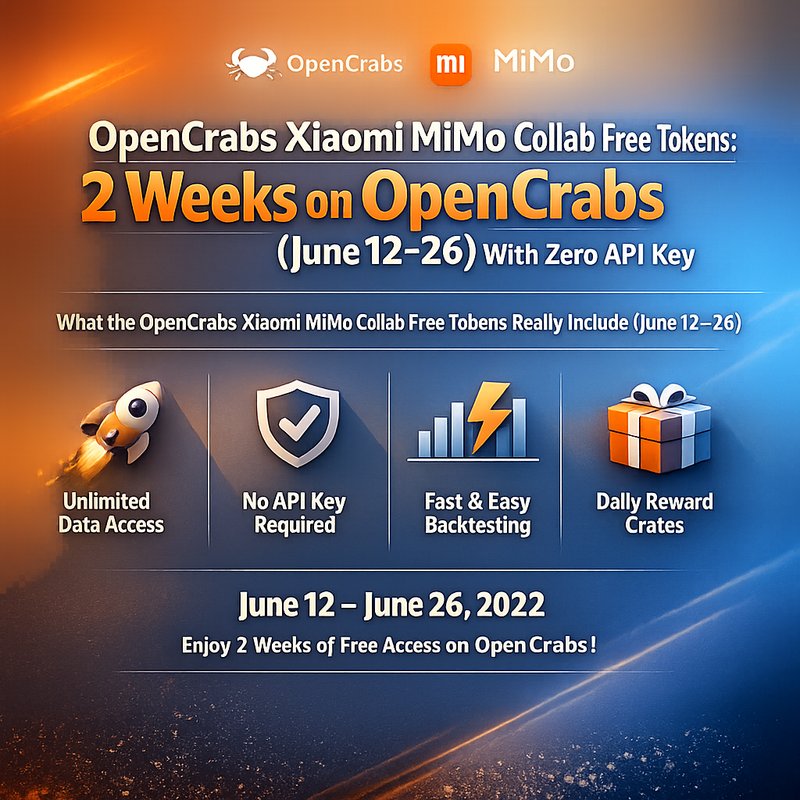
From June 12 to June 26, OpenCrabs users can get free token access for about two weeks with zero API key.
No credit card. No setup rabbit holes. Just install OpenCrabs and start using the Xiaomi MiMo v2.5 Pro model inside the collab.
Also, yes, this is specifically for the MiMo AI model inside the OpenCrabs workflow.
It is not a phone or home device offer.
It is an AI model access collab under the MiMo Orbit Program, aimed at letting developers and builders test how the model feels in real agent workflows.
This article breaks down what’s new in the collab, how to set expectations, and how to get real value from the free window.
You will also learn practical ways to use token time efficiently, even if you do not “write prompts like a pro”.
Because most people do not. And that is fine.
What the OpenCrabs Xiaomi MiMo Collab Free Tokens Really Include (June 12-26)
Let’s keep it clear, no marketing haze.
The OpenCrabs Xiaomi MiMo Collab Free Tokens run for about two weeks and start on June 12 and go until June 26.
Free access details you actually care about
During the collab period:
- You get free token access through OpenCrabs.
- It is keyless, meaning no API key needed.
- You do not need a credit card.
- The idea is to try the Xiaomi MiMo AI model as part of your OpenCrabs agent setup.
And based on the collab research context we are using here, the highlight model is:
- Mimo-v2.5-pro with up to 1M context
Yes, 1M context sounds huge.
But here is the honest take.
Most people do not need the full window all the time.
You can still get strong results by planning what you ask for, and by letting the agent handle the heavy lifting.
Why the “zero API key” part matters
A lot of free trials feel annoying.
Because you still need to create keys, copy-paste strings, store them somewhere safe, then hope nothing breaks.
With OpenCrabs Xiaomi MiMo Collab Free Tokens, the goal is “free tokens with zero friction”.
You can focus on tasks, not setup.
If you have ever started a project, then lost momentum because you were stuck on configuration, you already know why this matters.
Why MiMo-v2.5-Pro (1M Context) Is a Big Deal for Agent Work
You might be thinking, “Okay, so it has a large context window. Cool. What does that change?”
Here’s the simplest way to think about it.
A larger context window lets you put more relevant material in one go.
That can reduce how often you need to re-explain things later.
What “1M context” helps with in real use
Instead of splitting everything into many tiny messages, you can do things like:
- Put a longer spec into one request.
- Give the agent more source text to work from.
- Keep a bigger working set of notes while it drafts or revises.
- Do follow-up work without repeating the same background every time.
Now, I want to add a second thought, because this part is important.
You do not automatically get “better output” just because you can paste more.
But you often get fewer back-and-forth loops.
And with agents, fewer loops usually means more progress.
How to pick the right model during the collab
The collab includes multiple model options.
The research and collab context strongly suggests the mimo-v2.5-pro is the best pick when you want the most “room to think”.
But you might not need max context if your tasks are:
- short idea generation
- quick rewriting
- smaller drafts
So here’s the practical rule:
- If you are working with long documents or repeated background, pick MiMo v2.5 Pro.
- If you are doing fast small tasks, you can pick other models to keep it simple.
A Simple “No-Stress” Setup Plan for OpenCrabs During the Free Window
You do not need a complex plan to benefit from OpenCrabs Xiaomi MiMo Collab Free Tokens.
But having a simple workflow can help you actually finish something in two weeks.
Step 1: Install OpenCrabs and start with one goal
Pick one goal that you would still care about even if the collab did not exist.
Examples:
- write a high-quality blog draft
- build an agent that pulls sources and summarizes them
- create a small content system for your niche
The goal is not to burn tokens.
The goal is to produce outcomes.
Step 2: Use a prompt template you already understand
You might wonder: “Do I need special prompt knowledge?”
No.
Use a template that feels normal.
A solid template looks like:
- What you want
- What format you want
- What constraints you want
- What sources or notes you want included
This matters because token time is valuable.
Even if it is free, your time is not.
Step 3: Let the agent iterate, but with boundaries
Agents can draft and rewrite many times.
That can be good. But it can also waste time.
Try bounding the work like this:
- ask for a first draft in one pass
- ask for a revision pass only after you see the structure
- request a final “clean version” once
That is enough iteration for most people.
Skill Blocks and Automation: How OpenCrabs Fits Into Xiaomi MiMo Collab Workflows
One of the most interesting parts of the current OpenCrabs ecosystem is how “skills” are used as reusable building blocks.
It means the platform can keep your workflow organized and repeatable.
In the search results context, OpenCrabs also highlights integration with a stable SKILL.md format that can share workflow templates across different ecosystems.
That is a big deal for people who want to reuse the same agent patterns instead of reinventing them every time.
If you have been experimenting with agent workflows, you will feel the difference right away:
- you can define what the agent should do
- you can reuse that behavior
- you can move faster across tasks
Built-in skills that can help during MiMo collab tests
The search results mention new built-in skills like:

- browser-cdp for native browser automation
- a2a-gateway for peer-to-peer agent communication
Even if you do not use these on day one, knowing they exist helps you plan future tests.
For example:
- browser automation can support research and source gathering
- peer agent communication can support multi-step “delegate and verify” workflows
If your free collab window is only two weeks, planning for speed matters.
A practical test plan you can run in 60 to 90 minutes
Here is a quick way to “stress test” the collab without overthinking:
- Use OpenCrabs with MiMo v2.5 Pro for a draft based on your notes.
- Add a second instruction: “Improve structure, keep it simple, remove repetition.”
- If you use browser skills, ask it to verify or collect 3 supporting references.
- Output a final version in Markdown.
Then you compare:
- did the agent stay aligned?
- did it reduce repetitive prompts?
- did it keep the format you asked for?
That gives you real insight, not hype.
Token Time Strategy: How to Get More Output From OpenCrabs Xiaomi MiMo Collab Free Tokens
Even when tokens are free, you still need strategy.
Because the real bottleneck is usually not tokens.
It is clarity.
Use fewer but better inputs
If you paste a messy blob, the agent still needs to work through it.
That means more retries and more confusion.
Instead, do this:
- paste text sections with short labels
- give the task in plain words
- request output in a fixed structure
For example, for writing tasks you can ask:
- Title
- Outline
- Draft
- Final rewrite
Short and clean. No fancy wording needed.
Break big tasks into two passes
A useful approach is:
- Pass 1: “Create the structure first.”
- Pass 2: “Fill details and rewrite clearly.”
This often helps the agent stop wandering.
Avoid the common “free trial mistake”
People do this: they load everything at once, then panic if results are not perfect.
Try this instead:
- do one small test task early
- learn how the model behaves
- then scale up using what worked
This is how you avoid wasting your two weeks.
FAQ About OpenCrabs Xiaomi MiMo Collab Free Tokens (Quick Answers)
Do I need an API key?
No.
The collab is described as keyless, meaning you do not need an API key during the free window.
Is this about Xiaomi phones or home devices?
No.
This is about the MiMo AI model access inside the OpenCrabs environment under the MiMo Orbit Program.
How long does the collab run?
The collab runs about two weeks, specifically June 12 to June 26.
Which model should I choose?
For most content and agent workflows, MiMo v2.5 Pro (with 1M context) is the recommended pick based on collab context.
But if your tasks are short, other models can still work fine.
Do I need to be a developer to use it?
Not strictly.
If you can explain what you want in simple language, you can use the collab.
You do not need advanced tooling skills.
Extra Tips: Make Your Two-Week Output Look “Real” and Not Generic
Nobody wants generic drafts.
And lately, many people can tell when content is padded.
So here are practical tips you can use right away with OpenCrabs Xiaomi MiMo Collab Free Tokens:
- Ask for a specific audience and reading level.
- Ask for examples relevant to your niche.
- Ask the agent to remove filler sentences.
- Ask for a checklist at the end so it feels complete.
If you want help building repeatable agent workflows, you can also explore OpenCrabs skill patterns via the Neura ecosystem workflow ideas.
For example, you can look at Neura ACE for content routing patterns: https://ace.meetneura.ai
Or check the main Neura platform overview: https://meetneura.ai
Those are different tools, but the workflow mindset transfers well.
What We Learned From This Collab Setup (And What You Should Do Next)
Here’s my honest summary.
OpenCrabs Xiaomi MiMo Collab Free Tokens are interesting because the setup friction is low.
Two weeks is also just long enough for real testing.
If you have been curious about MiMo, this gives you a safe way to try it with real agent workflows.
And if you have been hesitant because “trials are annoying”, the keyless design cuts that problem.
If you want a simple next action
Pick one project you can finish in two weeks.
Then run it using:
- MiMo v2.5 Pro for serious drafting or long inputs
- simple task boundaries for faster iteration
- a fixed output format so results are easier to review
You’ll learn more in two focused sessions than in ten scattered tests.
Conclusion: Use the Free Tokens to Build Something, Not Just Test
OpenCrabs Xiaomi MiMo Collab Free Tokens run from June 12 to June 26 and focus on free token access with zero API key inside OpenCrabs for the Xiaomi MiMo AI model.
This collab is a rare chance to try MiMo in an agent workflow without setup pain, and with enough time to actually produce work you can share.
If you want the best results during the collab, choose one clear goal, use MiMo v2.5 Pro for long inputs when needed, and keep your prompts simple and structured.