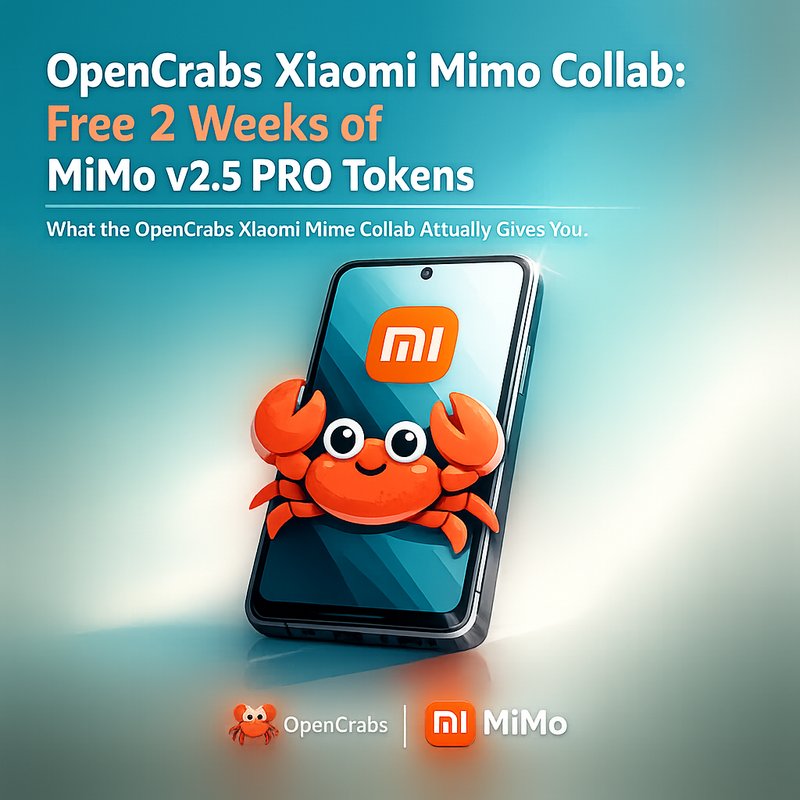
If you are an OpenCrabs user, this OpenCrabs Xiaomi Mimo Collab is the easiest free AI trial you will probably see this year. For a limited window, OpenCrabs users get 2 weeks of free tokens inside the OpenCrabs terminal, no API key, no credit card, straight setup.
This OpenCrabs Xiaomi Mimo Collab runs during a key part of the Xiaomi MiMo Orbit program, from June 12 to June 26, based on our current research. You can basically test the new Xiaomi MiMo v2.5 PRO AI model right where you already work, and you do not need extra accounts or payments to start.
And yes, the big draw here is MiMo v2.5 PRO. It is built for strong writing, tool use, and chat style work. But the real fun is not just “trying another model.” It is testing it in the OpenCrabs flow, and seeing how your tasks change when the model is always on standby.
What the OpenCrabs Xiaomi Mimo Collab Actually Gives You
The OpenCrabs Xiaomi Mimo Collab is a free token window for OpenCrabs users only. It is part of Xiaomi MiMo Orbit collaboration, and the goal is simple: let you try MiMo models without friction.
Here is what that means in practice:
- OpenCrabs terminal access to MiMo v2.5 PRO during the free token period
- No API key required
- No credit card required
- A limited time window: June 12 to June 26
- You can choose from multiple models in the collaboration set
If you have ever tried an AI model promo that asked you for an API key first, you already know why this matters. This OpenCrabs Xiaomi Mimo Collab skips the usual setup headache.
Source that MiMo Orbit is where this collaboration lives: https://mimo.xiaomi.com/index#blog
Why MiMo v2.5 PRO Feels Different in OpenCrabs
A lot of people try AI models by pasting prompts into a webpage. But OpenCrabs changes the vibe. You are working like an “agent operator,” where the terminal flow, tool calling, and multi-step thinking show up more naturally.
In this OpenCrabs Xiaomi Mimo Collab, the standout pick is MiMo v2.5 PRO (1M context). That long context window can matter when you handle:
- long instructions
- multi-part tasks
- bigger files or long chat histories
- workflows that need consistent planning
Even if you do not use the full window, the extra room often helps with fewer “wait, what was the rule again” moments.
Now, quick reality check. You might think 1M context automatically means “infinite memory.” It does not work like magic, of course. But it can reduce the number of times you have to restate yourself. That is a practical win.
Also, OpenCrabs self-hosted behavior can support a smoother long-running workflow. If you want more background on OpenCrabs itself, here is the repo: https://github.com/adolfousier/opencrabs
And if you are exploring OpenCrabs setup, the main site is worth a browse too: https://opencrabs.com
Free Token Window Tips: How to Plan Your 2 Weeks
The OpenCrabs Xiaomi Mimo Collab is time-limited. So it is smart to plan your testing like a mini sprint, not a random “try a prompt” day.
Here is a simple plan that works well for most people:
Day 1: Do a baseline test
Pick one workflow you repeat often. For example:
- writing help for a doc draft
- summarizing a long piece of text
- turning messy notes into a clean outline
- checking your own clarity (yes, AI can do that)
Then keep notes for yourself. What felt slow? What felt missing? Where did the model misunderstand?
Day 2 to 4: Try tool-style tasks
The MiMo models in the collaboration can support structured tool usage inside OpenCrabs.
Try tasks like:
- “Break this into steps and decide what tools to use next”
- “Extract key facts and produce a final response in a strict format”
- “Generate a checklist, then ask me one question to fix gaps”
Day 5 to 10: Stress it with messy inputs
This is the part people skip. You should throw messy real-world text at it, like:
- mixed bullet points
- partially wrong assumptions
- incomplete meeting notes
- a draft with weird formatting
The goal is not perfection. The goal is to see if the OpenCrabs Xiaomi Mimo Collab models recover well.
Final days: Compare your top workflow
Your last days should be about choosing what you keep.
Ask yourself:
- Did one model consistently require fewer retries?
- Did MiMo v2.5 PRO help with long-task consistency?
- Did OpenCrabs make it easier than just using a chat site?
Model Selection: Which One Should You Pick First?
This OpenCrabs Xiaomi Mimo Collab gives you multiple models during the free period. But if you only pick one to start, begin with MiMo v2.5 PRO.
Here is the straightforward reason. MiMo v2.5 PRO with a long context window is the best “first try” model because it is more forgiving. You can give it longer info without feeling like you must compress everything into a tiny prompt.
That said, there are still cases where you might choose a different model:
- when you want quick short answers
- when you want a stricter style response
- when you are doing template work and do not need long context
But for most people testing a new collaboration like this, MiMo v2.5 PRO is a safe first choice.
Key Phrase Workflow: Make Your Results Repeatable
One thing I have noticed while testing different models is this: most people waste their trial by writing prompts they cannot reuse.
So instead, create a repeatable prompt template for the OpenCrabs Xiaomi Mimo Collab period.
Try a template like this:
- Role: “You are my assistant for X”
- Inputs: paste the text or bullets
- Output format: “Return as bullets under H2 headings”
- Constraints: “Ask 1 clarifying question if needed”
- Quality check: “If you are unsure, say what is missing”
Then save it. Make it a repeatable system prompt for your OpenCrabs sessions.
If you want a general way to build prompt flows and write content tasks, Neura has tools too. For example, Neura ACE is useful for SEO content generation planning: https://ace.meetneura.ai
And for open source fallback chatbot options: https://opensource-ai-chatbot.meetneura.ai
(That is separate from the Xiaomi part, but good for organizing your workflows.)
A Simple “Try It Now” Challenge You Can Run in OpenCrabs
If you want a fast way to check whether the OpenCrabs Xiaomi Mimo Collab is worth your time, run this small challenge.
Challenge prompt
“Summarize the key points of the text below. Then turn it into an 8th grade explanation. Finally, ask me 2 questions to make the draft better.”
What to look for
While you test MiMo v2.5 PRO inside OpenCrabs, watch for three things:
- Does it keep the 8th grade style?
- Does it produce a clean structure without you forcing it?
- Does the model ask useful questions, not random ones?
If it nails those, the OpenCrabs Xiaomi Mimo Collab is already a win for you, even before you test bigger tasks.
How OpenCrabs Keeps Getting Better (And Why It Matters Here)
OpenCrabs is not just “a place to call models.” It is an evolving self-hosted agent project. The latest updates we found mention improvements like multi-pane live updates and video analysis fallback using ffmpeg.
That is relevant because it shows the project is actively working on smoother multi-step behavior. The update note we saw includes:
- Multi-Pane Live Updates
- Video Analysis Fallback via frame-extraction using
ffmpeg
If you care about where updates come from, the repo is here again: https://github.com/adolfousier/opencrabs
This matters for you because free tokens are great, but the real value comes when your tool environment stays stable while you test.
Limitations and What to Expect (So You Are Not Disappointed)
I am going to be honest here. This OpenCrabs Xiaomi Mimo Collab is free tokens, but it is still a model test window.
So here are normal limitations:
- Free windows can end, even if you feel like you just got started
- Not every prompt will “just work” on the first try
- Long context helps, but good instructions still matter
- Tool calls can fail if your task description is unclear
If something fails, treat it like training your prompt. Shorten the prompt. Tighten the format. Add examples. Then try again.
That is the real skill inside any trial. Not guessing.
Where This Fits in Your AI Workflow
The OpenCrabs Xiaomi Mimo Collab fits best if you do any of these:
- writing support where structure matters
- summarization tasks with strict formatting
- research-style notes where you want clean outputs
- multi-step planning where you want the model to guide you
And because it is inside OpenCrabs, it is usually easier to keep the work connected. You are not copy-pasting into a random interface and losing your flow.
If you want to compare agent tools across different approaches, Neura’s platform overview is here: https://meetneura.ai/products
It can help you understand other workflow styles too.
FAQ About OpenCrabs Xiaomi Mimo Collab Free Tokens
Do I need an API key for the OpenCrabs Xiaomi Mimo Collab?
No. The point of this collaboration is free tokens with zero friction, so you do not need an API key or credit card during the window.
How long does the free period last?
The collaboration free token window is June 12 to June 26, based on current research around MiMo Orbit.
Is MiMo v2.5 PRO the best pick?
For most people, yes. The MiMo v2.5 PRO (1M context) option is the best first choice in the OpenCrabs Xiaomi Mimo Collab because it is more forgiving with longer inputs.
Will I use the 1M context fully?
Probably not every day. But extra context helps with fewer reminders and better continuity across longer tasks.
Conclusion: Make the Most of the OpenCrabs Xiaomi Mimo Collab While It’s Live
This OpenCrabs Xiaomi Mimo Collab is one of the cleanest ways to test a new Xiaomi AI model without the usual payment setup. During June 12 to June 26, OpenCrabs users can access MiMo v2.5 PRO using 2 weeks of free tokens, with no API key and no credit card.

If you want a simple strategy, pick MiMo v2.5 PRO, test one real workflow you repeat, save your prompt template, and stress it with messy inputs. That is how you learn the difference fast, not by random trial prompts.
Also, if you like self-hosted agents and you care about tool reliability, keep your eye on OpenCrabs updates since the environment is actively improving.