Embodied AI robots are changing how machines see, hear, and move in the real world.
This article explains what embodied AI robots are, why they matter, and how teams can start building with them today.
You will get clear examples, tools to try, and simple warnings so you do not get stuck.
What are embodied AI robots?
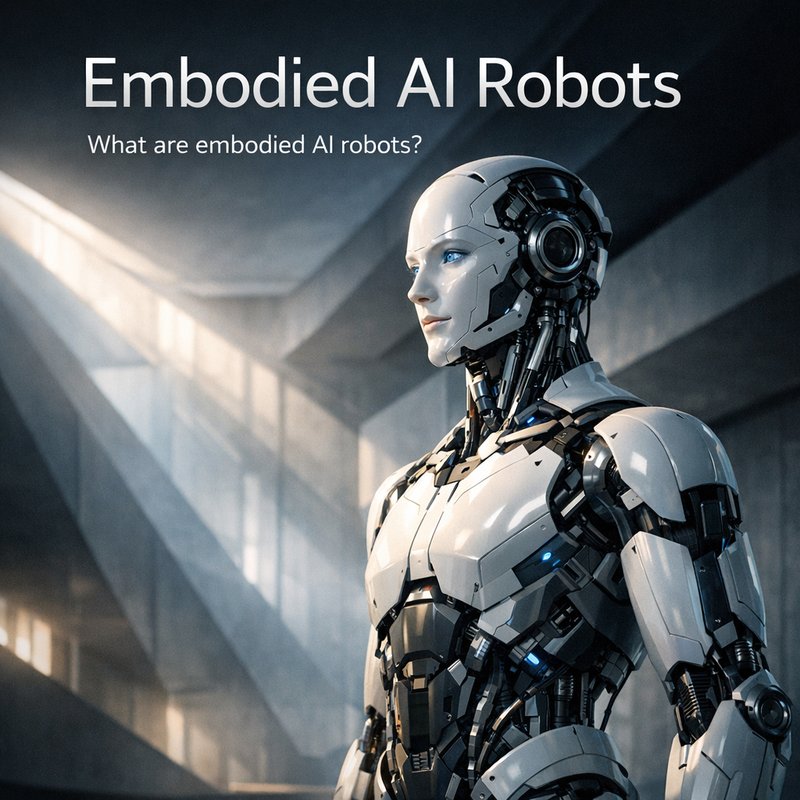
Embodied AI robots are machines that combine sensors, motors and AI models so they can act in the real world.
They do more than just answer questions on a screen.
They can walk, pick things up, listen, watch, and make decisions based on what they perceive.
Think of a robot that hears a person say "bring the red mug" and then turns, finds the mug, and hands it over.
That is an embodied AI robot at work.
Embodied AI robots use three main parts.
First, sensors for seeing and hearing.
Second, a decision model to plan actions.
Third, actuators like wheels, arms, or grippers to move.
All three parts must work together.
Why embodied AI robots matter now
Embodied AI robots are useful for real tasks in stores, warehouses, homes, and labs.
They can help with heavy lifting, routine checks, or simple chores.
Because models now mix vision, audio, and action, robots can work safer and smarter.
AGIBOT recently released a set of new foundation models for embodied AI.
Their WITA Omni model links vision, audio, and action, so robots can work with humans in close spaces.
AGIBOT also shared GO-2, called ViLLA, which uses a method that connects high-level plans with actual action steps.
You can read more in the AGIBOT announcement on PR Newswire: https://www.prnewswire.com/news-releases/agibot-unveils-new-generation-of-embodied-ai-robots-and-models-302120123.html
What this means is models are now better at practical tasks.
They can keep a plan in mind and adapt their actions when things change.
That makes embodied AI robots much more useful outside labs.
How embodied AI robots learn and act
Embodied AI robots learn using data from the world.
That can be camera images, sound clips, touch sensors, wheel encoders, or force sensors.
They train models to map inputs to actions.
There are a few common ways to teach these robots.
-
Imitation learning.
The robot watches a human do a task and learns to copy it. -
Reinforcement learning.
The robot tries actions and gets feedback on success or failure. -
Hybrid methods that mix planning with learned skills.
These let a robot map a long plan into short step actions that it can do safely.
AGIBOT’s GO-2 model uses a kind of step-by-step planning method that helps bridge thinking and doing.
This is useful when tasks need many small steps to reach a goal.
Tools and frameworks to build embodied AI robots
If you want to try building embodied AI robots, here are helpful tools and platforms.
-
Robot Operating System (ROS).
ROS gives a set of libraries and tools for building robot software.
It helps connect sensors, models, and motors. -
Simulation tools like Gazebo or Webots.
You can test robots in a virtual world before using real hardware. -
Vision models and multimodal models.
New foundation models that fuse vision and audio can be used to give a robot better perception. -
On-device inference runtimes.
Runtimes from companies like NVIDIA make it possible to run models on robot computers. -
Data stores for memory and logs.
Tools such as LanceDB can store long-term memory for robots that need to remember things across sessions.
If you are exploring, try running a small setup in a simulator first.
Use ROS to connect a camera to a model and a simple motor controller.
This setup teaches you the flow of perception to action.
Example use cases for embodied AI robots
These are simple and real tasks where embodied AI robots help.
-
Warehouse picking.
Robots can find items on shelves and move them to packing stations. -
Home helpers.
A robot that can carry a laundry basket or fetch items for someone. -
Inspection robots.
Walk through a building and detect damage or unsafe conditions. -
Retail assistants.
Robots that answer questions, show products, or restock light items. -
Research and education.
Labs use robots to test new ideas or teach students robot programming.
Each use case needs a mix of perception, planning, and safe physical control.
You do not need perfect AI to help in simple tasks.
Small reliable behaviors are often more valuable.
Hardware basics for embodied AI robots
You do not need a lab budget to get started.
Basic parts you will use include:
-
Cameras for vision.
Color cameras, depth cameras, or thermal sensors. -
Microphones for audio input.
Can be used for voice commands or detecting sounds. -
Motors and servos for movement.
Wheels, arms, or grippers are common. -
A small onboard computer.
A single board computer with GPU support helps run models locally. -
Power system.
Batteries sized for how long you want the robot to run.
Be careful with weight, heat, and balance.
A heavier robot needs stronger motors and more power.
Heat matters when you run large models on a small computer.
Software stack for embodied AI robots
A clear software stack makes development easier.
Here is a simple stack that many teams use.
-
Low level drivers.
Talk to sensors and motors. -
Middleware like ROS.
It connects modules and sends messages between perception, planning, and control. -
Perception models.
Vision and audio models that detect objects, people, and commands. -
Planner and policy.
A module that decides what to do next, often using task planners or learned controllers. -
Safety layer.
A watchdog that stops motion when the robot nears people or obstacles. -
Memory and logging.
Record events so you can debug and improve behavior over time.
Neura AI tools like Neura Open-Source AI Chatbot and Neura TSB can help with data handling and transcription during testing.
You can learn about these tools at https://meetneura.ai and https://opensource-ai-chatbot.meetneura.ai.
Safety and ethics for embodied AI robots
Safety is the most important part when robots move in the world.
Simple safety ideas help prevent accidents.
-
Use soft or limited speed for interactions with people.
-
Add emergency stop buttons that humans can reach.
-
Use redundant sensors so the robot does not rely on a single camera.
-
Log events so you can trace why the robot made a choice.

- Test extensively in simulation before real-world runs.
Ethics matter too.
Robots with cameras can collect personal data.
Design systems that respect privacy and are transparent about what they record.
How companies can adopt embodied AI robots
If you are a company thinking about adding embodied AI robots, follow these steps.
-
Start with a small pilot that solves a single task.
Pick a task that is repetitive and low risk. -
Run simulation first.
Use tools to test the task and find failure cases. -
Add safety limits and human oversight.
Keep a human in the loop at first. -
Measure clear metrics like task time and errors.
Track improvements over time. -
Scale by repeating the pilot in more locations.
Standardize hardware and software to reduce cost.
Neura AI offers tools for building, routing, and logging agent work.
See product details at https://meetneura.ai/products for ideas on automating parts of the workflow.
Real world example: service robot in a store
Imagine a robot that helps customers in a store find items.
It hears a question, leads a customer to an aisle, and points at a product.
This robot needs several skills.
-
Voice recognition to get the request.
-
Intent parsing to know which product to find.
-
Navigation to move through aisles safely.
-
Vision to spot the product on shelves.
You can prototype this in simulation.
Then test in a small area with a human supervisor.
Use memory to remember product locations and update as stock changes.
For logs and analysis, tools like Neura Brand Insider 247 can monitor customer feedback and interactions.
Check it out at https://brand-insider.meetneura.ai.
Multimodal models and embodied AI robots
A big change in this field is the arrival of multimodal models.
These models can process images, audio, and text together.
AGIBOT’s WITA Omni is an example that fuses vision and audio with action planning.
This gives robots a richer sense of what is happening.
For example, a robot can both see a spill and hear a person say there is a spill, which makes response faster.
Using multimodal models reduces the need for many separate modules.
That can simplify the design of embodied AI robots.
How to design a robust robot policy
A policy is how the robot picks actions.
Design policies that are simple and testable.
-
Break tasks into small subgoals.
-
Use safe controllers for each subgoal.
-
Add a monitor that checks for failures and switches to a safe mode.
-
Keep logs so the policy can be improved from real data.
Remember that simple rules often outperform complex controllers in noisy real-world settings.
Data needs for embodied AI robots
Robots need diverse data to work well.
Collect examples from different lighting, noise levels, and object types.
-
Use simulated data to augment real data.
-
Run data collection tasks where the robot explores and records sensor streams.
-
Label data for detection, action outcomes, and failure modes.
-
Store data in a searchable system like LanceDB for memory and retrieval.
Good data practices speed up improvement and reduce surprises in the field.
Cost and ROI for embodied AI robots
Robots cost money, but they can save time and lower errors.
Estimate cost in three parts.
-
Hardware upfront cost.
-
Software and model development.
-
Ongoing maintenance and power.
Measure ROI by tracking saved labor hours, reduced damage, or faster workflows.
Start small and only expand once metrics show gains.
Common challenges and how to avoid them
Here are common problems teams face and simple fixes.
-
Problem: Robot gets stuck in narrow spaces.
Fix: Add better mapping and smaller motion steps. -
Problem: Vision fails in poor light.
Fix: Add infrared or depth sensors and varied training images. -
Problem: Models are slow on device.
Fix: Use optimized runtimes or offload heavy work to an edge server. -
Problem: Memory gets messy with long logs.
Fix: Use a database designed for time series and vector search like LanceDB. -
Problem: Unexpected human behavior.
Fix: Train on many real interactions and add safe fallback actions.
Where to learn more and experiment
If you want to try embodied AI robots, start with these resources.
-
AGIBOT announcement for model details https://www.prnewswire.com/news-releases/agibot-unveils-new-generation-of-embodied-ai-robots-and-models-302120123.html
-
Try ROS tutorials and Gazebo simulation.
-
Read model docs from major providers for multimodal models.
-
Use Neura tools for logging, routing, and data handling at https://meetneura.ai and check case studies at https://blog.meetneura.ai/#case-studies.
-
Explore open source robot projects on GitHub for example code and designs.
Quick checklist to start a pilot in 6 weeks
Week 1: Scope the task and build a success metric.
Week 2: Create a simulator environment and initial sensor mock.
Week 3: Hook a perception model and a simple controller.
Week 4: Test in sim and collect failure cases.
Week 5: Run a supervised real-world test with safety limits.
Week 6: Measure results and plan scale.
This small plan helps move from idea to real testing in under two months.
Final thoughts
Embodied AI robots are practical now in ways they were not a few years ago.
Multimodal models and better tooling make it easier to build robots that act safely and help people.
Start small, keep safety first, and use simulators to avoid costly mistakes.
Embodied AI robots will shape many jobs and services in the years ahead.
If you care about building things that interact in the real world, now is a good time to learn and experiment.