The world of artificial intelligence is moving fast, and every month a new model or update grabs headlines. In early April 2026, OpenAI released a new internal model called Spud. The name is a code name, but the model itself is a big step toward what many call artificial general intelligence (AGI). In this article we’ll break down what the OpenAI Spud model is, how it is different from older models, what it could do for businesses and everyday life, and why it matters for the future of AI.
What Is the OpenAI Spud Model?
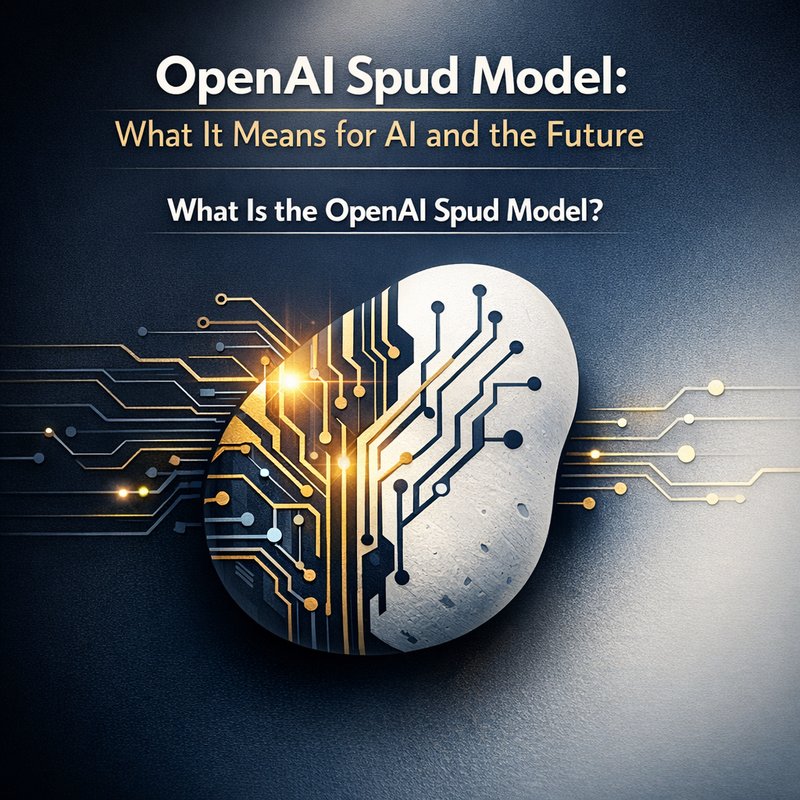
OpenAI’s Spud model is a large language model that was trained on a mix of text, images, audio, and video. Unlike earlier models that mainly read text, Spud can understand and generate content across many media types. The team says it can reason about complex problems, keep track of long conversations, and even plan actions in a step‑by‑step way.
The name “Spud” comes from an internal project code. It is not a public product yet, but the research team has shared a few details in internal reports. The model is built on a new architecture that mixes transformer layers with a memory system that can store and retrieve information quickly. This helps Spud keep context over longer stretches of dialogue or a long document.
Key Features of the Spud Model
- Multimodal understanding – Spud can read text, look at pictures, listen to audio, and watch video clips.
- Long‑term memory – It can remember facts from earlier in a conversation or from a document that is many pages long.
- Planning and reasoning – The model can break a task into steps, check each step, and adjust if something goes wrong.
- Safety controls – OpenAI added new safety layers that try to stop the model from giving harmful or misleading answers.
These features make the OpenAI Spud model a strong candidate for the next generation of AI assistants, content creators, and even tools that help with scientific research.
How Does Spud Differ From Earlier Models?
OpenAI’s earlier models, like GPT‑4, were already powerful, but they had limits. GPT‑4 could answer questions, write essays, and even generate code, but it struggled with very long conversations or tasks that required remembering many details. It also had trouble with images or audio unless you used separate tools.
The OpenAI Spud model addresses these gaps in a few ways:
- Unified multimodal training – Instead of training separate models for text and images, Spud learns from all media together. This means it can answer a question about a picture or explain a video clip without needing a separate tool.
- Extended context window – Spud can keep track of up to 50,000 tokens (roughly 100,000 words) in a single conversation. That’s more than ten times the context of GPT‑4.
- Built‑in safety checks – OpenAI added a new safety layer that runs in parallel with the main model. It flags potentially harmful content before it reaches the user.
- Efficient compute – The new architecture uses fewer parameters for the same performance, which means it can run faster on the same hardware.
Because of these changes, the OpenAI Spud model can do things that GPT‑4 could only do with extra steps or external tools.
The Architecture Behind Spud
OpenAI has kept the technical details of Spud fairly private, but the research team has shared a high‑level view. The model uses a transformer backbone similar to GPT‑4, but with a few key additions:
- Memory‑augmented layers – These layers act like a short‑term memory that can store recent facts and a long‑term memory that can store older facts.
- Cross‑modal attention – When the model sees an image, it can link the visual features to the text it is reading.
- Dynamic tokenization – Spud can split text into tokens that are more efficient for long documents, reducing the number of tokens needed.
- Safety sub‑model – A separate neural network runs alongside the main model to flag unsafe content.
Training Spud required a massive amount of compute. OpenAI used a cluster of GPUs that ran for several weeks, training on a dataset that included books, news articles, scientific papers, movies, and user‑generated content from the internet. The team also used synthetic data to help the model learn how to reason and plan.
What Can the Spud Model Do?
The OpenAI Spud model opens up many new possibilities for businesses and consumers. Here are a few examples:

1. Smart Customer Support
A company could use Spud to power a chatbot that can read a customer’s email, look at screenshots, and listen to a recorded call. The bot could then suggest a solution or even schedule a call with a human agent. Because Spud can remember context over long conversations, it would reduce the need for customers to repeat themselves.
2. Content Creation
Writers, marketers, and video producers could use Spud to generate scripts, captions, or even storyboard ideas. The model can read a draft script, suggest edits, and then generate a short video clip or a set of images that match the script. This could speed up the creative process dramatically.
3. Research Assistance
Scientists and researchers could feed Spud a long research paper and ask it to summarize the key findings, suggest related work, or even draft a grant proposal. The model’s reasoning ability could help spot gaps in the research or propose new experiments.
4. Personal Assistants
Imagine a personal assistant that can read your calendar, listen to your voice notes, and even watch a video you’re watching to give you a summary. Spud could handle all of that in one conversation, making it easier to stay organized.
5. Education
Teachers could use Spud to create interactive lessons that combine text, images, and video. Students could ask questions in natural language and get detailed explanations that reference the lesson material.
Risks and Safety Concerns
With great power comes great responsibility. The OpenAI Spud model is no exception. OpenAI has added safety layers, but there are still concerns:
- Misinformation – Even with safety checks, the model could produce plausible but incorrect facts.
- Bias – The training data includes a lot of internet text, which can contain biased viewpoints.
- Privacy – If the model is used to read private documents, there is a risk of leaking sensitive information.
- Misuse – Powerful models can be used to create deepfakes, phishing messages, or other malicious content.
OpenAI says it will continue to monitor the model’s behavior and release updates to improve safety. The company also plans to work with regulators and researchers to set standards for responsible AI use.
Industry Reaction and Future Outlook
The release of the OpenAI Spud model has sparked excitement and debate across the tech community. Some companies are already exploring how to integrate Spud into their products. Others are cautious, waiting to see how the model performs in real‑world tests.
Microsoft, for example, announced its own multimodal models in April 2026, but many analysts say Spud could still be a leader in the space. NVIDIA’s new NemoClaw stack, which helps run OpenClaw agents on NVIDIA hardware, could be a good match for Spud’s compute needs.
The future of AI looks promising. If the OpenAI Spud model lives up to its promise, it could become a foundation for many new applications. Companies that adopt it early may gain a competitive edge, while researchers will have a powerful tool to push the boundaries of what AI can do.
Conclusion
The OpenAI Spud model is a bold step toward more capable, multimodal AI. By combining text, images, audio, and video in a single model, it can handle tasks that were previously split across many tools. Its extended memory, reasoning ability, and safety features make it a strong candidate for the next wave of AI assistants, content creators, and research tools.
While there are risks to consider, the potential benefits are huge. As the AI community watches how Spud performs in real‑world scenarios, we can expect to see new products, services, and research that push the limits of what machines can understand and create.
The OpenAI Spud model may still be in the early stages, but it already shows that the future of AI is moving toward more integrated, intelligent systems that can help us in many ways.