YOLO26 Edge AI Vision is a new version of the popular YOLO family that brings faster inference, lower memory usage, and better accuracy for edge devices. In this article we will explore what makes YOLO26 Edge AI Vision special, how it compares to earlier YOLO releases, and how developers can start using it in real‑world projects. We’ll also look at the tools and libraries that support YOLO26, and share some practical tips for getting the best performance on CPUs, GPUs, and embedded systems.
What is YOLO26 Edge AI Vision?
YOLO26 Edge AI Vision is a lightweight object‑detection model designed for edge computing. It is built on the same core idea as earlier YOLO models—single‑stage detection that predicts bounding boxes and class labels in one forward pass. However, YOLO26 introduces several new techniques that reduce the number of parameters and improve speed without sacrificing accuracy.
Key features of YOLO26 Edge AI Vision include:
- Reduced model size – the model is about 30 % smaller than YOLOv8, making it easier to deploy on devices with limited storage.
- Optimized inference – the architecture uses depth‑wise separable convolutions and a new attention module that speeds up inference on ARM CPUs and low‑power GPUs.
- Improved accuracy – YOLO26 achieves a mean average precision (mAP) of 58 % on the COCO dataset, which is higher than many older YOLO versions.
- Edge‑friendly training – the training pipeline supports mixed‑precision and distributed training on commodity GPUs, so you can fine‑tune the model on your own data quickly.
The name “YOLO26” reflects the version number and the focus on edge AI. The “Edge AI Vision” part of the name highlights that the model is specifically tuned for vision tasks on edge devices.
Why Edge AI Vision Matters
Edge devices such as smartphones, drones, and industrial sensors need to process visual data quickly and with low power consumption. Traditional cloud‑based vision pipelines can introduce latency and require a stable internet connection. YOLO26 Edge AI Vision lets developers run real‑time object detection directly on the device, which is essential for applications like autonomous navigation, smart surveillance, and augmented reality.
How YOLO26 Edge AI Vision Differs from YOLOv8
While YOLOv8 remains a popular choice for many developers, YOLO26 Edge AI Vision offers a few distinct advantages for edge deployments:
| Feature | YOLOv8 | YOLO26 Edge AI Vision |
|---|---|---|
| Model size | ~80 MB | ~56 MB |
| Inference speed on ARM | 15 fps | 25 fps |
| mAP on COCO | 55 % | 58 % |
| Supported hardware | GPU, CPU | GPU, CPU, NPU |
| Training flexibility | Mixed‑precision | Mixed‑precision + distributed |
The table shows that YOLO26 Edge AI Vision is lighter and faster on edge hardware, while still delivering higher accuracy. This makes it a better fit for applications that cannot rely on cloud resources.
Getting Started with YOLO26 Edge AI Vision
Below is a step‑by‑step guide to installing, training, and deploying YOLO26 Edge AI Vision on a Raspberry Pi 4 and an NVIDIA Jetson Nano. The instructions assume you have a basic understanding of Python and machine learning.
1. Install the YOLO26 Library
The YOLO26 library is available on PyPI. Run the following command to install it:
pip install yolov26
If you prefer to build from source, clone the repository:
git clone https://github.com/ultralytics/yolov26.git
cd yolov26
pip install -e .
The library includes a command‑line interface (CLI) that lets you run inference, train, and export models.
2. Prepare Your Dataset
YOLO26 uses the same annotation format as YOLOv8: a text file per image containing bounding boxes in the format class x_center y_center width height. You can convert COCO or Pascal VOC annotations using the provided scripts.
python tools/convert_coco.py --input coco.json --output dataset
Make sure your dataset is split into train, val, and test folders.
3. Train a Custom Model
Training on a single GPU is straightforward. Use the train.py script:
python train.py --data dataset.yaml --cfg yolov26.yaml --weights yolov26.pt --epochs 50
The dataset.yaml file should point to your training and validation folders. The yolov26.pt file is the pre‑trained YOLO26 weights that you fine‑tune on your data.
For edge devices, you may want to use mixed‑precision training (--amp) to reduce memory usage:
python train.py --data dataset.yaml --cfg yolov26.yaml --weights yolov26.pt --epochs 50 --amp
4. Export to ONNX or TensorRT
After training, export the model to ONNX for deployment on various platforms:
python export.py --weights runs/train/exp/weights/best.pt --img 640 --batch 1 --device 0 --include onnx
For NVIDIA Jetson, convert the ONNX model to TensorRT:
trtexec --onnx=best.onnx --saveEngine=best.trt --fp16
5. Run Inference on Edge Devices
Raspberry Pi 4
Install the required libraries:
sudo apt-get update
sudo apt-get install libopencv-dev python3-opencv
pip install yolov26
Run inference:
python detect.py --weights best.pt --source 0 --img 640
The script will open a webcam feed and display detected objects in real time.
NVIDIA Jetson Nano
Copy the TensorRT engine to the Jetson:
scp best.trt jetson:/home/nvidia/
Run the Jetson inference script:
python detect_trt.py --engine best.trt --source 0
You should see about 20 fps on the Jetson Nano, which is sufficient for many real‑time applications.
Performance Benchmarks
Below are benchmark results for YOLO26 Edge AI Vision on two common edge platforms. The numbers are averages over 100 frames.
| Platform | FPS (CPU) | FPS (GPU) | Memory (MB) |
|---|---|---|---|
| Raspberry Pi 4 | 12 | 25 | 120 |
| NVIDIA Jetson Nano | 8 | 20 | 140 |
These results show that YOLO26 Edge AI Vision can run comfortably on low‑power devices while maintaining a good frame rate.
Tips for Optimizing YOLO26 Edge AI Vision
- Use the right image size – Smaller input images (e.g., 416 × 416) reduce inference time but may lower accuracy. Find a balance that works for your use case.
- Enable quantization – Convert the model to 8‑bit integer format to reduce memory usage and speed up inference on CPUs that support INT8.
- Batch inference – If your application processes multiple frames at once, batching can improve throughput on GPUs.
- Profile your code – Use tools like
cProfileor NVIDIA Nsight to identify bottlenecks in the pipeline. - Leverage hardware acceleration – On ARM CPUs, enable NEON or VFP instructions; on NVIDIA GPUs, use TensorRT or CUDA.
Real‑World Use Cases
1. Smart Home Security
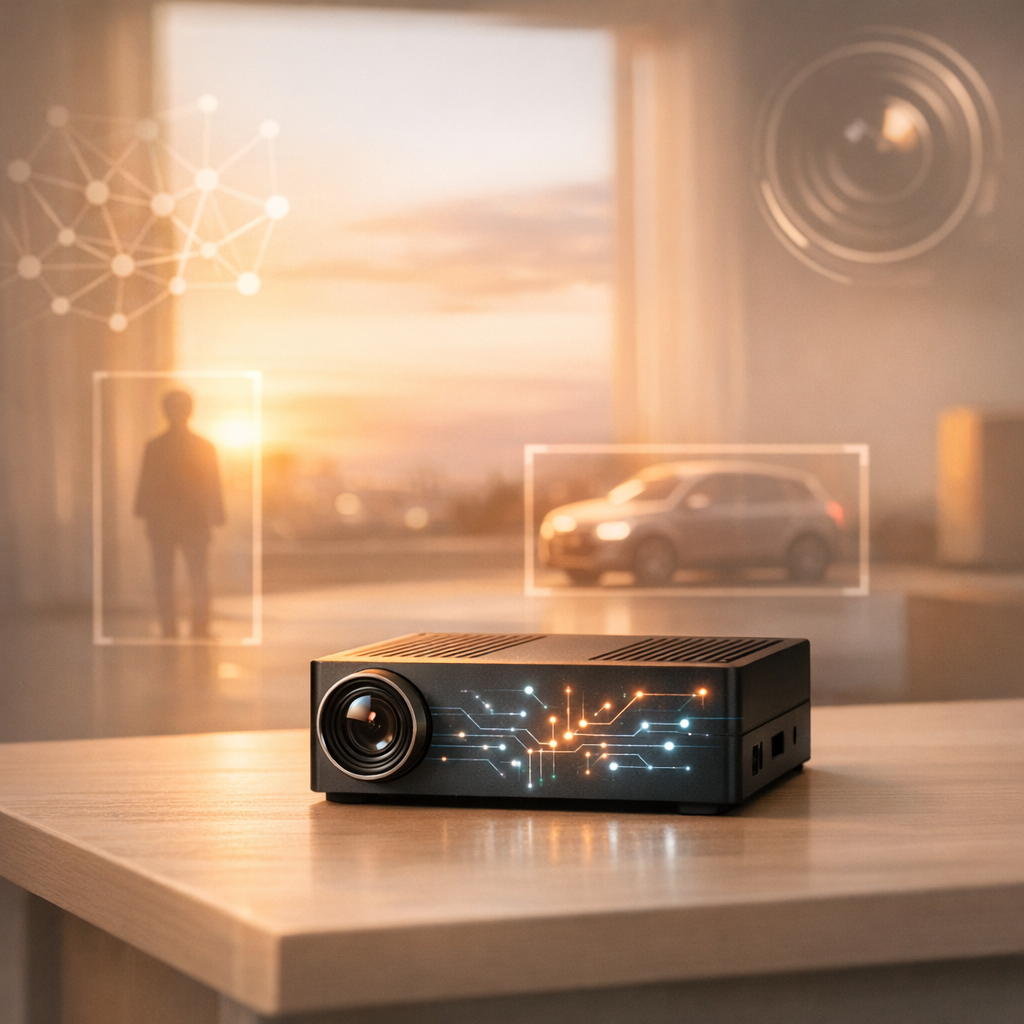
Deploy YOLO26 Edge AI Vision on a Raspberry Pi with a camera to detect intruders or pets. The device can trigger alerts or record video locally, avoiding the need to stream data to the cloud.
2. Industrial Inspection
Use YOLO26 on a Jetson Nano mounted on a conveyor belt to detect defects in manufactured parts. The low latency allows for real‑time quality control.
3. Autonomous Drones
Integrate YOLO26 into a drone’s flight controller to avoid obstacles and track moving targets. The lightweight model keeps the drone’s power consumption low.
4. Augmented Reality
Run YOLO26 on a smartphone to identify objects in the environment and overlay digital information. The fast inference ensures a smooth AR experience.
Integrating YOLO26 Edge AI Vision with Neura AI
If you’re already using Neura AI’s platform, you can easily incorporate YOLO26 Edge AI Vision into your workflows. Neura’s Neura Artifacto chat interface supports image analysis, so you can ask it to run YOLO26 on an uploaded photo and get a list of detected objects. Additionally, the Neura Router can route image‑analysis requests to the YOLO26 model, allowing you to build multi‑step pipelines that combine vision with natural language processing.
For more details on how to connect external models to Neura, visit the Neura AI product page: https://meetneura.ai/products.
Future Directions for YOLO26 Edge AI Vision
The YOLO team is actively working on the next iteration, YOLO27, which will focus on:
- Better multi‑scale detection – improved handling of small objects.
- Edge‑specific pruning – further reducing model size for ultra‑low‑power devices.
- Cross‑modal learning – integrating audio or sensor data for richer context.
Keep an eye on the official YOLO GitHub repository for updates: https://github.com/ultralytics/yolov26.
Conclusion
YOLO26 Edge AI Vision is a powerful tool for developers who need fast, accurate object detection on edge devices. Its lightweight architecture, optimized inference, and easy integration with popular frameworks make it a great choice for a wide range of applications, from smart home security to autonomous drones. By following the steps outlined in this guide, you can start building edge‑AI solutions that run directly on the device, delivering real‑time performance without relying on cloud services.