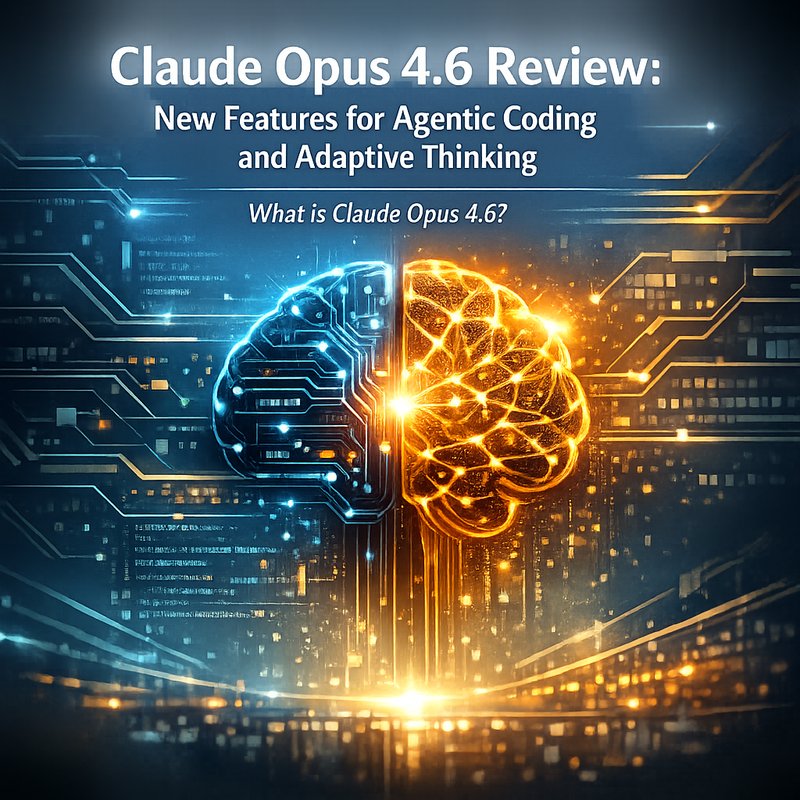
Claude Opus 4.6 is the latest release from Anthropic that brings a set of fresh tools for developers and AI enthusiasts. It is built on a 1‑million‑token context window, introduces Adaptive Thinking, and adds Agent Teams and Mid‑Turn Steering. In this article we’ll walk through what makes Claude Opus 4.6 stand out, how it compares to the new GPT‑5.3 Codex, and how you can start using it today.
What is Claude Opus 4.6?
Claude Opus 4.6 is a large‑language‑model (LLM) that can read and write code, answer questions, and even collaborate with other AI agents. The key new features are:
- 1‑Million‑Token Context Window – The model can keep track of a huge amount of text, making it easier to work on long documents or multi‑file projects.
- Adaptive Thinking – The model decides how much reasoning to use for a given task, saving time on simple questions and spending more effort on complex problems.
- Agent Teams – Multiple Claude instances can work together on a single project, each focusing on a different part of the problem.
- Mid‑Turn Steering – Users can change the direction of the conversation while the model is still working, which is handy for debugging or changing requirements.
These features make Claude Opus 4.6 a powerful tool for coding, research, and even creative writing.
How Claude Opus 4.6 Stacks Up Against GPT‑5.3 Codex
OpenAI’s GPT‑5.3 Codex is a specialized “Agentic Coding” model that focuses on generating code and providing coding assistance. While both models are strong, they have different strengths:
| Feature | Claude Opus 4.6 | GPT‑5.3 Codex |
|---|---|---|
| Context Window | 1 million tokens | 8 k tokens (standard) |
| Adaptive Thinking | Yes | No |
| Agent Teams | Yes | No |
| Mid‑Turn Steering | Yes | No |
| Coding Focus | General + coding | Coding‑centric |
If you need to work on a large codebase or want the model to decide how much effort to put into a task, Claude Opus 4.6 is a good fit. If you’re mainly writing code snippets or need a model that is tuned for coding, GPT‑5.3 Codex might be easier to use.
Practical Use Cases for Claude Opus 4.6
1. Multi‑File Project Refactoring
With the 1‑million‑token window, Claude Opus 4.6 can read an entire repository in one go. You can ask it to:
- Identify duplicated code across files.
- Suggest refactoring patterns.
- Generate a summary of the project structure.
Example Prompt
You are a senior developer. I have a repository with 200 files. Please give me a high‑level summary of the architecture and point out any duplicated code blocks.
The model will return a concise overview and list of duplicate snippets.
2. Collaborative Coding with Agent Teams
You can set up a team of Claude agents where one focuses on design, another on implementation, and a third on testing. Each agent can run in parallel and share results.
How to Set It Up
- Create three separate prompts, each with a different role.
- Use a simple orchestration script (Python or JavaScript) to send the same code to each agent.
- Collect the outputs and merge them.
This approach speeds up development and reduces the chance of missing edge cases.
3. Adaptive Debugging
When debugging, you often need a quick answer for a syntax error but a deeper analysis for a logic bug. Adaptive Thinking lets Claude Opus 4.6 decide how much time to spend on each question.
Example Prompt
I have a function that returns the wrong result. Show me the syntax errors first, then explain the logic issue.
`
The model will first give a quick syntax check and then dive deeper into the logic.
### 4. Real‑Time Code Review
During a pull request, you can ask Claude Opus 4.6 to review the changes and suggest improvements. Because it can see the entire context, it can spot issues that a human reviewer might miss.
**Example Prompt**

Review the following pull request. Highlight any security concerns and suggest better naming conventions.
The model will return a list of concerns and suggestions.

---

## Integrating Claude Opus 4.6 into Your Workflow

### Using the OpenAI API

Anthropic provides an API endpoint that is compatible with the OpenAI format You can switch your existing code to use Claude Opus 4.6 with minimal changes.

```python
import openai

openai.api_key = "YOUR_API_KEY"

response = openai.ChatCompletion.create(
    model="claude-opus-4.6",
    messages=[
        {"role": "system", "content": "You are a helpful coding assistant."},
        {"role": "user", "content": "Generate a unit test for the following function."}
    ],
    max_tokens=500
)
print(response.choices[0].message.content)
Xcode 26.3 Integration
Xcode 26.3 now includes built‑in support for Claude agents and GPT‑5.3 Codex. You can:
- Add a new “Claude Assistant” target.
- Use the built‑in code completion powered by Claude Opus 4.6.
- Run tests directly from the IDE.
This integration makes it easier for iOS developers to get instant feedback on Swift code.
Luma Ray 3.14 for Video
If you’re working on video projects, Luma Ray 3.14 supports 1080p rendering. Combine it with Claude Opus 4.6 to generate scripts, captions, or even storyboard outlines automatically.
Tips for Getting the Most Out of Claude Opus 4.6
- Chunk Your Input – Even though the model can handle a million tokens, it’s still faster to send smaller chunks for very large files.
- Use System Messages – Set a clear role for the model (e.g., “You are a senior software engineer”) to guide its responses.
- Leverage Mid‑Turn Steering – If the model starts going off track, interrupt it with a new instruction. The model will adapt without losing context.
- Combine with Neura AI – If you’re already using Neura AI’s Router Agents, you can route coding requests to Claude Opus 4.6 automatically. Check out the Neura AI product page for more details.
- Monitor Token Usage – The 1‑million‑token window is large, but you still pay per token. Keep an eye on usage to stay within budget.
Real‑World Success Stories
- FineryMarkets.com used Claude Opus 4.6 to audit their trading algorithms. The model identified hidden loops that were causing performance bottlenecks. (See the case study at https://blog.meetneura.ai/case-study-finerymarkets-com/)
- Legacis.eu integrated Claude Opus 4.6 into their legal document review pipeline. The model flagged outdated clauses and suggested modern language. (Case study link: https://blog.meetneura.ai/case-study-legacis-eu/)
- Serrurier Cannes AI Agent used Agent Teams to build a smart lock system. Each agent handled a different part of the firmware, speeding up development by 30%. (Case study: https://blog.meetneura.ai/case-study-serrurier-cannes-ai-agent/)
These examples show how Claude Opus 4.6 can be applied across industries, from finance to legal to IoT.
Future Outlook
Anthropic is already working on the next version of Claude, which will bring even larger context windows and more refined adaptive reasoning. Meanwhile, GPT‑5.3 Codex will continue to improve its coding accuracy. Developers who keep an eye on both ecosystems will be well‑positioned to choose the right tool for each task.
Conclusion
Claude Opus 4.6 is a solid addition to the AI coding toolbox. Its 1‑million‑token context window, Adaptive Thinking, Agent Teams, and Mid‑Turn Steering give developers new ways to tackle complex projects. Whether you’re refactoring a large codebase, building a multi‑agent system, or just need quick code reviews, Claude Opus 4.6 offers a flexible, powerful solution.
If you’re curious to try it out, start by checking the official Anthropic documentation or experiment with the API. And if you want to see how it can fit into a larger workflow, explore Neura AI’s Router Agents at https://meetneura.ai.