OpenCrabs 0.2.2: Token Counting & Memory Improvements Explained
OpenCrabs 0.2.2 brings accurate token counting and a three‑tier memory system to help developers build smarter AI agents. This article explains the new features and how to use them.

OpenCrabs 0.2.2 brings accurate token counting and a three‑tier memory system to help developers build smarter AI agents. This article explains the new features and how to use them.
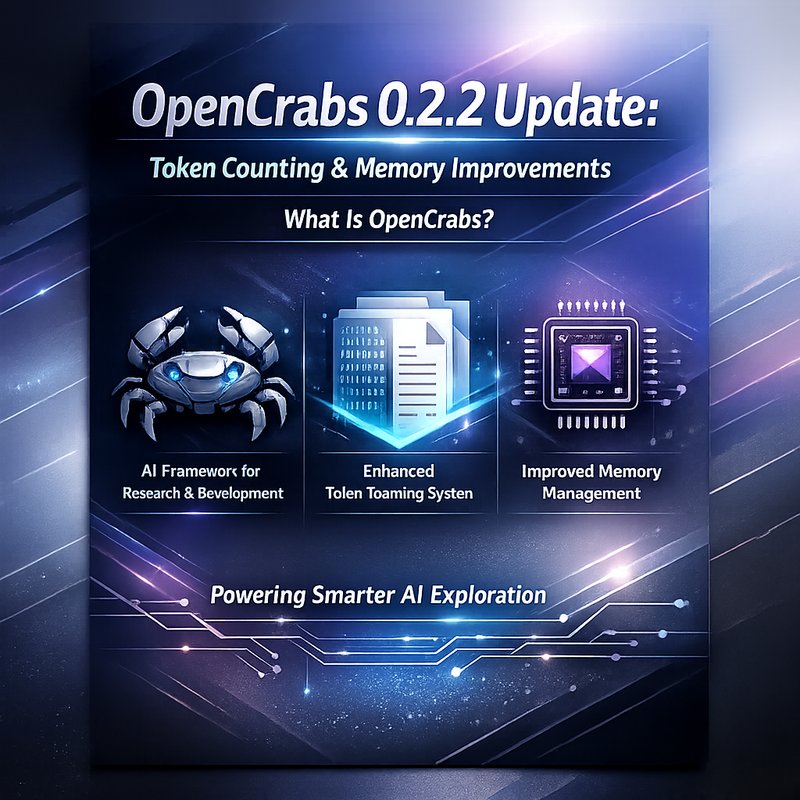
OpenCrabs 0.2.2 introduces precise token counting, earlier memory compaction, and a new config manager tool. These updates help developers keep AI agents within budget and context limits.
The n8n 2.9.0 release introduces a Code‑Base Workflow Builder and Focused Nodes, making automation faster and cleaner. This guide explains how to use these features and why they matter.
A practical, easy guide to the latest open-source models. Includes testing steps, cost tips, safety checks, and a simple multimodal prototype.
Claude Opus 4.6 brings a 1‑million‑token context window, Adaptive Thinking, Agent Teams, and Mid‑Turn Steering. This review covers its new features, compares it to GPT‑5.3 Codex, and shows how to use it in real projects.
Apple’s Xcode 26.3 release brings Anthropic’s Claude Agent and OpenAI’s Codex directly into the IDE, offering AI‑powered code completion, explanations, and generation for Swift and Objective‑C developers.
Parallel Agent Mode in Cursor 2.0 lets you run up to eight AI agents at once, each on its own branch. This speeds up feature delivery, reduces merge conflicts, and keeps your codebase clean.
GLM‑4.7 is the newest open‑source language model that scores 87.4 on the τ²‑Bench. It offers long‑running task support, stable tool calling, and a new architecture that keeps context intact. Learn how to use it for chatbots, data pipelines, and more.
The EliGen Framework is a new open‑source library that lets developers control every part of an AI‑generated image. It works with any diffusion model and requires no extra training.
Antigravity AI is Google’s new browser‑use platform that lets AI agents click, type, and run commands inside web browsers and IDEs. This article dives into its features, security patches, and how it can transform development workflows.