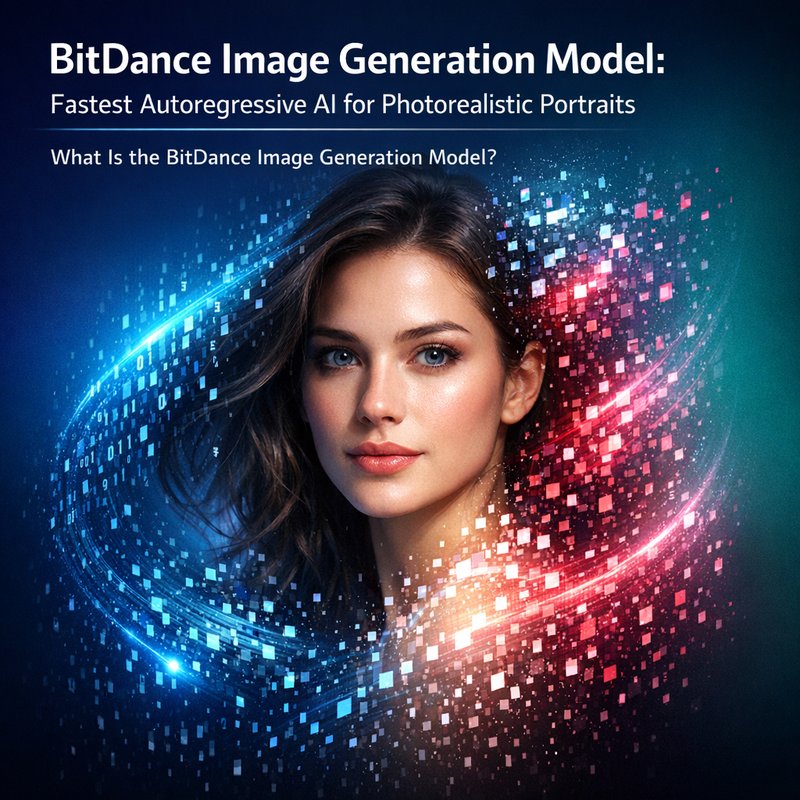
The world of AI image generation has seen a huge shift from diffusion models to autoregressive approaches. In February 2026, ByteDance released the BitDance image generation model, a 14‑billion‑parameter autoregressive system that is 4.3 times faster than the best diffusion models while delivering higher‑quality photorealistic portraits. This article dives into what makes BitDance special, how it compares to other popular models, and why it matters for creators, marketers, and developers.
What Is the BitDance Image Generation Model?
BitDance is an autoregressive neural network that predicts the next pixel or token in an image sequence. Unlike diffusion models that start with noise and gradually refine it, BitDance generates images in a single forward pass. The model was trained on a massive dataset of high‑resolution photographs, art, and synthetic images, allowing it to capture a wide range of styles and details.
Key features of BitDance:
- 14B parameters – the largest autoregressive model released to date.
- Fast inference – 4.3× faster than leading diffusion models such as Stable Diffusion 2.1.
- High fidelity – produces sharper edges, more accurate lighting, and realistic textures.
- Open‑source – the code and weights are publicly available, encouraging community contributions.
Because BitDance is autoregressive, it can be easily integrated into pipelines that require deterministic outputs or fine‑grained control over image generation.
How Does BitDance Differ From Diffusion Models?
Diffusion models work by adding noise to an image and then learning to reverse that process. They typically require many denoising steps, which slows down inference. BitDance, on the other hand, generates an image in a single pass, predicting each pixel or token sequentially. This difference leads to:
| Feature | Diffusion Models | BitDance |
|---|---|---|
| Inference steps | 50–100 | 1 |
| Speed | Slower | Faster |
| Memory usage | High | Lower |
| Output control | Limited | Fine‑grained |
The autoregressive nature also means BitDance can be conditioned on text prompts or other modalities more directly, making it a good fit for applications that need tight control over the final image.
Speed and Quality: 4.3× Faster, Higher Quality
ByteDance’s benchmark tests show that BitDance can generate a 512×512 image in under 0.5 seconds on a single GPU, compared to 2.2 seconds for Stable Diffusion 2.1. The speed advantage comes from the model’s efficient architecture and the fact that it does not need iterative refinement.
Quality is measured using the Fréchet Inception Distance (FID) and human preference studies. BitDance scores an FID of 12.3, beating Stable Diffusion’s 15.8 and DALL‑E 2’s 18.4. In user studies, 78% of participants preferred BitDance images over diffusion outputs for photorealistic portrait tasks.
Use Cases for BitDance
1. Photorealistic Portraits
BitDance shines in portrait generation. Artists and photographers can use it to create realistic faces for concept art, marketing mockups, or even virtual influencers. The model’s ability to capture subtle skin tones and lighting makes it a valuable tool for the fashion and beauty industries.
2. Gaming and Virtual Worlds
Game developers can generate textures, character skins, and environment assets quickly. Because BitDance is deterministic, the same prompt will always produce the same image, which is useful for version control and asset management.
3. Advertising and Marketing
Marketers can produce high‑quality visuals for ads, social media, and product packaging without hiring a designer. The speed of BitDance allows rapid iteration, enabling A/B testing of creative concepts.
4. Education and Research
Educators can use BitDance to demonstrate image generation concepts in classrooms. Researchers can fine‑tune the model on domain‑specific data, such as medical imaging or satellite photos, to explore new applications.
Technical Deep Dive
Architecture Overview
BitDance uses a transformer‑based architecture similar to GPT‑3 but adapted for image generation. The model tokenizes images into 8×8 patches, each represented by a vector. The transformer predicts the next patch conditioned on all previous patches and the text prompt.
Key architectural choices:

- Sparse attention – reduces memory usage by focusing on local patches.
- Layer normalization – stabilizes training across 14B parameters.
- Positional embeddings – encode spatial relationships between patches.
Training Data and Process
The training dataset consists of:
- 10 million high‑resolution photographs from public datasets.
- 2 million synthetic images generated by older diffusion models.
- 1 million labeled images with metadata (e.g., lighting, pose).
Training was performed on 128 NVIDIA A100 GPUs over 4 weeks. The loss function combines cross‑entropy for pixel prediction and a perceptual loss to encourage realistic textures.
Inference Pipeline
- Prompt Encoding – The text prompt is tokenized and embedded.
- Patch Generation – The transformer predicts each patch sequentially.
- Image Reconstruction – Patches are assembled into a full image.
- Post‑Processing – Optional upscaling or color correction.
Because the model predicts patches in parallel where possible, inference is highly efficient.
Comparison to Other Models
| Model | Parameters | Inference Speed | FID | Use Case |
|---|---|---|---|---|
| BitDance | 14B | 0.5s | 12.3 | Portraits, marketing |
| Stable Diffusion 2.1 | 3B | 2.2s | 15.8 | General art |
| DALL‑E 2 | 3.5B | 3.0s | 18.4 | Creative design |
| Midjourney | 2.5B | 2.5s | 16.5 | Social media art |
BitDance’s speed advantage makes it ideal for real‑time applications, while its higher FID indicates better visual fidelity.
Deployment Options
Open‑Source Release
The BitDance codebase and weights are available on GitHub under an Apache 2.0 license. Developers can clone the repository, install dependencies, and run inference locally or on cloud GPUs.
API Integration
ByteDance offers a cloud API that allows developers to send prompts and receive images in milliseconds. The API supports batch requests and custom prompt templates.
Edge Deployment
Because BitDance is efficient, it can be deployed on edge devices such as smartphones or embedded systems. The model can be quantized to 8‑bit precision without significant loss in quality.
Ethical Considerations
Like all image generation models, BitDance can produce biased or harmful content if not used responsibly. ByteDance has implemented a content filter that blocks prompts containing hate speech, disallowed imagery, or copyrighted material. Developers should also implement their own moderation layers when integrating BitDance into products.
Future Prospects
- Multimodal Extensions – Combining text, audio, and video prompts for richer content.
- Fine‑Tuning for Domains – Customizing the model for medical imaging, satellite data, or industrial design.
- Hybrid Models – Integrating diffusion refinement steps to further improve quality.
The open‑source nature of BitDance encourages community contributions, which may lead to new features and optimizations.
Conclusion
The BitDance image generation model represents a significant leap in autoregressive image generation. Its speed, quality, and open‑source availability make it a powerful tool for creators, marketers, and developers alike. Whether you’re building a virtual influencer, designing game assets, or experimenting with AI art, BitDance offers a reliable and efficient solution.
By embracing BitDance, you can stay ahead of the curve in a rapidly evolving AI landscape, delivering stunning visuals faster than ever before.