If you build or run AI agents, you already know the hard truth. AI governance choreography is the difference between an agent that “sounds right” and an agent that does the right thing in production. In the last few months, multiple signals have pointed to the same direction: teams are moving from small safety rules to full “agent operating constraints,” often described as a harness for models. And they are testing governance gaps as early as possible, not after something breaks.
In this article, we will explain what AI governance choreography really means, why it matters when agent workflows get autonomous, and how you can design a practical setup using test loops, tool permissions, and compliance checks. We’ll connect the dots between the idea of a “harness” from engineering teams and the real-world need for runtime governance, with an extra focus on what you can do when your system is under outage pressure or when the compliance story is not as clean as you hoped.
Along the way, we will also share a simple step-by-step checklist you can copy into your own agent projects, plus examples from modern tool ecosystems and public outage reports like the Claude Code service issue.
What “AI governance choreography” means (in plain English)
Let’s simplify it.
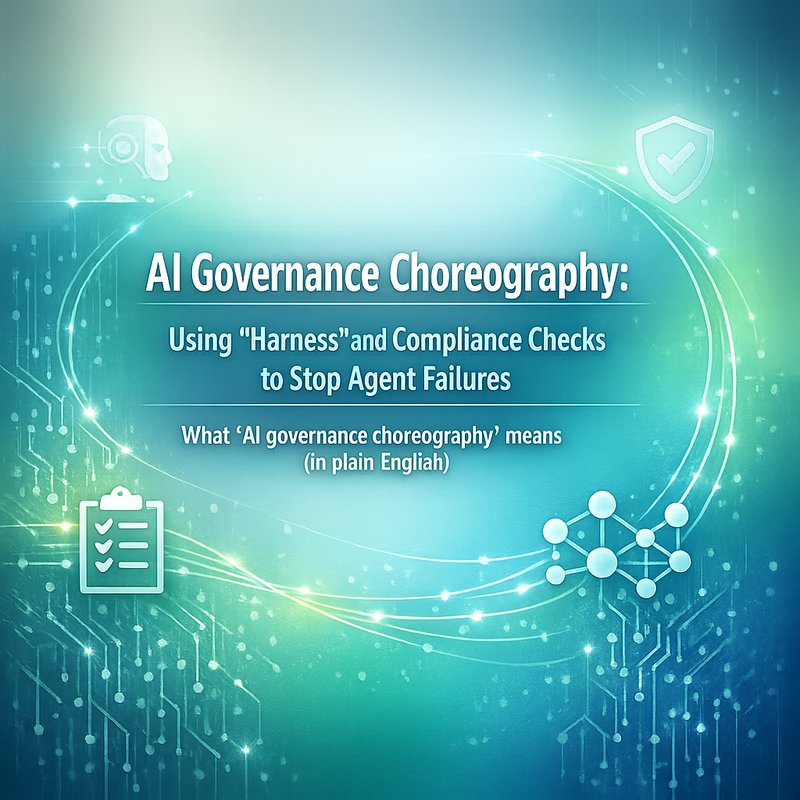
AI governance choreography is the planned order of safety steps that guide an AI agent while it thinks and while it acts. It includes rules for:
- What tools the agent can use
- When it is allowed to act on real systems
- How you verify results
- What happens when the system is uncertain
- How you log, review, and repair failures
- How you keep the whole flow working even when a provider has an outage
Here’s the key part. It’s not only one guardrail. It’s the sequence.
You can think of it like a dance practice. If one dancer misses a step, the performance can fall apart. If the model skips the wrong “step,” your agent can:
- Send an email it should not send
- Use the wrong credentials
- Hallucinate a tool call and fail silently
- Generate a response that violates a policy rule
- Get stuck in a loop and keep retrying
So AI governance choreography is your way of making sure the agent is “held in rhythm” by constraints, checks, and feedback loops.
This idea shows up in many forms. One widely repeated engineering concept is the “harness” that sits between the raw model and production tools. That same concept shows up in articles about AI engineering practices and in governance coverage about compliance gaps.
You might have seen the line: the harness represents the constraints, feedback loops, and tool permissions that keep raw models from hallucinating in production environments. That is basically AI governance choreography in one paragraph.
Sources worth reading:
- Harness Engineering, “What Every AI Engineer Needs to Know in 2026” (dev.to): https://vertexaisearch.cloud.google.com/grounding-api-redirect/AUZIYQHI0LpkhPiLIehi59EMFQmGs173T2uAod4VKeWCqXIywjMIIImPyFEgs7KTboEfkTYgLQnZ2gfm9PEHcqKQkfhjPJh1J78Dc0SqylhtVEPg3cgJRuqHFUab4M9pVEzDY22tlvL7cSk1DDWTLaJ6GXVzV7hjTx38evLQHNojp393-bLMwZ78xuqfguLgENKXd_87i2NPSIgN
- Truelens & Compliance Gaps (efficientlyconnected.com): https://vertexaisearch.cloud.google.com/grounding-api-redirect/AUZIYQG5_dRposLUdkg3yyM_-4UW960lar5bxBgdk1EaNf22hcU9lumgJF0ZxFXtyvBr9woccyx1R_3DN8xXG2VMtHwO_ku1Wvpu41-TNm3nwPN05hoVVZsHR5-PPF-qbSZ7q_R2XKQBTIXwPI7ojHCXi-1bAslrNkFk2Rwy9XbvtOKI0_US8kJAz8gpvK_sgeg2
If you want a practical starting point for how to think about production constraints, you can also look at Neura’s R&D approach and app ecosystem (for example, Neura Router, Neura Keyguard, and auto-replier style agents). Not because Neura is “the only way,” but because it’s a good reference for what production structure looks like.
- https://meetneura.ai/products
- https://meetneura.ai/products/ (Neura Router and supporting agents are relevant here)
- https://keyguard.meetneura.ai
Why governance fails when agents get more autonomous
Most teams start small.
First they build a chat agent. Then they add “tool use.” Then they let it run more steps, maybe across testing, security, and deployment. At that point, your agent is no longer “a conversation.” It is a system that can change the real world.
And that is where governance breaks.
Here are the biggest reasons:
1) Tool access grows faster than checks
A model can keep improving its answers, but your audit checks might stay the same. So the agent can use more powerful tools without a matching upgrade in safety steps.
2) Failures are hard to see
If a tool call fails, some agent frameworks just retry. That can turn a small error into a busy loop.
3) Provider outages look like “agent logic errors”
Sometimes the model or endpoint is down. The agent thinks it is a reasoning failure and tries to recover. But the real cause is infrastructure.
There was a reported major outage affecting Claude Code and Claude Cowork (July 6, 2026). Even if your system uses different providers, the lesson is the same: governance needs an outage plan. Otherwise, your agent becomes noisy and unpredictable under provider stress.
- Outage report reference (MacRumors): https://vertexaisearch.cloud.google.com/grounding-api-redirect/AUZIYQGIIN2rBTG4NijMxFhd2xq82N6I9-I7wu5Ekx5TxFAheNZFOsUIDqODcjviWes-C6TZeyGjVewYfdVul68uiyGKa056vrIVBWB713j0zOCFXWc0CZ_s9ZXhBqQ_Xo7BfjV2IEv3nVwdcuINpz7bJmkxKfmWrTdvvG_SFA_xxSW-7wQ2Tzpw-pP3urNvFg==
4) Compliance is often a post-process
You may have logs and review steps, but the core workflow still runs. That means you can “comply after the fact,” which does not fix what already happened.
This is exactly why some governance write-ups call out compliance gaps between what teams measure and what they actually enforce at runtime.
The “harness” idea: constraints plus feedback loops, not vibes
When engineering teams say “harness,” they usually mean a set of controls that sit around the raw model.
A harness often includes:
- Tool permissions (which tools, which fields, which operations)
- Input checks (schema, allowed formats, safe prompts)
- Output checks (policy filters, structured validation)
- Retry strategy (what retries are allowed)
- Logging and trace capture (so you can debug)
- Human review triggers (for risky steps)
This is AI governance choreography because it defines order. Example flow:
- Agent drafts a tool plan
- Harness validates allowed tools and parameters
- Agent calls tool
- Harness validates tool response
- Agent drafts final response
- Harness checks policy rules again
- System logs a trace
That’s not just “safety.” That’s choreography.
If you want a tool-level way to think about it, consider Neura Keyguard. It is designed to scan for API key leaks in frontend apps. That is a governance layer, because it prevents one category of failure: accidental credential exposure.
Another example from a production perspective is building a rigid “router” layer that sends requests to the right model or tool. That reduces unexpected behavior when the system sees different inputs.
And for teams that build content workflows, an “ACE style” multi-agent content pipeline is one way to structure steps so not every request is free-form.
The point is not to copy those tools blindly. The point is to adopt AI governance choreography as a design rule: you need constraints and checks in the places where the agent actually acts.
Runtime governance under outages: the choreography you need for uptime
Here’s a scenario that happens more often than people admit.
Your agent is polite. It can explain plans. But when the provider is down, it starts failing. And if governance is weak, the agent keeps trying, switching models, or generating partial steps.
Good AI governance choreography includes fallback logic and stop conditions.
What to build into your choreography
You can implement an outage-aware flow like this:
- Detect provider health (fast checks, timeouts)
- Pause or degrade actions when health is bad
- Switch to a limited mode (for example, “draft only,” no real tool writes)
- Force a reasoned error response so users know what happened
- Log the outage cause separately from model reasoning
Even if you do not use Claude Code or the same stack, the lesson from the Claude Code outage is universal: your governance must not confuse “infrastructure failure” with “agent intent failure.”
When governance is correct, the agent can say:
“I can draft the next step, but I cannot execute right now because the tool endpoint is not responding.”
That is governance, expressed as choreography.
Compliance checks that actually catch problems (not just report them)
Let’s be honest. A lot of compliance systems are built like dashboards.
They observe.
They show counts.
They create reports.
But your agent still acts without the “must comply before execute” rule.
To close that gap, you need checks that block risky actions at runtime.
A helpful compliance approach for agent workflows
Here’s a simple structure:
- Policy schema checks: Does the request and response follow required formats?
- Tool operation checks: Does the agent request a safe operation?
- Content checks: Does the generated text match allowed categories?
- Human review triggers: Are there conditions where you require review?
- Audit logging: What was generated, and what tool was used?
One public source in your search results mentions Article 50 requiring AI-generated content to be human-understandable and machine-readable. Even without treating that as a complete legal guide, it’s a good example of a compliance idea that affects runtime output structure.
- Article reference (arxiv link): https://vertexaisearch.cloud.google.com/grounding-api-redirect/AUZIYQHfFN-nNY-pwE6yfBEHv7QEBkT7COdwkUhTKONVWJMHb7CiS8uD7De6w7ZsyK0sfF7F3G0q9SDbY-CxBEwDth9RfmXtCTnOtAIP_LodoFWeEwnhSTqriIRN
Now, the practical trick is: don’t only store the text. Store the data that lets you verify it is readable and structured.
That means your choreography should enforce machine-readable output packaging when needed.
A practical checklist for building AI governance choreography
If you’re trying to implement AI governance choreography this quarter, this checklist will help.
Step 1: Map your agent actions into risk tiers
Make a list:
- Read-only actions (low risk)
- Draft actions (medium risk)
- Execute actions (high risk)
- Write actions with external impact (highest risk)
Then decide what harness checks block each tier.
Step 2: Lock tool permissions early
Your harness should use allowlists for:
- Tools
- Arguments
- Output formats
- Destination systems
If your agent can do “write,” it should pass stricter validation than it would for “read.”
Step 3: Add a “pre-tool plan” validation step
Before executing any tool call, require a plan object.
Validate:
- The plan matches user intent
- The plan uses allowed tools
- The plan arguments are safe
This stops a huge class of “the model said it would do one thing but executed another thing” bugs.
Step 4: Add a “post-tool” sanity check
After the tool returns:
- Validate response shape
- Validate the response matches expected constraints
- Detect outliers (wrong IDs, mismatched records)
Step 5: Add outage mode behavior
Your choreography must define:
- What happens when providers are down
- Whether the agent can draft but not execute
- Whether retries are capped
- What gets logged
Step 6: Log enough to debug, not enough to leak
Log tool calls and outcomes. But avoid logging sensitive secrets. Pair your logs with secret scanning like Neura Keyguard.
Step 7: Run “policy tests” like software tests
Don’t treat compliance checks as a last-minute filter.
Build test cases that cover:
- Disallowed content
- Missing required fields
- Bad formatting that breaks downstream systems
- Attempts to use blocked tools
Where this is heading: more interoperability, more agent “ops”

Search results point to a bigger theme: governments and large orgs are pushing agent interoperability for real operations. For example, there is coverage about G42 Inception42 and Microsoft collaboration tied to UAE goals for AI automation of federal operations.
- Coverage reference (bignewsnetwork.com): https://vertexaisearch.cloud.google.com/grounding-api-redirect/AUZIYQEs3n0Hb_c5GvBDDbQfrvR7QKC4ofw4GqcMYh7FtM8bxWvcVAyV5aGm_mlahoQPdKL2AlmOx1td0IXh6rbcDdZ9eFr2Yg1VSg-N3A35MYxAY8_RrNN0kJRaHErmcAuqaZowu70WQQnFdFlDNVxAQkIlAMI71A5xc-WaCJlo6jGETO_qrvnkAAgdT2PHRUSk4deOtSB7rWAJjEDeqa1Le0LEEIE1KpVsmvOhm-a193Y91yJpNbq8n349Zw==
This kind of push usually forces two things:
- Standardized agent interfaces (so systems can swap parts)
- Stronger runtime governance (because high-stakes automation needs proof)
That means AI governance choreography will become a common requirement, not a niche engineering detail.
What to do next if you already have an agent
Maybe you already built something. It works sometimes. But lately you’ve seen failures or weird retries.
Here’s what I’d do, in order:
- Pick one critical workflow (for example, any step that writes records).
- Add a harness “pre-tool plan” check.
- Add “post-tool sanity” validation.
- Add outage mode.
- Add structured output checks for compliance.
- Then expand to other workflows.
You don’t need to rebuild everything. You need to choreograph the risky edges.
And since this is a real engineering job, having the right internal tools matters too. If your team has to deal with lots of integrations, consider a router layer that reduces unpredictable model behavior. If you generate lots of content, structured “SEO output format tests” help. If you handle keys and credentials, secret scanning matters.
A short reality check about “compliance”
A quick contradiction: Some teams think they can solve compliance by adding a filter at the end.
But if your agent already executed a risky tool action, the filter is too late.
That’s why AI governance choreography is the real solution. It chains together checks so compliance is enforced before actions, not only after.
Plus, it makes debugging easier. When something goes wrong, you can point to the step where the choreography blocked or allowed it.
Conclusion: treat governance like choreography, not a checkbox
The next wave of agent building is not just about smarter models. It is about safer systems. And the safety part is no longer optional once your agents can act on tools and workflows.
AI governance choreography gives you that safety by making governance an ordered set of runtime steps. It uses a harness idea: constraints, feedback loops, tool permissions, and validation steps. It also handles outages and compliance gaps without turning everything into a frantic retry loop.
If you’re building agents right now, start with one risky workflow and choreograph the edges. Then expand.
If you do that, your agent will be less chaotic. Your logs will be more useful. And your team will sleep better, which honestly is the best metric.
Before you go: if you want more structured examples from the Neura ecosystem, you can explore: