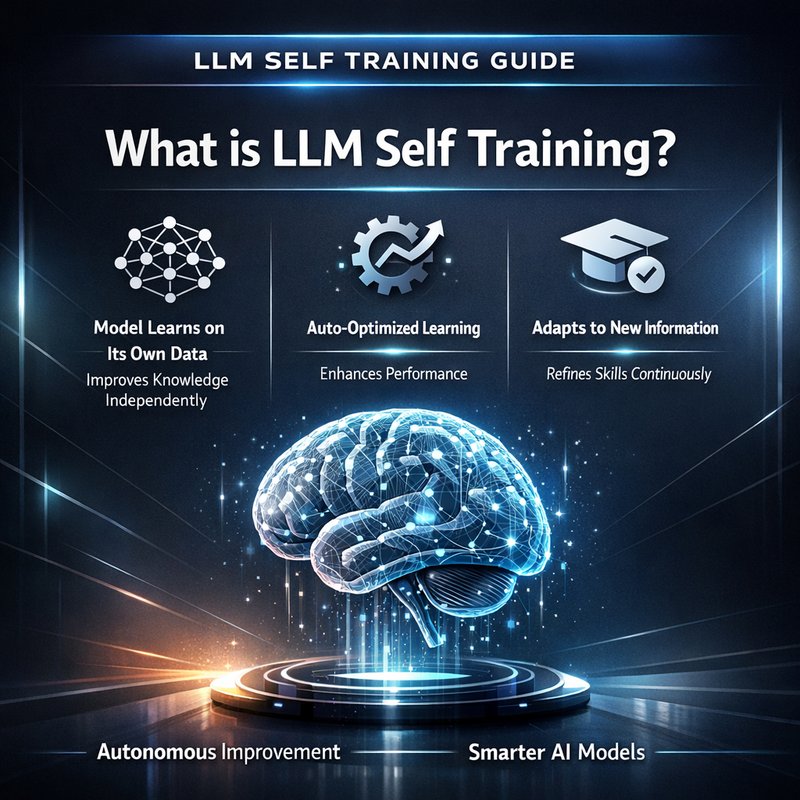
Self‑adapting LLMs are a new way for large language models to learn from the conversations they have, without needing a human to retrain them. The SEAL (Self‑Adapting LLMs) framework from MIT’s Improbable AI Lab shows how a model can create its own training data and update its own weights on the fly. This article breaks down how SEAL works, why it matters, and what it could mean for the future of AI tools.
What Are Self‑Adapting LLMs?
Large language models (LLMs) like GPT‑4 or Claude are usually static. Once they are trained, their knowledge stops growing. Every new fact or skill requires a new training cycle that takes weeks and a lot of data. Self‑adapting LLMs change that. They can:
- Generate new training examples from the conversation they are having.
- Apply those examples to themselves so they remember the new information.
- Keep learning as long as they are used.
The SEAL framework is the first open‑source system that lets an LLM do all of this automatically. It uses a small “self‑edit” module that writes new data, a lightweight training loop, and a safety layer that checks the edits before they are applied.
How SEAL Works in Simple Steps
- Conversation starts – The user asks a question or gives a task.
- Model answers – The LLM gives a response based on its current knowledge.
- Self‑edit request – The model decides it needs more data, so it writes a short training example that captures the new fact.
- Safety check – A separate safety module reviews the example to make sure it is correct and safe.
- Update – If the example passes, the model trains on it and updates its internal weights.
- Next turn – The updated model continues the conversation, now with the new knowledge.
Because the model writes its own training data, it can adapt to new domains, slang, or user preferences without waiting for a data scientist.
Why Self‑Adapting LLMs Matter
Faster Knowledge Updates
Imagine a medical chatbot that learns about a new drug as doctors talk to it. With self‑adapting LLMs, the chatbot can incorporate that drug’s details in minutes instead of months. This is especially useful for fields that change quickly, like technology, finance, or health.
Personalization at Scale
Every user has a unique way of speaking. Self‑adapting LLMs can learn a user’s style and preferences during a single session. That means the assistant can write emails, code, or reports that feel like the user’s own voice.
Lower Maintenance Costs
Traditional LLMs need large teams to curate data, retrain, and redeploy. Self‑adapting LLMs reduce that overhead because the model does most of the work itself. Companies can keep their AI up‑to‑date with fewer resources.
New Opportunities for Developers
Open‑source frameworks like SEAL let developers experiment with on‑the‑fly learning. They can build custom agents that adapt to niche industries, such as legal research or scientific literature, without massive retraining pipelines.
The SEAL Framework in Detail
Architecture Overview
SEAL is built on three core components:
- Self‑Edit Module – Generates synthetic training data from the conversation.
- Safety Layer – Uses a separate model or rule set to vet the generated data.
- Training Loop – Fine‑tunes the main LLM on the vetted data in real time.
The architecture is lightweight enough to run on a single GPU, making it accessible to small teams.
Self‑Edit Module
The self‑edit module is a small neural network that takes the conversation context and produces a short text snippet that can be used as a training example. For example, if a user says, “The new iPhone 15 has a 120‑Hz display,” the module might generate:
“iPhone 15 has a 120‑Hz display.”
This snippet is then fed back into the main model.
Safety Layer
Safety is critical because the model could generate incorrect or harmful data. The safety layer checks:
- Fact consistency – Does the snippet match known facts?
- Bias and toxicity – Is the snippet free of harmful language?
- Relevance – Does it add useful information?

If the snippet fails any check, it is discarded.
Training Loop
Once a snippet passes safety, the training loop fine‑tunes the main LLM on it. The loop uses a small learning rate and a few gradient steps so the model can adapt quickly without overfitting. After training, the model’s weights are updated, and the next turn uses the new knowledge.
Real‑World Use Cases
1. Customer Support Bots
A support bot can learn new product features as customers ask about them. If a user mentions a new feature, the bot can add that feature to its knowledge base instantly, improving future responses.
2. Code Assistants
A coding assistant can learn a new library or API as developers use it. The assistant can then generate code snippets that use the new library without waiting for a new training cycle.
3. Content Creation
A content writer’s assistant can adapt to a brand’s tone of voice during a session. If the writer prefers short, punchy sentences, the assistant learns that style and writes future content accordingly.
4. Research Tools
Academic assistants can incorporate new research papers on the fly. As a researcher discusses a paper, the assistant can add its key findings to its knowledge base, making subsequent queries more accurate.
Challenges and Limitations
Data Quality
The model’s self‑edit module might produce low‑quality or incorrect data. The safety layer mitigates this, but it is not foolproof. Continuous monitoring is needed.
Computational Overhead
Fine‑tuning on the fly adds extra compute. While SEAL is lightweight, it still requires a GPU for real‑time updates. For large deployments, this could increase costs.
Security Concerns
If an attacker can feed malicious data into the model, they might trick it into learning harmful behavior. Robust safety checks and monitoring are essential.
Regulatory Compliance
In regulated industries, any changes to a model’s knowledge must be auditable. Self‑adapting LLMs need clear logs of what data was added and when.
How to Get Started with SEAL
- Clone the Repository – The SEAL code is open‑source on GitHub. You can start by cloning the repo and running the demo scripts.
- Set Up a GPU – A single NVIDIA GPU (RTX 3060 or better) is enough for small experiments.
- Run the Demo – The demo shows a chat interface where the model learns new facts during the conversation.
- Integrate with Your Stack – Use the SEAL API to embed the model into your own applications, such as a customer support portal or a code editor plugin.
- Monitor and Log – Keep logs of all self‑edits and safety checks to ensure compliance and quality.
For more details, visit the official GitHub page or the MIT Improbable AI Lab website.
The Future of Self‑Adapting LLMs
Self‑adapting LLMs are still in early stages, but they promise a future where AI systems can keep themselves up‑to‑date without human intervention. As the technology matures, we can expect:
- More robust safety mechanisms that catch subtle errors.
- Better efficiency so that real‑time learning becomes cheaper.
- Standardized APIs that let developers plug self‑learning into any application.
- Wider adoption across industries that need fast knowledge updates.
If you’re building AI tools, keeping an eye on self‑adapting LLMs is essential. They could become the backbone of next‑generation assistants, code generators, and research aids.
Conclusion
Self‑adapting LLMs, exemplified by the SEAL framework, are a breakthrough that lets language models learn from their own conversations. By generating and vetting new training data on the fly, these models can stay current, personalize interactions, and reduce maintenance costs. While challenges remain, the potential benefits are huge. As the field evolves, we’ll likely see more tools that can adapt in real time, making AI more useful and responsive than ever before.