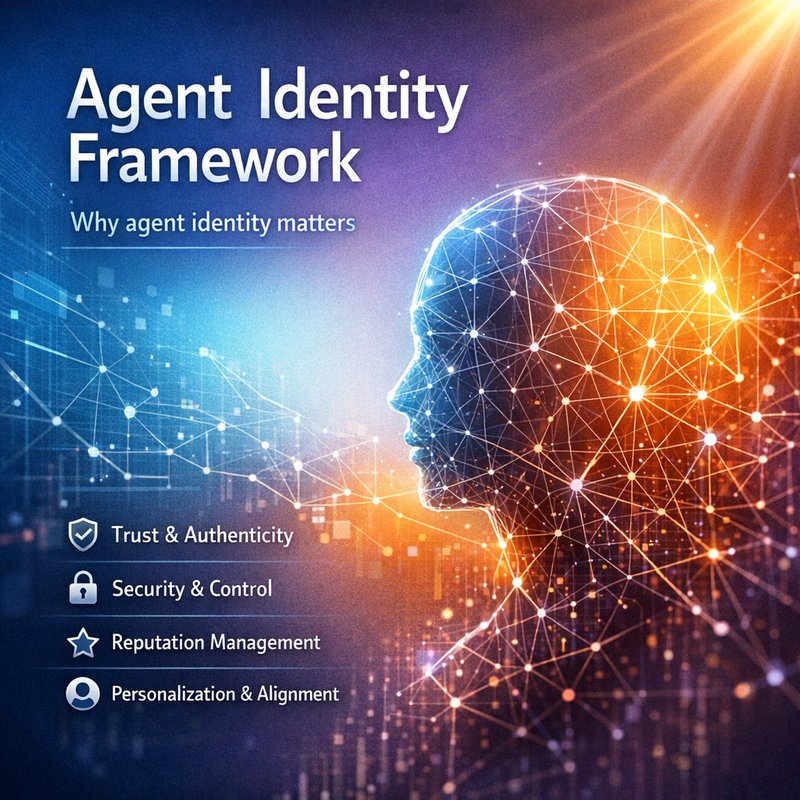
An agent identity framework is a set of rules and tools that give an autonomous agent a unique, verifiable identity.
An agent identity framework helps systems know who made a decision and why.
An agent identity framework makes it easier to audit actions and trace problems.
An agent identity framework also keeps agents from pretending to be other agents.
An agent identity framework is a simple idea with big effects when agents run by themselves.
Why agent identity matters
These days, software agents do more than fetch web pages.
They buy, edit, file, and talk for people and companies.
When agents act alone, we need to know those actions are safe and traceable.
That is where an agent identity framework comes in.
Why care about identity at all?
Without identity, you cannot tell if an action was taken by a trusted agent or by a copy made by someone else.
That leads to wrong orders, fraud, and broken systems.
Identity gives a way to check who acted, when, and what rules they followed.
Real-world teams need this.
Security teams want logs that link back to specific agent keys.
Product teams want to know which agent ran a growth test.
Legal and ops teams want to run audits without guessing who did what.
Large providers like Google and OpenAI publish tools and guidance that assume identity matters.
Open standards like Decentralized Identifiers and public key signatures are used by many projects.
InfoQ covered a new release called Teleport Agentic Identity Framework that shows how this is moving fast.
This is not just a research idea.
It is becoming a practical part of agent systems.
What goes wrong when agents lack identity
Imagine a browser agent that fills forms for dozens of users.
Now imagine a bug lets one user agent impersonate another.
Customer data leaks.
Wrong purchases get made.
The company gets blamed.
Here are common failures without identity:
-
Confused audit trails.
You see an entry in logs but cannot tie it to a single agent key. -
No accountability.
When something breaks, no one can explain why the agent did it. -
Easy spoofing.
Malicious code can pretend to be a trusted agent, and the system accepts it. -
Hard policy enforcement.
You cannot set per-agent limits if agents share no identity.
An agent identity framework avoids these problems by using unique keys, signed claims, and clear attestation paths.
How a cryptographic agent identity works
At the core, identity for agents uses simple tools most engineers already know.
-
Public and private keys.
The agent gets a private key that it keeps secret.
The agent uses the key to sign messages. -
Signatures.
Any action the agent takes is signed.
A verifier checks the signature with the agent’s public key. -
Certificates or attestations.
A trusted authority can say, in a signed statement, that this public key belongs to a given agent and has specific permissions. -
Decentralized Identifiers (DID).
DIDs give a compact way to refer to agent identities across systems.
They can point to a small document with the agent public key and other metadata. -
Key rotation and revocation.
If a key leaks, a revocation step stops the agent from acting until a new key proves identity.
When these parts work together, every decision an agent makes has a verifiable trail.
That trail shows who acted, what they did, and checks whether they had the right to do it.
Basic example: signing a web action
- Agent requests a token from an authority.
- The authority returns a signed claim saying the agent can post on site X.
- The agent uses its private key to sign the post request.
- The server checks both the authority signature and the agent signature.
- The server accepts the action and logs the claims.
This pattern makes simple checks powerful.
You can deny any action where signatures or claims fail.
The Teleport Agentic Identity Framework in context
A recent description of the Teleport Agentic Identity Framework highlights one way to do agent identity.
It adds clear rules for cryptographic identities that agents use across services.
Teleport uses keys, attestations, and routing rules so agents can authenticate without copying human credentials.
Why this matters:
- It gives a standard form for agent identity that different teams can adopt.
- It supports cross-system checks, so a cloud tool and a browser extension can both trust the same agent ID.
- It helps privacy by letting systems verify only the needed facts, not the full user profile.
You can read about similar ideas on InfoQ and other tech news sites.
These topics are also discussed alongside agent browsers and agent teams in industry blogs and forums.
If you build or run agents, look up Teleport and related standards to avoid inventing one-off solutions.
Best practices for safe agent identity
Creating an identity system is not just crypto and keys.
You need process and policy.
Here are practical steps to follow.
-
Start small.
Give each agent one purpose and one identity at first. -
Use separate keys for separate roles.
Never use one key for many unrelated actions. -
Short-lived claims.
Keep tokens short so leaked tokens expire quickly. -
Audit everything.
Log signatures, claims, and decision steps for later review. -
Enforce least privilege.
Give agents only the rights they need for a task. -
Automate rotation and revocation.
Make it easy to roll keys when needed. -
Create human review gates.
For high risk flows, add approval steps that require a human signed decision.
Following these steps helps teams keep agent systems secure and trustworthy.

Checklist for adoption
- Decide what counts as an agent in your product.
- Choose key storage strategy: HSM, software keystore, or cloud KMS.
- Pick a DID method or document store for identity metadata.
- Build signing libraries and verification endpoints.
- Add monitoring to track agent activity.
- Train teams on how to read and use signed logs.
Want tools that help build this?
Neura Router connects many models and tools and can be part of a secure agent flow.
Check the Neura Router and other product pages for how agents can fit into business flows: https://meetneura.ai/products and https://router.meetneura.ai
Use cases where agent identity matters most
Agent identity is useful in many places. Here are a few real examples.
-
Enterprise automation.
Agents do payroll queries or move funds.
Identity lets auditors tie actions to an agent key, not a human password. -
Browser agents.
Agents that autofill or scrape must prove who they are to avoid impersonation. -
Marketplace bots.
When bots price items or list inventory, identity prevents fake sellers from manipulating results. -
Customer support assistants.
Signed messages show an agent had the right context and privileges to change an account. -
Content moderation agents.
Agents that flag content should be auditable to prevent biased or faulty filters.
Many of these match patterns seen in recent tool updates and community projects.
For example, agent toolkits in the open source world and new releases in the browser automation space have added features for safer identity and session handling.
How agent identity fits into agent teams and router systems
Modern teams sometimes use multiple agents that work together.
One agent searches, another checks inventory, another prices a sale.
You need a way to pass trust between them.
Router agents or RDA agents can help.
They decide which agent handles each task and attach the right identity claims.
Neura AI has Router Agents that connect models, tools, and apps and that can manage identity flows for you.
See Neura Router for one way to put this into practice: https://router.meetura.ai
When agent teams exchange claims, follow these rules:
-
Attach provenance.
Each step gets a signed claim describing what happened. -
Limit claim scope.
Avoid passing global rights across many agents. -
Validate every hop.
Each agent checks the previous agent signature before trusting output.
This keeps multi-agent systems from becoming a chain of trust problems.
Tools and standards to watch
If you plan to build agent identity, these items are worth learning.
-
Decentralized Identifiers (DID) standards.
They give a universal way to name an identity. -
Verifiable Credentials.
These let an authority sign statements about an identity. -
Public key infrastructure (PKI).
Traditional tools for certificates and HTTPS tie into agent systems. -
Hardware or cloud key management.
Use HSMs or cloud KMS to keep private keys safe. -
Audit and logging tools.
Tools that can verify signatures and show the chain. -
Agent frameworks and router systems like Neura Router.
They can embed identity checks into workflows.
Look at guides from Google and published standards to learn the core patterns.
Link to community sources and vendor docs helps teams stay consistent.
Risks and limitations
Agent identity reduces many problems but does not fix everything.
-
Bad policies still lead to bad actions.
Signed logs only show what was done, not whether the decision was correct. -
Key compromise is dangerous.
If a key leaks, the attacker can act as the agent until you revoke it. -
Complex user flows can create privacy issues.
Too many attestation steps may expose more data than needed. -
Standard fatigue.
Multiple identity standards can make integration hard.
You need both good tech and good human policy.
Design for recovery and clear human review paths.
Practical steps to start today
If you want to add agent identity to a project, here is a short plan you can follow right now.
- List automated tasks that need audit and control.
- Pick a signing method and rotate keys weekly for testing.
- Add a verification endpoint that accepts signed claims.
- Log claims with a unique agent ID and timestamp.
- Run a few simulated attacks to check revocation.
- Add human approval gates on high risk actions.
These steps are small but make a big difference.
How Neura and agent identity work together
Neura AI builds RDA agents that route tasks and attach context to work items.
When teams use Router Agents, they can add signing and claims before forwarding tasks.
If you want to explore how an agent identity framework can work in a business setting, check Neura product pages and examples: https://meetneura.ai and https://meetneura.ai/#leadership
Case studies can help you see real results.
Look at our case studies to see agent uses and outcomes: https://blog.meetneura.ai/#case-studies
Final thoughts
Agent identity is a practical way to make autonomous systems safer, fairer, and easier to audit.
It uses simple cryptographic tools and clear policies to make actions traceable.
If you run agents or plan to deploy them at scale, start with identity and build from there.
Small steps now make audits and incident response much easier later.